



What Is EAM? Benefits, Features & Applications
Before we dive into the features, limitations, and capabilities of modern Enterprise Asset Management EAM software applications, let’s start with the basics.
What is Enterprise Asset Management?
Enterprise asset management is a type of business intelligence that involves tracking the handling, usage patterns, and quality of usage of assets.
It is the practice of managing an entire pool of organizational assets, with the help of the combined capabilities of software, systems, and services. These form a framework that allows professionals to optimize the quality and usage of assets throughout their lifecycle.
The primary goal of asset management is to enhance the lifespan and the ROI from individual assets.
It is closely related to asset lifecycle management (ALM) in terms of tracking the assets and their usage patterns. However, it further incorporates elements like work order management, energy management, asset maintenance, planning and scheduling, supply chain management, and environmental safety into the system.
Organizations that still do not have a detailed EAM process can face service disruptions, equipment failures, and limited visibility into assets.
EAM allows businesses to track assets from cradle to grave, informing capital investments and daily operations decisions.
As per a report from Splunk, the downtime costs for Global 2000 companies accounted for 9% total profits, which amounts to $200 million every year.
EAM is also pivotal for enterprises in highly regulated industries such as healthcare, aviation, and utilities. Now, apart from taking care of assets, EAM also manages capital procurement, installation, performance, and maintenance, operational compliance risks.
How Does EAM Systems Work?
Traditional EAM systems relied on local data storage and processing to offer insights. However, the scenario has shifted, and now they run in the cloud. EAM is an asset lifecycle management approach that supports asset performance from acquisition to disposal.
With cloud integration, EAM systems can process more data and provide stronger security to the organization's data. So, let's see how these systems work.
Collect and store asset data: The EAM systems collect data from sensors or specialized devices that monitor an asset’s status. The data is sorted and organized through algorithms, which are then stored in a centralized data repository. This data becomes the core of all the analytics and extracts detailed insights to find out how assets are performing and where there is a gap in maintenance processes.
Asset strategy and productivity optimization: The data from the assets tells professionals the risk of failures and potential issues in the assets. Today’s EAM systems use machine learning and digital twin technology for predictive analysis. This helps professionals identify failures beforehand and strategize maintenance tasks based on the current status.
Proactive scheduling and maintenance: Modern EAM systems combine data from various sources and use it for scheduling inspections and maintenance activities. It works as an intelligent system, where it analyzes failure patterns and then prioritizes maintenance work according to those. Further, it schedules inspections not randomly, but based on critical data from the assets, to minimize downtime, enhance maintenance efficiency, and operational performance.
Benefits of EAM Systems
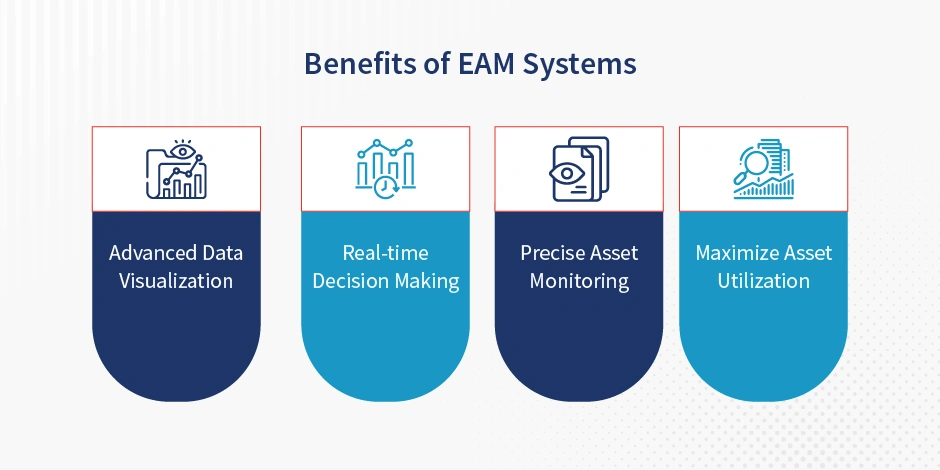
EAM systems aggregate data from assets into a central spot from where professionals can monitor and optimize the assets. With insights from real-time and historical asset data, the EAM system also helps them schedule maintenance, manage work orders, and the entire asset lifecycle, optimize asset usage for enhanced lifespan, ROI, and asset uptime.
Advanced data visualization: EAM platforms provide professionals with detailed dashboards for data visualization.
These dashboards are also customizable as per organizational needs, supporting advanced analytics. Professionals can view data from various assets, measure parameters, and make data-driven decisions for asset management.
Real-time decision making: Unlike traditional methods, where cumbersome paper reporting led to errors and inaccuracies that directly impact decision-making. But modern EAM systems obtain real-time data through sensors that support enhanced decision making. The process of responding to issues, whether minor or major, is faster. Now, with artificial intelligence and machine learning, these systems provide predictive analysis. This lets managers predict issues before they arise by identifying root causes. Once the cause is identified, it sends notifications to technicians for instant repair or replacement.
Precise asset monitoring: With the help of EAM platforms, professionals can perform asset tracking in real-time. And since this monitoring is not paper-based, but physical, but monitored by a system, it is highly precise. Unlike traditional methods where asset information was handled in silos for different departments, these bring all together in a single place. Hence, asset managers can prioritize maintenance work and also ensure that aging equipment is upgraded and maintained.
Maximize asset utilization: EAM systems collect historical and real-time data and combine them to derive insights that help in extending asset lifespan. When assets are utilized per their condition, asset performance increases and maintenance costs reduce drastically.
With AI and ML integrated, these systems can provide detailed guidance on appropriate servicing times and part replacement for an extended lifespan. EAM systems are used to demonstrate compliance with regulatory bodies to preclude liability if a failure occurs.
EAM systems facilitate compliance with regulatory requirements by documenting compliance-related activities and generating reports.
Now, as we have gone through the benefits of the EAM system, let’s learn about the features that come into use.
Key Features of Effective EAM Software
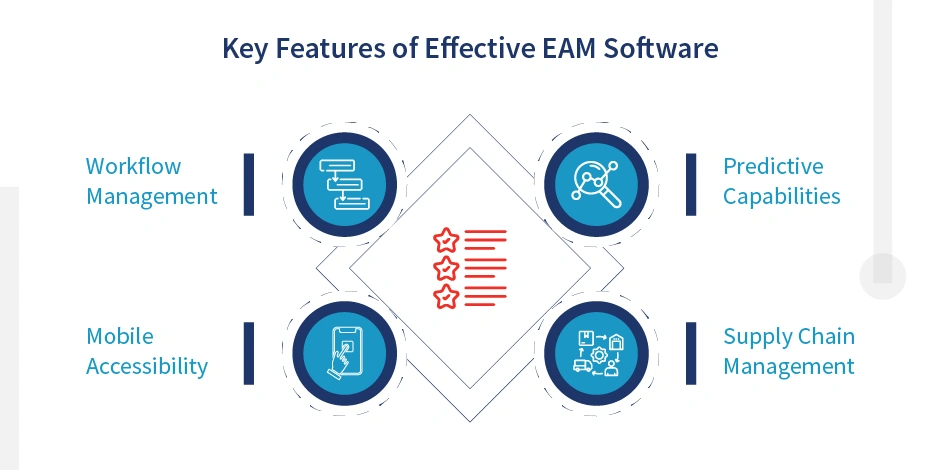
Different organizations have varied needs for their asset management strategies. Knowing the most effective features will help you understand which combination will serve your goals.
Workflow Management
EAM platforms help professionals track and manage maintenance activities. These include both planned and unplanned tasks, ensuring that the process is completed from the initial request.
Modern EAM software applications are intelligent enough to guide asset managers in prioritizing maintenance work for better asset usage and extended lifespan.
Further, these systems also flag issues in maintenance activities, which keep underlying issues unresolved and cause failures again and again.
Predictive Capabilities
The industry has already made big steps towards predictive maintenance from corrective maintenance.
Now, the basic need is to identify issues with fixed assets before they occur and prevent them.
Earlier, it was like issues were resolved once they happened on site, making the process slow and downtimes eating up productivity. So, asset managers can schedule maintenance in advance, identifying patterns that lead to asset failures.
The system identifies failure patterns by collecting real-time data from assets and sending notifications to technicians.
Mobile accessibility
EAM systems, when integrated with a computerized maintenance management system like InnoMaint, provide direct access to the application to technicians in the field.
These systems also have a mobile version that the technicians can install on their phones. From there, they can change work status if fixed, or ask for additional assistance, and upload fixation reports instantly. With this approach, everything remains on track, ensuring that issues are not overlooked.
Supply Chain Management
Supply chain operations heavily rely on the reliability and asset availability of physical assets, such as machines and fleet assets.
However, issues occur when critical assets collapse, or inventory is overstocked, or there is an unavailability of critical parts during emergencies. EAM systems connect maintenance schedules with spare parts inventory management data, forecasting spare part demands, optimizing procurement processes, and reducing the need for emergency asset investments. Fleet management is also possible with EAM software, given that organizations need to equip their fleet with the necessary devices.
Applications of EAM across industries
Energy and Utilities
This sector can use EAM systems to track and monitor asset life. These include various pipelines that carry fresh/waste water, gas, or electricity. These systems are critical and should be maintained to avoid any losses due to downtime and safety incidents. Utilities use EAM to support reliability-centered maintenance models by providing benchmarking capabilities and continuous documentation. In these high-risk environments, EAM helps in complex scheduling by analyzing geospatial information from remote assets and technicians, enhancing asset reliability and operational efficiency.
Chemicals, petroleum, and Mining
These sectors impact the surrounding environment through their daily operations. An EAM system can help maintain sustainability and reduce costs by optimizing gas, oil, and mining operations and managing industrial assets. Oil and gas companies use EAM processes that incorporate sensor data, IoT, edge computing, and advanced analytics to manage their assets. Since these are also high-risk environments, enterprise asset management software can generate alerts remotely when an asset malfunctions and poses a risk to workers on site, which enables prompt risk management and also reduces operational costs.
Manufacturing
The manufacturing sector, including the automotive, aerospace, defense, and electronics sectors, depends on sensitive assets and robotic equipment.
If these are not maintained intelligently, they can lead to huge monetary losses, leading to failure in meeting consumer demands. EAM systems add that intelligent layer to the system, identifying issues through current and historical patterns to schedule preventive maintenance tasks. It assists managers in promptly addressing issues, so they do not turn into major faults downstream.
Final Thoughts
EAM adds advanced capabilities, transforming traditional asset management into proactive maintenance and reduce maintenance costs. However, to achieve predictive capabilities in enterprise asset management, the most critical part is data. And if data is not properly optimized for the EAM systems, insights can be ambiguous and not as effective as expected. Hence, before installing an EAM system, ensure that your organization has a smooth data flow and data management from every asset, equipment, and machinery, which can be directed to the EAM software.