How Digital Tools and Automation Improve Production Efficiency
Every minute counts when you work in factory or company. The work you do have a direct impact on how much is done and how well it is made, whether you are operating a machine, moving equipment, or checking the quality of the final product. To be efficient in manufacturing company, you need to use all of the resources wisely and should not waste time, materials, and effort.
Now-a-days, factories are changing a lot because of computers and robots. People should not lose their jobs because of these tools. They should not make your work harder, more dangerous, or less productive. This article will discuss about the idea of production efficiency, including what it is, how we measure it, and how factories all around the world use digital technology every day to make their manufacturing processes more efficient.
Production Efficiency
Production efficiency is one of the most critical part of making things efficiently. You can get the most done with the least amount of people, materials, time, and energy. Alternatively, it's about completing more with less while making sure the quality is still good.
There is a difference between productive efficiency and allocative efficiency to completely understand the idea. In productive efficiency, a productive factory manufactures things at a fair price and does not waste any materials. If running at its best, a factory cannot make more things until it has more resources, like more workers or machines.
Allocative efficiency is to use the available resources to make something that people really want.
Both allocative efficiency and productive efficiency work closely to make sure that a factory is producing the right items and doing it in the best possible way with the least amount of money.
How Do You Gauge the Effectiveness of a Product?
Any operations leader needs to know how to figure out the efficiency calculation. The most common way to figure out how efficient something is to compare standard performance to real performance.
So, what does the efficiency ratio mean? The efficiency ratio is the number of standard hours of labor needed to make something divided by the number of hours of labor it actually took.
The Equation:
Efficiency Ratio = (Standard Labor Hours / Actual Labor Hours) × 100
For instance, if you estimate it to take 50 hours (standard) to make a batch of car parts, but it actually takes 65 hours (actual) because of machine jams and sluggish human operations, your computation looks like this: 76.9% is the answer.
Your production efficiency is 76.9%, which means that inefficiencies cost you more than 23% of your potential productivity. Modern facilities use production efficiency tools to get that figure as near to 100% as they can.
What does Mass Production mean and why is it Important to be Efficient?
Mass production is the way of making a lot of similar products or things using less time, machinery, assembly lines, and defined steps. This shows, quickly and consistently tens of millions of the same products are made, like mobile phones, cars, or food packages.
A business that manufactures a lot of things can lose a lot of money if it isn't efficient. Even though a factory makes 1,000 units a day, it loses 100 units a day when the efficiency drops from 90% to 80%. That's a lot of units that lose in only one month—3,000. Speeding up production is one of the most important things that every factory should do.
Typical Result of Low Manufacturing Efficiency
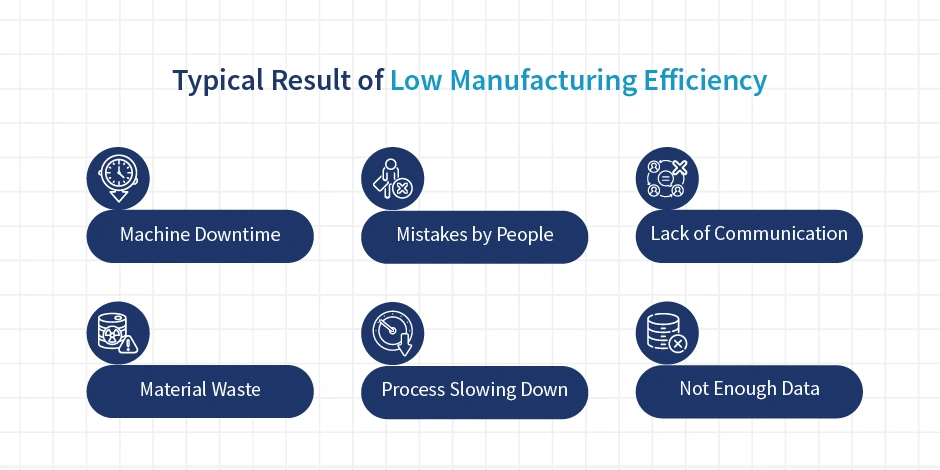
You need to know why factories don't work well before we talk about solutions:
- Machine Downtime: Production stops when machines break down or need maintenance without warning.
- Mistakes by People: People have to redo tasks and spend time when they make mistakes while measuring, putting things together, or labeling them.
- Lack of Communication: When teams do not share insights between them quickly, things get stuck and gives loss.
- Material Waste: Using excess raw materials than you need will slow down the manufacturing and increases costs.
- Process Slowing down: Products that are made by hand or old outdated ones take longer time than expected.
- Not Enough Data: Managers cannot make decisions quickly if they don't have the real time data.
How digital technologies enhance the Production Efficiency
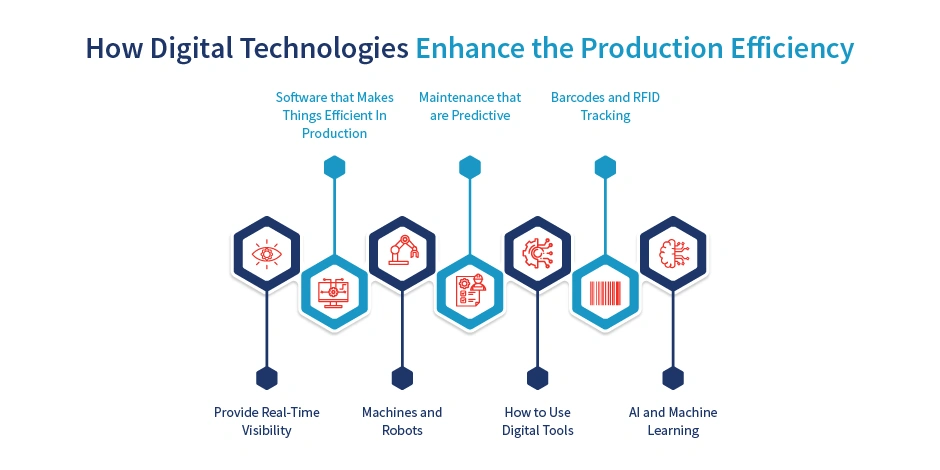
Modern technology tools can help resolving the problems with the following ones.
1. Provide Real-Time Visibility
The embedded sensors in machinery continuously gather data on factors such as temperature, speed, production phase, and vibrations. This information will be displayed on a main screen or dashboard, easily accessible to both operators and supervisors, which ensures the constant alertness of the factory's operational status.
When a machine starts to look faulty or slow down, an alarm gives alert so that the crew can fix it before it breaks down completely. This is one of the best ways to improve the efficiency in production.
2. Software that makes things Efficient in Production
This software keeps track of how productive the production is, and keeps track of every stage of the process of manufacturing. It also keeps track of how long each stage will take, how many units were made, how many got rejected down, and where the time was spent more. This information helps managers to find and fix problems and improve the process. Some common examples are:
- Manufacturing Execution Systems (MES) to maintain the track of real time production.
- Enterprise Resource Planning (ERP) to manage the track of your orders, timetables, and materials.
- Overall Equipment Effectiveness (OEE) software lets you know how well the machines are working.
3. Machines and Robots
Mainly the robots and machines that work on their own finishes the boring and time-consuming tasks including sorting, painting, packing, and welding. They do jobs faster and more reliably than people do, which makes production more efficient instantly. Automation does not eliminate all occupations; it certainly alters the way in which individuals perform their tasks. People still need to keep an eye on, program, fix, and make automated systems better.
4. Maintenance that are Predictive
Predictive maintenance uses data from sensors to figure out when a machine is likely to break down o, so you don't have to wait for it to happen. After that, maintenance workers should be there before the problem happens. This cuts down a lot of unplanned downtime, which is one of the worst things that can happen to a factory's output.
5. How to Use Digital Tools
Instead of outdated paper manuals, employees get instructions on their tablets, mobiles or computers. This can be videos, images, or lists of activities to do. Digital instructions help new workers to learn quicker, make fewer mistakes, and make sure that every product is manufactured the same way every time.
6. Barcodes and RFID Tracking
These tags or barcodes can help you keep track of things including equipment, materials, and items. With this asset tracking system, keep track of inventories and production records and workers can quickly scan anything. This helps managers to avoid making mistakes when they manually enter the data by hand and gives them up-to-date information about inventories. This makes sure that there are enough supplies, which helps avoid material shortages and keep production going.
7. AI and Machine Learning
The AI-powered systems look at a lot of data to find patterns that people might not see. For instance, AI can tell that a machine slows down when it is hot outside or that the material received from a certain supplier causes more defective products. Factory managers can use this data to stop problems from happening before they cause the manufacturing to slow down.
How Automation Make Factories Efficient
These are the most common ways to find out how well an automation makes the factory efficient:
Digital technologies provide you information and help you understand things, but automation does things happen. Automation is the one that speeds up the process of making things efficient. This is how it modifies the action:
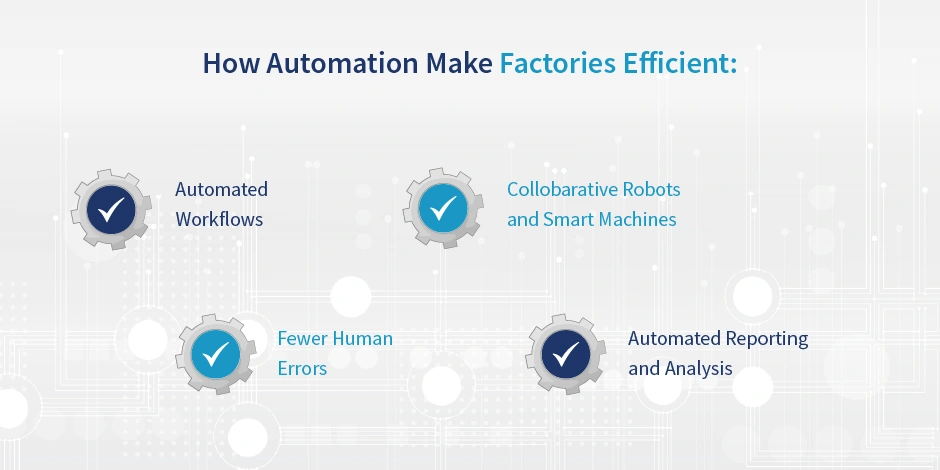
Workflows that are Automated
The Administrative problems might cause much downtime similar to technological problems. By automating tasks like making a purchase order when spare parts are low below a required level or assigning a maintenance ticket when an IoT sensor starts up with strange vibrations. You can make sure that production will not stop because of administrative problems.
Robots and Smart Machines
Collaborative robots and industrial robots can perform repetitive, boring, dangerous, or very precise tasks faster and more accurately than human. Incorporating robots to the assembly line can help manufacturers attain better precision, eliminate constraints, and keep production flowing 24 hours a day, every day. This makes the output increase a lot.
Fewer Mistakes by Human
People make mistakes compared to robots, which leads to a lot of quality and safety issues. These mistakes cost money, like when an operator types in the wrong setting on a machine or a maintenance technician uses the wrong lubricant because the printed manual was hard to read. Automation makes the steps the same every time. A digital system makes sure that the right settings are always loaded. This means that the quality of the product is always the same and there is less work to be done again.
Automated Reporting and Analysis
It used to take days to fetch the data needed for reporting at the end of the month. Automated reporting system instantly collects data from throughout the working environment to make personalized dashboards. The managers can easily find out how much work is completed, how much scrap they have, and how much OEE they have. This allows them adjust their plans straight away instead of waiting for meetings to talk about it.
Using Digital Technology to Speed Up Production
Here is a practical way to use digital technologies to enhance your factory better:
- You need to figure out where you are right now. You cannot fix things if you cannot measure it. Start finding out your present efficiency score by using the formula. Figure out where you spend the most time, money, and items.
- Pick the correct software to speed up production. You should check for software that integrates with the tools you already have and delivers your team data in real time. Digital dashboards are better than paper records for keeping track of things.
- Important thing is to train your employees how to use technology. It only works if workers know how to use them. Invest good amount for training so that all of your workers learn how to read the data, respond to warnings, and use digital systems properly.
- Automate the necessary key tasks. You do not have to do everything automatically. It is essential to use automation only for tasks that are risky, repetitive, or have a lot of work to do, and where consistency matters mostly. After that, allow the workers to choose, check the quality, and rectify problems.
- Always pay attention to things by tracking, learn and improve them. Use your production efficiency software to check your work once a week or once a month. Look for trends, celebrate how far you have come, and always look for ways to improve.
What Factories Really Achieve in the Real World
Factories all over the world are starting to use digital systems and automation, and they are seeing major gains in how effectively their manufacturing processes work:
- Predictive maintenance solutions can help you avoid up to 50% of downtime that is not necessary.
- After using the production efficiency software for 12 to 18 months, OEE ratings rose from 60% to more than 85%.
- Use AI-powered quality control cameras to find and reduce problems by 30–40%.
- Digital learning instructions cut the time taken by 60% to train new workers.
- Saved 15% to 25% on material costs by keeping an eye on stock levels as they change in real time.
Final Thoughts
Most manufacturers and organization who want to stay ahead in this fast pacing industrial world need to focus on improving production efficiency. Some of the common problems with traditional manufacturing systems like limited monitoring, manual process, and reactive maintenance practices that cause inefficiency and downtime.
We have found the digital technologies and robotic automation to solve these problems in better way. With this technology, manufacturing companies can complete their operations more effective, reduce down the downtime, and increase the performance of their assets with tools like production monitoring system, IoT-enabled machinery, predictive maintenance software, and advanced analytics.
Majority of companies like Innomaint have switch their production settings into data-driven decisions and more efficient operations by leveraging modern tools like smart maintenance software and digital manufacturing technology.
Organizations that support digital transformation will be able to boost productivity, streamline the operations, and stay ahead of the competitors.
Frequently Asked Questions
Productive efficiency means making products at the lowest possible cost without wasting any resources. A factory achieves productive efficiency when it cannot produce more without getting more resources like workers or machines.
Use this formula: Efficiency (%) = (Actual Output ÷ Maximum Possible Output) × 100. For example, if your line can make 1,000 units per shift but made 850, your efficiency is 85%.
Productive efficiency is about making products at the lowest cost. Allocative efficiency is about making the right products — the ones customers actually want. A factory needs both to be truly efficient.
Some well-known options include Innomaint, SAP Manufacturing, Siemens Opcenter, Rockwell FactoryTalk, and various OEE platforms. The best choice depends on your factory size, budget, and existing systems.
Yes. Even small factories can use affordable digital tools like digital checklists, simple sensors, or basic scheduling software to improve their manufacturing efficiency without large upfront investments.