What Is Total Productive Maintenance? 8 Pillars, Examples, and Benefits Explained
Quick Answer
Total Productive Maintenance (TPM) is a company-wide system that maximizes equipment effectiveness by eliminating losses, preventing breakdowns, and putting machine-health ownership on operators as well as maintenance technicians. It rests on 8 pillars — Autonomous Maintenance, Planned Maintenance, Quality Maintenance, Focused Improvement, Early Equipment Management, Training and Education, Safety/Health/Environment, and Office TPM — and is measured through OEE (Overall Equipment Effectiveness). Developed by Seiichi Nakajima in Japan in the 1970s, TPM's core departure from standard preventive maintenance is simple: the person running the machine is also responsible for its daily care, not just the person who repairs it.
That's the short version. Here's the full picture, including where most implementations quietly fail.
Introduction
Walk into most manufacturing plants and you'll find the same scene playing out in some form: a machine goes down, someone radios the maintenance team, production halts, and everyone scrambles. It gets fixed, production resumes, and two weeks later, same machine, same problem. The cycle repeats itself like clockwork.
That cycle has a name. It's called reactive maintenance, and it's one of the most expensive habits in operations. Total Productive Maintenance (TPM) is what breaks it — not by scheduling better, but by changing who is responsible for equipment health, how losses get tracked, and what "good" actually looks like on a production floor.
This guide covers the full picture: the TPM definition, the 8 pillars that hold it together, a maturity self-check you can run today, real-world examples, and why the right TPM maintenance software, like InnoMaint, can determine whether the whole thing sticks.
TPM Full Form and What It Actually Means
TPM stands for Total Productive Maintenance. This concept was developed by Seiichi Nakajima in Japan during the 1970s, drawing heavily from American preventive maintenance practices and combining them with the participative culture already embedded in Japanese manufacturing at the time. Nakajima's most disruptive idea wasn't the maintenance framework itself, it was the idea that operators, not just technicians, should be responsible for the machines they run.
That shift in thinking is still radical in plants where the unspoken rule is: operators run it, maintenance fixes it. TPM challenges that division at its root.
The total productive maintenance definition, stated plainly: a company-wide system that maximizes equipment effectiveness by eliminating losses, preventing breakdowns, and distributing ownership of machine health across every function, from the shop floor to the front office.
TPM vs. Preventive Maintenance: What's the Difference?
Preventive maintenance (PM) is a task — scheduled inspections and part replacements carried out by technicians on a calendar. TPM is a system that includes PM but adds operator ownership (Autonomous Maintenance), loss elimination through cross-functional teams (Focused Improvement), and a company-wide measurement standard (OEE). A plant can run preventive maintenance without ever practicing TPM. It cannot run TPM without preventive maintenance — PM is one pillar inside a larger structure.
Why TPM Has Become a Competitive Necessity in 2026
Margins in manufacturing have been compressing for years. Lead times are shorter, customer expectations are higher, and the cost of a missed delivery has grown from inconvenient to genuinely damaging. In that environment, unplanned downtime isn't just a maintenance problem, it's a commercial one.
What makes TPM in manufacturing particularly powerful is that it targets losses most facilities don't even measure. Everyone tracks machine downtime. Fewer track the slower-burning losses: equipment running below rated speed, micro-stoppages that each last under five minutes, startup scrap after a shift change, or quality rejects caused by a machine drifting out of calibration. These losses don't trigger alarms. They don't show up as breakdowns. They accumulate quietly, shift after shift, and rarely appear on a standard downtime report.
What Is OEE and How Is It Calculated?
The way TPM captures all of this is through OEE — Overall Equipment Effectiveness, calculated as:
OEE = Availability × Performance × Quality
| Factor | Formula | What It Measures |
|---|---|---|
| Availability | Actual run time ÷ planned production time | Is the machine running when it should be? |
| Performance | Actual output speed ÷ ideal output speed | Is it running at the right speed? |
| Quality | Good units produced ÷ total units produced | Is it producing good parts? |
The 85%-and-above "world class" OEE benchmark traces back to Seiichi Nakajima's original TPM literature from the 1970s–80s, based on plants that won Japan's Distinguished Plant Prize. It's widely cited across the industry, though attainable ranges vary by sector — discrete, high-volume manufacturing can realistically target closer to it, while continuous-process and heavily regulated industries typically operate lower by design, not by failure. Commonly cited industry sources put most manufacturers' baseline OEE in the 40–60% range when measured for the first time. That gap is where TPM's ROI lives — closed by extracting more from equipment already owned, not by buying new machines.
The 8 Pillars of Total Productive Maintenance
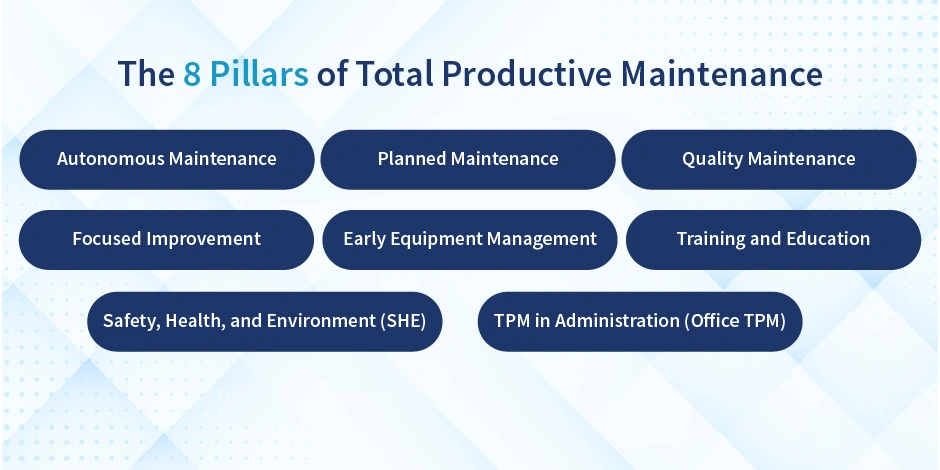
The 8 pillars of total productive maintenance are the framework's structural core. Each one targets a different category of loss. Skip one and the whole system develops a blind spot that tends to surface later as an OEE plateau — gains stall even though the pillars in use are being run well.
| # | Pillar | Loss Category It Targets | Primary KPI Moved |
|---|---|---|---|
| 1 | Autonomous Maintenance | Preventable minor stoppages | Availability |
| 2 | Planned Maintenance | Unplanned breakdowns | Availability, MTBF |
| 3 | Quality Maintenance | Process-driven defects | Quality rate |
| 4 | Focused Improvement | Chronic, unassigned losses | OEE (composite) |
| 5 | Early Equipment Management | Lifetime maintenance cost | Total cost of ownership |
| 6 | Training and Education | Skill-gap-driven errors | Availability, Quality |
| 7 | Safety, Health, Environment | Incident-driven downtime | Recordable incident rate |
| 8 | Office TPM (Administration) | Administrative delay | Mean time to repair (MTTR) |
1. Autonomous Maintenance
Definition: Operators take responsibility for the routine care of their own machines — cleaning, lubricating, tightening, inspecting. Not overhauls. Not major repairs. The daily habits that prevent the failures that show up weeks later.
Mechanism: Machine-specific checklists assign standardized daily tasks to operators, with clear escalation triggers for anything beyond Level 1 scope. This works because the person running a machine eight hours a day catches drift long before a technician who sees it once a month.
Example: A stamping press operator who wipes down die faces every shift and runs a brief visual check before startup isn't doing maintenance work — they're protecting a capital asset the company relies on for output. TPM makes that explicit, trains it properly, and builds it into the daily routine.
Failure mode: This is the pillar most implementations fake. If operators are signing off on checklists without actually performing the tasks, the entire system still rests on an already-stretched maintenance department. Pillar 1 has to be real before Pillars 2–8 can deliver.
2. Planned Maintenance
Definition: Converting breakdown hours into scheduled hours — moving repair work from crisis mode to controlled execution.
Mechanism: Uses MTBF data, failure history, and condition monitoring to schedule interventions before equipment fails. The U.S. Department of Energy has documented reactive maintenance costing roughly three to five times more than planned preventive maintenance once emergency labor, expedited parts, and extended downtime are counted.
Example: A facility that tracks mean time between failures on a given asset class and schedules replacement of wear parts ahead of the historical failure point stops repairing those parts under emergency conditions — where parts cost more, labor costs more, and downtime runs longer simply because the work wasn't planned.
3. Quality Maintenance
Definition: Eliminating the equipment conditions that create defects, rather than catching defects after the fact.
Mechanism: Maps specific defect types to specific machine conditions — temperature variance, feed rate drift, worn tooling, vibration, contamination — then sets monitoring limits on those conditions directly.
Example: A packaging line producing inconsistent seals whenever sealing-unit temperature drifts outside its defined operating range isn't facing a quality problem — it's facing a maintenance problem that quality control happens to notice first.
4. Focused Improvement (Kobetsu Kaizen)
Definition: Structured, time-boxed problem-solving aimed at one specific, measurable loss — not a general suggestion program.
Mechanism: Small cross-functional teams, typically three to five people from operations, maintenance, engineering, and quality, are assigned a narrow, quantified loss and given time and data to eliminate it, then the fix is standardized before the team moves on.
Example: A team assigned to a CNC machining center losing significant shift time to tool-change delays redesigns the tool carousel layout, documents the resulting changeover-time reduction as a new standard, and moves to the next loss — rather than trying to "improve the whole plant" at once.
5. Early Equipment Management
Definition: Influencing a machine's lifetime maintenance cost before the purchase order is signed, since that cost structure is largely locked in for the next 10 to 20 years.
Mechanism: Maintenance engineers participate in equipment specifications, vendor selection, and commissioning — catching design issues (blocked access points, shutdown-required lubrication points, long-lead-time spares) before they get absorbed silently for years.
Example: If a maintenance engineer reviews a new robotic welding cell's design before delivery and flags that the guarding blocks gearbox access, that single review can prevent years of avoidable downtime once the machine is in production — far cheaper to fix on paper than after installation.
6. Training and Education
Definition: Building the new skill set TPM requires — operators who understand basic maintenance, technicians who interpret condition data, supervisors who facilitate improvement activities rather than just manage headcount.
Mechanism: A tiered certification structure rather than a one-day workshop: operators are certified on Level 1 autonomous maintenance tasks before being trusted with Level 2 troubleshooting, with training records tied directly to what each person is authorized to do.
7. Safety, Health, and Environment (SHE)
Definition: A maintenance culture that asks operators to do more with machines must be built on non-negotiable safety practices. Zero accidents isn't a target in TPM, it's a precondition.
Mechanism: Safety procedures are embedded into maintenance tasks, not bolted on as reminders. Lockout/tagout steps are written into every autonomous maintenance checklist, and near-miss reporting is treated as valuable data, not an inconvenience.
8. TPM in Administration (Office TPM)
Definition: Applying the same loss-elimination thinking used on the shop floor to procurement, planning, scheduling, and documentation.
Mechanism: Tracks and reduces the administrative friction between a problem being identified and a fix being executed.
Example: A machine sitting idle because nobody manages spare parts proactively, or a work order stuck waiting on approval as it moves between inboxes — both are administrative losses with the same production impact as a mechanical one, just invisible on a maintenance dashboard.
TPM Maturity Self-Check
Use this as a rough diagnostic, not a certification. For each pillar, rate your organization 1 (not started) to 5 (fully embedded and audited):
| Pillar | 1–2 (Ad hoc) | 3 (Defined) | 4–5 (Embedded) |
|---|---|---|---|
| Autonomous Maintenance | No operator checklists | Checklists exist, inconsistently followed | Daily tasks completed and spot-audited |
| Planned Maintenance | Mostly breakdown-driven | Calendar-based PM schedule | MTBF-driven, condition-based scheduling |
| Quality Maintenance | Defects caught at inspection | Some machine-condition monitoring | Defect root causes tied to control limits |
| Focused Improvement | No structured teams | Ad hoc improvement projects | Cross-functional teams with tracked loss data |
| Early Equipment Mgmt | Maintenance not consulted on purchases | Consulted occasionally | Standard step in procurement/commissioning |
| Training | Informal, on-the-job only | Some documented training | Tiered certification tied to task authorization |
| Safety (SHE) | Reactive incident response | Documented procedures | Safety built into every maintenance task |
| Office TPM | Manual, email-based workflows | Some digital tracking | Automated approvals, spare-parts visibility |
An organization scoring mostly 1–2 is running preventive maintenance with a TPM label on it. Mostly 4–5 across all eight is genuine TPM.
Total Productive Maintenance in TQM: Understanding the Connection
For organizations already running Total Quality Management frameworks, TPM slots in as a natural complement rather than a competing initiative.
TQM and total productive maintenance in TQM environments share the same foundational belief: quality isn't inspected in, it's built in. Where TQM focuses on process design and variation reduction across the organization, TPM focuses specifically on equipment as the source of both variation and loss.
Simply, TQM ensures your processes are designed right. TPM ensures your machines execute those processes the way they were designed to. When both are running together, the result is consistent, predictable output rather than the kind of "good day, bad day" variability that frustrates customers and makes planning nearly impossible.
TPM in Practice: What It Looks Like in Real Companies
Toyota is the obvious reference point, and for good reason. The Toyota Production System has autonomous maintenance threaded into daily work at every level. When a problem is detected by an operator, not just a sensor, production stops. The problem is surfaced, contained, and addressed. There's no "we'll sort it at the end of the shift."
Beyond Toyota, TPM has been adopted widely across consumer goods, food and beverage, automotive supply, and pharmaceutical manufacturing over the past several decades — industries where equipment uptime and consistent quality directly determine output. What these implementations share isn't a single industry or geography, it's the commitment to run all 8 pillars at once, with visible leadership support and real operator engagement underneath it, rather than picking a convenient subset.
How Long Does TPM Implementation Take?
There's no universal timeline, and any specific number of months or years quoted without context is a guess. What's consistent across implementations: Autonomous and Planned Maintenance pilots on a small number of lines show measurable OEE movement well before plant-wide rollout across all 8 pillars is complete, and full maturity — training tiers, cross-functional Focused Improvement teams, Early Equipment Management built into procurement — is a multi-year effort, not a single-quarter initiative. Organizations that treat TPM as a project with an end date are the ones most likely to see early gains erode once the routines are deprioritized.
The Real Benefits of Total Productive Maintenance
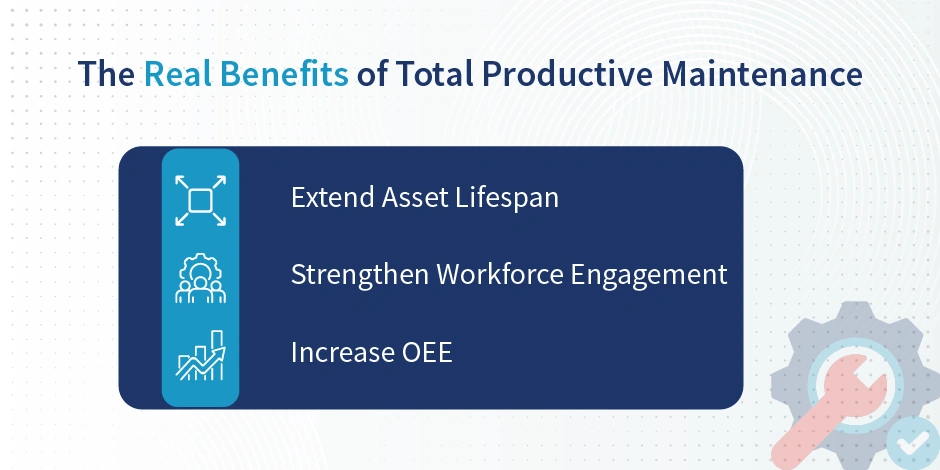
- Unplanned downtime drops, along with the expedited freight, overtime, and missed shipments that follow every breakdown.
- Maintenance costs shift from reactive to planned, which is consistently cheaper because planned work happens with the right parts, tools, and time.
- Quality improves because equipment running within defined parameters produces fewer defects, meaning less rework, less scrap, and fewer customer complaints.
- OEE climbs, often significantly, without new capital equipment, by extracting more from assets already owned.
- Workforce engagement strengthens, since operators with real ownership over a machine behave differently than operators executing someone else's checklist.
- Assets last longer when looked after daily instead of repaired after failure.
What TPM Maintenance Software Actually Does
The operational discipline of TPM requires visibility that paper-based systems genuinely cannot provide. Maintenance logs that live in binders, checklists scanned weekly rather than checked daily, and work orders moving through email create the illusion of control without the substance — by the time a missed daily check shows up on paper, the failure it was meant to prevent has often already happened.
TPM maintenance software, more broadly a CMMS (Computerized Maintenance Management System) built for TPM environments, provides the digital backbone the framework needs. This is where platforms like InnoMaint come in — a purpose-built maintenance management solution designed around all 8 pillars working in coordination, not just work order tracking.
- Planned maintenance schedules generate work orders automatically from time, cycle, or condition triggers.
- Autonomous maintenance checklists reach operators on mobile devices on the floor, not on a clipboard in a break room.
- OEE data connects to maintenance history, so the relationship between equipment care and equipment performance is visible in real time, not at month-end.
- Failure analysis tools give focused improvement teams real data to work with rather than anecdote.
- Spare parts inventory management ensures the right components are available when planned work is scheduled.
- Integration with ERP and production monitoring systems keeps maintenance data connected to plant-wide decisions instead of sitting in a silo.
When evaluating total productive maintenance software, the practical questions are these: Does it support all 8 pillars, or just work order management? Can operators use it on the floor without IT involvement at every step? Does it give leadership the visibility to track compliance, not just completion?
Where TPM Implementation Goes Wrong
- Starting with tools instead of culture. Software gets deployed, checklists get created, OEE dashboards go up, and nothing fundamentally changes because leadership still treats maintenance as a cost center to be minimized rather than a capability to be built. Compliance happens. Commitment doesn't.
- Weak autonomous maintenance. If operators aren't genuinely performing daily care routines, and not just signing off on them, the entire system rests on a maintenance department that was already stretched thin. Pillar one has to be real before the others can deliver.
- Treating TPM as a project with an end date. Organizations launch with energy, see early OEE improvements, declare success, and gradually deprioritize the routines. The gains erode over time and old habits return. TPM isn't a transformation initiative. It's an operating model, and operating models don't end.
Frequently Asked Questions
What industries use TPM besides manufacturing?
TPM principles apply anywhere equipment uptime drives output — food and beverage processing, pharmaceuticals, automotive, packaging, utilities, and increasingly warehousing and logistics equipment.
Is TPM the same as Lean manufacturing?
No. TPM is often implemented alongside Lean and shares tools like Kaizen (used in the Focused Improvement pillar), but Lean targets waste across the entire value stream while TPM targets equipment-specific losses and ownership.
What's a good starting OEE target for a new TPM program?
Most manufacturers measuring OEE for the first time land somewhere in the 40–60% range, well below the widely cited 85% "world class" benchmark. Rather than chasing 85% directly, a more realistic approach is setting a target based on your own baseline and industry, then tracking steady, incremental improvement as Autonomous and Planned Maintenance take hold.
Do small manufacturers need a CMMS to run TPM?
Not strictly — TPM can start with paper checklists and spreadsheets. But MTBF tracking, OEE calculation, and cross-pillar visibility become error-prone manually past a handful of machines, which is where most plants adopt a CMMS.
Final Thoughts
Total productive maintenance is, at its core, a decision to stop accepting equipment losses as the normal cost of doing business. It's the recognition that every hour of unplanned downtime, every defect traced back to a machine running out of spec, every repair done under emergency conditions rather than planned conditions — these aren't inevitable. They're manageable. With structure, with data, and with a team that's actually invested in the outcome.
The 8 pillars of total productive maintenance give you that structure. TPM maintenance software gives you the visibility to sustain it. But neither one does the work on its own. What actually moves the needle is an organization where the plant manager talks about OEE the way they talk about safety — as a shared responsibility, tracked seriously, and improved continuously.
The manufacturers already operating that way aren't looking back.
Frequently Asked Questions
TPM stands for Total Productive Maintenance. It is a company-wide operational strategy that maximizes equipment effectiveness by eliminating production losses, preventing equipment failures, and distributing maintenance responsibility across operators, technicians, and management not just the maintenance department.
The 8 pillars of Total Productive Maintenance are Autonomous Maintenance, Planned Maintenance, Quality Maintenance, Focused Improvement, Early Equipment Management, Training and Education, Safety Health and Environment (SHE), and TPM in Administration (Office TPM). Each pillar targets a specific category of operational loss, and all 8 work together as an integrated system.
Total Productive Maintenance was developed by Seiichi Nakajima in Japan during the 1970s. He built the framework by combining American preventive maintenance principles with Japan’s participative manufacturing culture, most notably by introducing the idea that machine operators, not only maintenance technicians should be responsible for equipment care.
OEE stands for Overall Equipment Effectiveness. It is the primary metric used to measure TPM performance, combining three factors: equipment availability, operating performance, and output quality. A world-class OEE score is considered to be 85% or above. Most facilities measure below 65% when they first track it honestly, and closing that gap is precisely what TPM is designed to do.
Preventive maintenance is a scheduled maintenance activity performed at fixed intervals to reduce the chance of equipment failure. TPM is a broader management system that includes preventive maintenance as one component but goes much further — involving operators in daily equipment care, eliminating root causes of defects, improving equipment through focused kaizen projects, and extending TPM thinking into administration and procurement. In short, preventive maintenance is a practice; TPM is an operating philosophy.
Total Productive Maintenance and Total Quality Management (TQM) are complementary frameworks. TQM focuses on building quality into processes and reducing variation across the organization. TPM focuses on equipment as the root source of both production loss and quality variation. When implemented together, TQM ensures processes are designed correctly while TPM ensures the machines execute those processes consistently — producing predictable, high-quality output.
TPM is widely used across industries that rely on equipment-intensive production, including automotive, food and beverage, pharmaceuticals, packaging, chemicals, electronics, and heavy manufacturing. Companies like Toyota, Nestlé, and Unilever have implemented TPM at a global scale. The framework is applicable to any operation where equipment reliability directly impacts production output, product quality, or safety.
A meaningful TPM implementation typically unfolds over 2 to 3 years before it becomes a deeply embedded operating culture. The first 3 to 6 months usually focus on establishing autonomous maintenance routines and baseline OEE measurement. Pillar by pillar improvements follow over the next 12 to 18 months, with cultural maturity where TPM thinking is instinctive rather than managed developing over a longer horizon. Organizations that treat TPM as a short-term project rather than a sustained commitment rarely hold their initial gains.