Unlock Superior Asset Management with Our Free EAM Strategy eBook!

Access the eBook
Key Benefits of CMMS Software for Maintenance

Key Benefits of CMMS Software for Maintenance

CMMS Software Benefits: Why Investing in CMMS During Economic Downturn is a Smart Move

A CMMS software is used by an organization for planning, tracking, measuring and optimizing stuff for better maintenance practices proving the value of maintenance. Let us have a look at some of the reasons for investing in a CMMS software.

In times of financial uncertainty, businesses are under immense pressure to reduce costs, increase efficiency, and maximize asset performance. This is where CMMS Software (Computerized Maintenance Management Software) plays a crucial role. A modern CMMS not only ensures preventive maintenance and asset tracking but also provides visibility into equipment performance, reduces unplanned downtime, and helps organizations make data-driven decisions. Investing in CMMS during an economic downturn is a proactive strategy that empowers organizations to extend asset life, optimize resources, and build long-term resilience.

Why CMMS is Critical During Economic Downturn

  • Role of CMMS in cost-efficient maintenance management.
  • Avoids expensive emergency repairs by enabling preventive maintenance.
  • Enhances visibility into maintenance budgets for better ROI.
  • Improves compliance and audit readiness.
1. Keep track of what’s happening in your business

Think of a place where you can pull up a specific asset and know all the information you need to know. That’s exactly the reality of today’s maintenance and asset management software.

You need not waste your time sifting through file cabinets or scouring through clipboards. The CMMS also help when the customer’s preventive maintenance procedures are under objections during a lawsuit filed by a guest. With all the detailed records, you can protect your business from serious matters as and when they arise.

2. Increased productivity

Computerized Maintenance Management Systems (CMMS) drive productivity by automating manual tasks and streamlining maintenance workflows.

For example, a manufacturing plant using CMMS can automate work orders directly from IoT sensor alerts. Instead of waiting for breakdowns, maintenance teams get real-time notifications, schedule repairs instantly, and keep machines running with minimal interruptions.

Similarly, a facilities team can track warranties, spare parts, and service history in one platform. With instant access to inventory and vendor details, repairs are faster, and assets last longer reducing both downtime and operational delays.

By integrating IoT, predictive maintenance, and asset tracking, CMMS helps teams achieve higher efficiency, optimize resources, and deliver more work in less time.

Just like a good billing software streamlines your business, having a good CMMS software like Innomaint will not only help you with preventive maintenance but also allows you to see instructions for a specific job, and whether you have the parts on hand to complete the job.

It also shows information such as service histories, warranties, etc. needed for your business. Some packages also come with additional features to manage reports and key performance indicators for presentation purposes. The cloud based CMMS solution Innomaint also allows you to connect to the cloud for faster and easier sharing for enhanced flexibility.

3. Foster teamwork and collaboration

Teamwork is often one of the most efficient ways to get things done in a company. When individuals work in a team, they can bounce ideas off each other and come up with a better solution. Innomaint helps promote behaviors that lead to better teamwork by providing a central location for users to collaborate.

For instance, a junior tech looking for a solution can use the CMMS to see how team members solved similar issues in the past. They can also take help from a senior technician to get suggestions for their task.

It also helps the organizations that work in rotational shifts to stay connected by transferring knowledge through Innomaint. It also makes sure that there are maximum transparency and alignment by offering the team better visibility of the activities of each member of the team.

4. Less downtime

Unplanned breakdowns cost time and money. With IoT-enabled CMMS, organizations can predict failures before they happen. Sensors track real-time data like vibration, temperature, and energy use, sending early alerts to maintenance teams.

Instead of reacting after a failure, predictive maintenance lets you schedule repairs in advance, order spare parts early, and assign the right technicians. This proactive approach significantly reduces downtime compared to traditional reactive strategies, while also extending asset lifespan and lowering costs.

By combining IoT insights with a cloud-based CMMS, businesses ensure higher equipment uptime, smarter planning, and uninterrupted operations.

Whenever a system breaks down, the downtime occurs while the machine is waiting to be fixed. It can be even longer if all the parts needed to fix the system are not available on hand. If you use Innomaint, you will be alerted when you need to order parts before a machine breaks down so as to reduce the downtime.

You can easily schedule and plan the maintenance to make it simple for the maintenance team. With achieving lesser downtime and increased productivity, Innomaint can be a great investment for organizations to become more cost-efficient.

5. Asset location

Do you often forget where a certain system or item is located? Large companies often fight with this issue constantly. Having a large business is great, but it’s difficult when you start forgetting where things are kept. Using Innomaint can be helpful in finding your assets effectively. The assets may comprise your machines, computers, products, employees as well as all the items needed to effectively do your business.

Future-Proofing with Cloud-Based CMMS

Cloud-based CMMS empowers maintenance teams with anytime, anywhere access, making collaboration seamless across locations. Its scalable architecture grows with your business needs, while AI and analytics integration deliver smarter maintenance planning through real-time insights.

With solutions like InnoMaint CMMS, organizations benefit from cost efficiency, remote accessibility, and future-ready technology that ensures long-term sustainability and competitiveness.

Bottom line

The CMMS software offers a helping hand for your business that you have needed for long. From taking care of the maintenance part to improving your productivity and keeping your employees trained, these systems come packed with many other benefits. And the best part about Innomaint is that it can be implemented with just a little tech knowledge.

Frequently Asked Questions

What are the benefits of CMMS during economic downturns?

CMMS software helps businesses cut maintenance costs, extend asset life, reduce downtime, and improve productivity. During an economic downturn, it ensures cost-efficient maintenance, better asset tracking, and optimal resource utilization.

How does CMMS reduce downtime and improve productivity?

CMMS reduces downtime by scheduling preventive maintenance, alerting teams before failures occur, and tracking spare parts availability. It improves productivity by automating work orders, centralizing data, and providing real-time visibility to technicians.

Why should businesses invest in cloud-based CMMS software?

Cloud-based CMMS offers remote access, scalability, and seamless team collaboration. With AI and analytics integration, businesses can plan smarter maintenance and achieve long-term cost efficiency. InnoMaint CMMS provides a future-ready solution with these benefits.

What is predictive maintenance in CMMS?

Predictive maintenance uses IoT sensors and analytics within CMMS to predict equipment failures before they occur. This proactive approach reduces unplanned downtime, extends asset lifespan, and saves maintenance costs compared to reactive repairs.

How does CMMS help in asset tracking?

A CMMS allows businesses to track asset location, usage history, warranties, and service records in real-time. This ensures better decision-making, reduced asset loss, and maximum equipment uptime.

Is CMMS cost-efficient for small and medium businesses?

Yes, CMMS software is highly cost-efficient for SMEs. It eliminates manual processes, reduces downtime, lowers repair costs, and helps businesses make data-driven decisions to improve ROI even with limited budgets.

To Automate Your Preventive Maintenance Process

Try Innomaint Equipment Maintenance
Management System for Free

Customer Satisfaction Tips for Service Request Management

Customer Satisfaction Tips for Service Request Management

4 tips SRM banner

4 Tips for Service Request Management: The Secret to Achieving Customer Satisfaction

Maintenance teams need to be agile in attending to field service customer requests. People run out of time these days, and there is an increasing intolerance among the public. The ability to properly receive, route, and manage service requests impacts operational efficiency and customer satisfaction.

In this blog post, let us discuss the best practices for service request management. Digitization of field service business is the order of the day. It unifies all service requests routed earlier via inefficient and disorganized approaches of emails, phone calls, etc., into one digital stream as customers can submit service requests via an easy-to-use mobile app. Such a cloud-based approach ensures no service request goes unnoticed or gets lost in the middle owing to communication gaps.

Here are a few ways you can improve your service request management process. Please remember field service management software is a pre-requisite for all tips to meet the modern demands of customers.

i) Craft the best work orders

Work orders are the engine of the service business. It is not an exaggeration to state that a good work order raised early with a clear illustration of the issue amounts to fifty percent of the work done. Yes, clarity in communication is an art!

A good FSM software should permit anyone in the customer’s organization to raise a defect statement irrespective of the registration status with the application or awareness of concerned asset details. A simple QR code scan must be enough to do that. What if the first observer of the defect struggles to portray the issue in words?

No problem! The person can describe the issue as voice, video, or image(with annotations) and attach them to the work order.

Upon receiving the service request, field supervisors can edit it, add additional information, notes, documents, etc., for quick resolution of the issue.

ii) Auto-assign the ticket to the best for the situation

The crew may operate in rotational shifts. The knowledge of staff availability across and the updation of the information in the FSM system is essential.

The FSM software provides supervisors full view of the real-time workload of technicians at any given moment. Thus supervisors can distribute work evenly, saving the workforce from fatigue so that they attend to service requests with good morale.

The best fix depends on the situation. In urgent situations the technician’s proximity is of higher priority. FSM software can limit the assigning of the ticket only to those within the Geo-Fencing circle in such a case.

In case of availability constraints, the FSM application can auto-assign the ticket to a group of technicians corresponding to the category and available in the shift. The supervisors need not be awake for assignments during odd hours.

In usual cases, the same application assigns the ticket to the most skilled technician.

iii) Automate Service Request Notifications

It would be professional to send notifications to customers upon each activity on the service request. People who need maintenance assistance would appreciate it.

It would be even better if notifications are sent for each comment on the work order for complete ruling out of delays due to communication gaps. Thus the service firm keeps informed on the status of fixes – whether a spare change is required/ temporary fix is given/ the fix is complete.

Customers can track the work order status and recent communication even after a few days, maintaining transparency and trust between the parties. Notifications are useful for the maintenance team as well. Service request notifications can notify administrators when they receive new service requests, approve or reject requests. Notifications also alert technicians when the application assignes service requests to them.

Customers can also track the route techs take during transit. It helps reduce the wait time for customers as they can plan their day better.

iv) Track Service Request Management KPIs

Maintenance managers and customers can glance at the FSM application Dashboard to know the big picture on current progress.

Accordingly, managers can plan for meetings, arrange training or concentrate on specific areas of lags. You get to know all metrics needed to measure performance, such as Average service request response time, Backlog task count, Customer satisfaction rating, Percentage of service requests completed on time, etc.

These tips help you stay on top of Service Requests with an able FSM software such as InnoMaint. With the digital transformation of service business, you radiate a culture of fair and transparent business practices.

You can reinforce the accuracy of time and cost estimates, provide help to front-line teams with reusable knowledge and knowledge from peers, and much more. All these factors combinedly cement customer relations to unmatched levels.

InnoMaint shows up in the Leaders Matrix of the Top CMMS Software 2023

InnoMaint shows up in the Leaders Matrix of the Top CMMS Software 2023

Leader matrix blog banner

InnoMaint Shows Up in the Leaders Matrix of the Top CMMS Software 2023

InnoMaint ranked ahead of major CMMS players

It’s time for us, in the InnoMaint family, to feel glad and satisfied! Software Suggest has listed Innomaint in the superior ‘Champions‘ category of the Leaders Matrix, ahead of all other major players. Be proud you’re using a product recognized as the best in its field. For more details, please click here.

An Introduction of Software Suggest

SoftwareSuggest, a leading business consultant, helps businesses and organizations choose the best business software fitting their needs, solving unique problems, and providing a good return on investment. With a consistent performance in linking businesses with their vendors, the consultant started appearing in dailies and online magazines as early as 2014.

Comparison of B2B software

The B2B portal helps business software seekers connect with verified service providers by,
  • Listing the best software for business functionalities.
  • Reviewing the best software based on exhaustive in-house research.
  • Performing in-depth comparison of the top B2B software based on various functionality and criteria.

Criteria for Arriving at Leadership Matrix

Software Suggest carefully examined each CMMS product and vendor, paying close attention to parameters such as features, reviews, customer support, third-party integration, traffic, social media engagement, usability, etc. The consultant quantified the results of its evaluation for these aspects:
  • User rating score
  • No. of Reviews Score
  • Freshness Score
  • Social Score
  • Monthly website visitor Score
  • Usability Score:
  • Ease of Setup Score
  • Ease of Use Score
  • Features Score
  • Support Score
  • Value of Money Score

Previous Awards from Software Suggest

Software Suggest does a good job showcasing the best-of-breed product on its website from various perspectives as efficiently as possible. It has been conferring meritorious badges on InnoMaint such as:
  • Committed to Deliver-Summer
  • Best Value Software
  • Best Usability Software
5 Things You Should Know About Maintenance KPI Metrics

5 Things You Should Know About Maintenance KPI Metrics

KPI Metrics blog banner

5 Things You Should Know About Maintenance KPI Metrics

What are metrics?

Maintenance metrics are parameters used to measure how the maintenance crew is sincere, talented, and efficient at work. Metrics also indicate how assets operate without breakdowns or malfunctions, how often preventive maintenance tasks are performed, etc. Metrics and KPI reveal the budget consumption trend and overall maintenance progress, at a facility. You can use them to compare the maintenance performance between different facilities.

Difference between metrics & KPI

Maintenance metrics and Maintenance KPIs are not the same. KPIs are digits that relate organizational progress to maintenance performance, while metrics connect maintenance performance to maintenance actions. In short, maintenance KPIs are a target your business is aiming. Maintenance metrics are the arrows you’re firing at that target. Confusing? Just read the para below for cent percent clarity on this.

For instance, your primary business goal might be increasing revenue by 20%. Equipment downtime is inversely related to the goal. Lesser the equipment is running, the fewer the products are manufactured. Therefore, one of your maintenance KPIs is downtime.

All those parameters that affect downtime such as First Time Fix Rate(FTFR) and Mean Time to Repair (MTTR) are maintenance metrics.

These are core to your maintenance key performance evaluation, directly linking to overall equipment effectiveness (OEE).

The significance of maintenance metrics

Having the numbers makes it easier to perform a SWOT analysis -I.e., strengths, weaknesses, opportunities, and threats for improvement in maintenance performance for supporting overall improvement in business processes. Metrics convey a clear picture on how daily maintenance chores impact the bigger picture. You gain control over maintenance operations and practical ways to improve work.

Keeping assets running at peak performance is crucial to the success of any organization. So organizations must have a well-established standardized processes to track and manage their assets. Automate work orders to maximize the uptime of your assets. Metrics help you realize where you stand now concerning your goals and set quality benchmarks to make improvements.

They also help prioritize maintenance backlog based on risk, reduce equipment failures, and refine maintenance strategies.

Types of KPI & metrics

i) KPI Metrics on Asset performance – Preventive compliance, Scheduled vs Assigned, Work order by category, Availability uptime, Total downtime hours, MTBF (time between failures), MTTR (mean time to repair), Total spend time, etc.

ii) KPI Metrics on Technician performance – Average response & resolution time, On time arrival, First time fixed-rate(FTFR), Technician Performance, Repeated Problems, SLA Compliance, etc.

iii) KPI Metrics related to Budget – No. of hours worked, No. of breakdown calls, Spare Consumption, No. of Assets, etc.

iv) IoT-related metrics– Energy usage tenant, facility wise; visitor traffic towards and away from key location; visitor management-related metrics, etc.

How to compute & extract KPI & metric values?

A good computerized maintenance management system (CMMS) captures all relevant planned maintenance hours versus total maintenance hours (including repairs) to support metrics like MTBF, MTTR, and performance and quality of your upkeep processes.

A competent EAM/FMS/CMMS software calculates metrics automatically for you. View the metrics from the Dashboard page of web-based and mobile applications of the above software.

Make the right investment for digital transformation of your maintenance business for arriving at wise data-driven decisions, planning for quick meetings, identifying training requirements, setting performance goals, and generating new avenues for reducing utility costs and operating expenses.

To Automate Your Preventive Maintenance Process

Try Innomaint Equipment Maintenance Management System to align your maintenance team, manage the maintenance backlog and optimize maintenance strategies.


How can CMMS Software Simplify Operations in the Oil and Gas Industry?

How can CMMS Software Simplify Operations in the Oil and Gas Industry?

How can CMMS Software Simplify Operations in the Oil and Gas Industry?

The role of Computerized Maintenance Management System (CMMS) is constantly at the surge in various industries and areas. May it be the oil & gas industry, pharmaceutical industry, fleet & transport industry, or food industry, the roleplay of CMMS is inevitable. It renders efficacy and precision of operations in several fields, and some are stated below.

Significance of CMMS in Oil and Gas Industry

Oil and gas manufacturing industries undergo a trivial trial and face several complexities. The demand for oil and gas is continuous, and it assists in fulfilling many consumer requirements like energy needs, cooking, transportation, and electricity generation. It is also a crucial part of the heating and cooling process. These products are also used as the raw materials for manufacturing fabrics, fertilizers, plastics and synthetic rubber.

The role of CMMS software in managing oil and gas industry operations is noteworthy. Oil and gas are a vital part of exports and imports as well. Many gas and oil suppliers are smoothly completing their operations with a computerized maintenance management system. This helps them deliver precise, timely and relevant data under a secured network.

Using this software also eliminates hurdles related to unscheduled equipment repairs, keeps track of safety and regulatory standards, and improves overall productivity. It also helps reduce costs and send quick responses in times of emergency.

What is the Role of CMMS?

CMMS collects all the maintenance data from any location and secures it under a centralized database. It helps quickly access the information through multiple channels like from a computer or any other mobile device.

Accessing CMMS also reduces unplanned downtime and other potential threats related to optimal production. It also streamlines all trivial tasks and processes effectively. Accessing important data and sharing real-time updates on orders or the warehouse is also possible under a single roof with CMMS.

Advantages of CMMS in the Oil and Gas Industry

  • Work Order Management– Along with creating on-demand work orders, this software also helps organize sections for the users so that they can browse through and generate complete details on assignments and the work orders. This also includes equipment repair, service requests and preventative maintenance planning. There is also an inter-reliant functionality that helps the oil and gas industry to manage working with even the modern infrastructure businesses. Utilizing a CMMS solution helps in overall operations handling at the workplace.
  • Preventive and Planned Maintenance– The PM program helps in maximizing the lifespan of assets. Regular maintenance of plant equipment can also help reduce equipment failures or breakdowns. CMMS avoids unplanned interruptions that might show adverse effects on production goals and unforeseen costly repairs. It is an easy-to-use yet powerful application used in Oil & Gas industry in Saudi Arabia, pharmaceutical company in Germany, etc., that aids in managing and protecting assets.
  • Asset and Equipment Management– In the oil and gas industry, assets are a costly investment that could drain away your savings if not appropriately managed. The incorporation of CMMS helps in easy preventive maintenance and repair work related to every asset. It can track the assets and ensure that you can complete value for it by tracking its warranty data, schematics, operating manuals, insurance details and other documentation parts associated with it.
  • Safety– These days, there is very low tolerance when it comes to making mistakes with employee safety and accidents. Specifically, the oil and gas industry is more prone to this. CMMS software ensures a safe environment by coming up with excellent solutions to retain complete document safety. They also ensure that you have met the compliance standards appropriately.
  • Managing and Control Costs– CMMS also effectively manages the operations to optimize the inventory costs. It calculates and retains the specific budget for work order completion, equipment replacement, tracking of special projects, purchasing and spot purchases. In this manner, it surges up the life span of certain assets or equipment via automated maintenance solutions.
  • Labor Management– Time tracking is also a spectacular CMMS software functionality. It considers reporting, labor availability and costing related to work orders as a significant part of a successful business. CMMS includes work orders that gather all crucial information and several variables like labor hours, location of closest technician and the contacts of various parts and service-related vendors.
  • Spare Parts and Inventory Management– CMMS grants accurate records related to the inventory of the oil and gas industries and also helps in enhancing the real cost savings.
  • Dashboard and Reports– Reports, analytics and dashboards can amp up the performance metrics and help in preventive maintenance compliance. It helps in swiftly providing all the data handy for the users.
  • Mobile Access– Managers and officials of the oil and gas industry can access data through the CMMS Software on their laptops or mobile devices. They can check for the inventory parts and access manuals, warranties, and schematics properly. All of this leads to a cut down on costs and overall profitability in various areas.

Winding Up

In short, the CMMS Software is a boon to the oil and gas industry. It could retain the regulatory compliance standards and various external or internal audits. Document repair history and safety compliance are the primary benefits that you can gain with this system.

Getting the best choices is possible when you search for the reputed CMMS vendor who streamlines expert product options to impact maintenance activities positively. Thus, the oil and gas industry could prevail a significant advantage by incorporating the CMMS into their framework!

5 Industries that Would Benefit from a CMMS System

5 Industries that Would Benefit from a CMMS System

5 Industries that Would Benefit from a CMMS System

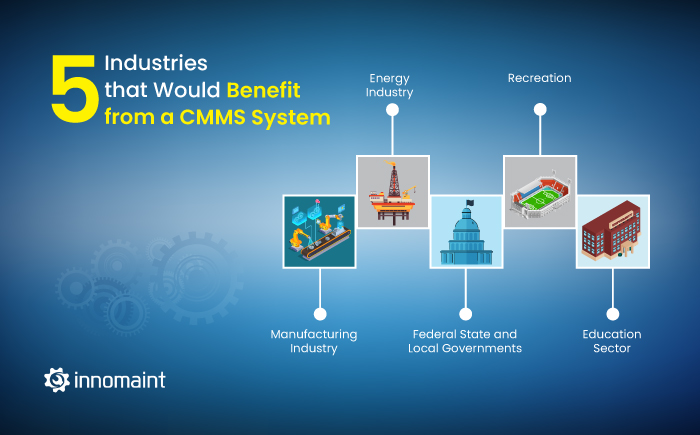
Computerized maintenance management systems or a CMMS helps organizations track work orders, manage assets, and schedule maintenance. A CMMS system offers many benefits to various industries, including saving time and money, reducing costs, and improving health and safety. They also help to increase efficiency, reduce downtime and collect data. Here are five industries that would benefit from a CMMS system.

Manufacturing Industry

The manufacturing industry faces various challenges such as machine breakdowns, high operation costs, loss of productive hours, and delayed or missed work orders. Other challenges include:

  •  Costly equipment purchases
  •  Lack of crucial performance data
  •  Low spare parts inventory
  •  Sudden shutdowns

There is a lot of wear and tear in the manufacturing industry, and parts and replacements are usually needed to complete orders. A CMMS system helps track the life cycle of assets to get maximum return on investment and increase the assets’ productivity and uptime. It also increases automation to enhance operational efficiency and ensure that the manufacturing operations run smoothly.

Other benefits of using a CMMMs system for manufacturing include:

  •  Scheduling preventive maintenance
  •  Recording real-time asset
  •  performance data
  •  Enhancing access to manufacturing data anywhere at any time

It also helps optimize spare parts and inventory management and monitor multiple sites from a central location.

Energy Industry


Energy plants like oil and power plants use heavy machinery and assets and depend on their reliability, uptime, and performance to make profits. Errors in maintenance and breakdown of the assets can lead to massive losses for the industry. A CMMS system can help maximize productivity and ensure that the operations run seamlessly.

CMMS software has numerous benefits for the energy industry, including document management, compliance, preventive maintenance, and condition monitoring. All the information is in a central location, and managers can easily access work orders and check spare parts’ availability and repair costs. The software also helps managers track asset maintenance and costs from a central location and receive automated maintenance reminders.

Federal State and Local Governments

Government organizations both at the state and local level need A CMMS system for maintenance management. They have many facilities and assets under their control, which can be daunting to manage. Managing these assets using manual methods can lead to inaccurate data management, increase operational costs and take a lot of time.

Using CMMS software like InnoMaint can help manage day-to-day maintenance operations. It is a cloud-based maintenance management software that government agencies can adopt to reduce downtime, extend equipment life, measure performance, and improve maintenance planning. Local governments can also use it to provide faster services and achieve organization visibility.

Recreation

Recreational facilities such as sports stadiums and athletic clubs require CMMS software to manage all the equipment, courts, and facilities effectively. Managing all the assets manually can consume a lot of time and money and lead to many errors and downtime. A CMMS system can help reduce maintenance costs and downtime and predict equipment failures. You can use the system to schedule preventive maintenance and prevent breakdowns.

Zoos or Amusement parks also need CMMS software to set up preventive maintenance schedules for the facilities. The system can help to ensure the park is safe and all the animal cages or rides are in good condition at all times. It also provides updated maintenance information by sending reminder notifications. Managers can use the software to track all the maintenance from a central location.

Education Sector

Education institutes such as universities and colleges have many facilities such as dining rooms, athletic facilities, dormitories, parking lots, libraries, classes, labs, and more. There will be interruptions in learning and other crucial activities without proper preventative maintenance schedules. A CMMS system can help to ensure that all the facilities are running efficiently and regular operations run smoothly. Administrators can use the system to track all the equipment to enhance transparency. They can solve problems are quickly and manage the equipment from a central location.

CMMS Systems Benefits Industries

More and more industries are adopting CMMS systems to improve their operations and maximize profits. Managing maintenance manually is prone to errors and consumes a lot of time and money. It also involves a lot of paperwork that reduces efficiency. Industries that utilize CMMS systems enjoy improved security and risk management.

Author Bio:
Sierra Powell graduated from the University of Oklahoma with a major in Mass Communications and a minor in Writing. She’s passionate about writing, reading, and learning. When she’s not writing, she loves to cook, sew, and go hiking with her dogs.