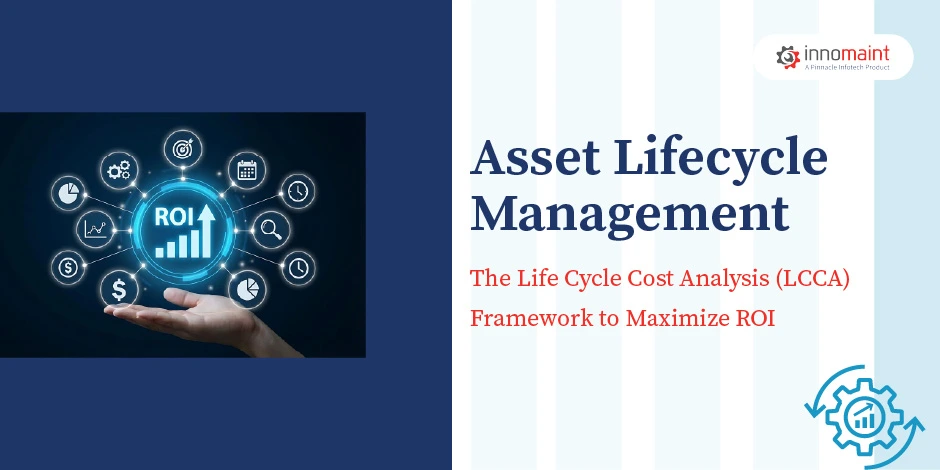
Asset Lifecycle Management (ALM): The Life Cycle Cost Analysis (LCCA) Framework to Maximize ROI
In 2026, the cost of an asset goes beyond its purchase price.
Organizations are seeing that a greater percentage of the total expense of an asset throughout its lifecycle comes after installation.
If you are an organizational owner and your operations depend heavily on continuous asset functioning, the upcoming years demand the adoption of Asset Lifecycle Management, integrated with Life Cycle Cost Analysis (LCCA).
If organizations want to maximize the ROI from assets, the focus should be on the complete lifecycle of an asset.
This indicates active monitoring, tracking the work order count for that particular asset, and using this data for analysis of the cost. The process also includes the cost of replaced parts or parts that were procured actively on demand.
Unplanned Downtime Leads to Inefficiencies
While the operational complexity of assets is increasing, the cost of unplanned failures is also taking a leap, leaving organizations unaware of the extra expenses.
An estimate from Siemens shows that unplanned downtime now costs large organizations nearly 11% of their annual revenue. On a global level, this manifests into 1.5 trillion US dollars yearly.
Global News Wire published another 2025 report from Fluke, which reveals 61% of manufacturers faced unplanned downtime, costing the sector a total of up to 852 million US dollars every week.
And these losses will escalate predictably, signifying that traditional reactive asset management is no more effective. There is a concerning gap in how assets are planned, operated, and evaluated across the lifecycle.
Life Cycle Cost Analysis becomes an essential component in 2026, and the seamless integration of a solid framework is even more critical to maximize ROI from assets.
Now, before we dive into the framework, let's start with the fundamentals.
What is Asset Lifecycle Management?
Think of it as the upgraded version of typical Asset Management practices.
The basics remain the same, where facility managers initiate the purchase of equipment, utilize, monitor, maintain, and replace an asset.
Now, in Asset Lifecycle Management, this data is used strategically to optimize an asset's useful lifecycle further, to maximize the ROI. Here, the cost of maintaining this asset is calculated over its lifecycle, integrated with planning and maintenance to maximize asset lifespan and ROI.
Now, there are five key stages in this process.
Stages of Asset Lifecycle Management
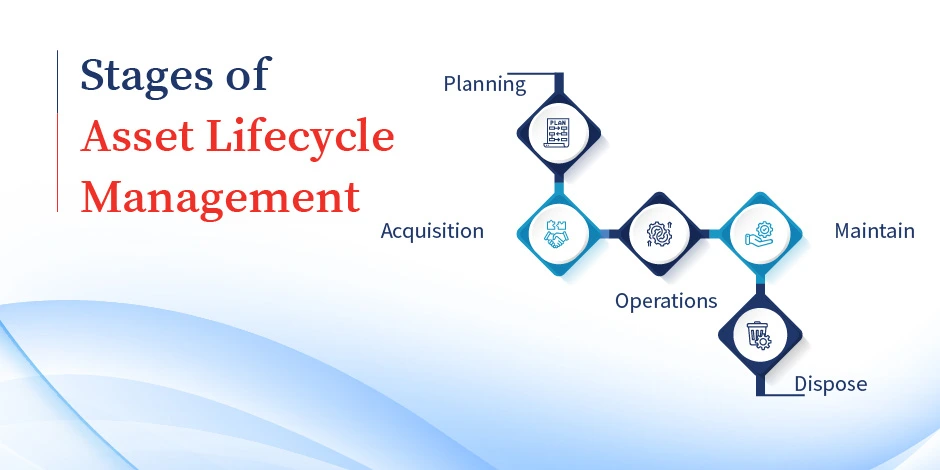
An asset goes through mainly five stages of the lifecycle management process for optimal asset health. This is also the same for IT assets, where operational efficiency is a must. Understanding the significance of each step is essential to making a difference in the current ROI. Let's delve into the steps of execution:
Planning
It all starts with buying the assets in the first place. If there is a significant financial investment required, the planning phase will take longer to explore and choose an option that will best fulfill the needs and avoid costly repairs.
The planning phase is where the organizations determine asset requirements, specifications, installation cost, and usage. This identification of asset information is necessary for asset procurement, in terms of capacity gaps, serves expectations, growth, and risk management plan is crucial.
Acquisition
This step not only involves purchasing the asset, but also planning for its installation. In most industrial setups, the process of getting an asset into operation requires great attention.
Across large organizations, skilled technicians facilitate this process of installation. If available in-house, fine, or else need to be hired. and this directly adds to the asset's lifecycle costs as well.
Hence, it also affects the initial budget that is planned for the new asset to get into operation.
Operations
Once the asset is installed and the organization is using it, it is time to assess its maintenance needs. This will help you come up with plans that will be best for the asset lifecycle.
For organizations that are already using CMMS (Computerized Maintenance Management System) and Digital twin solutions for maintenance, determining a strategy for the asset becomes easier. The maintenance system will give them detailed insights that are the basis of understanding the type of maintenance strategy that will work for that asset.
Preventive or predictive maintenance strategies are beneficial to enhance maintenance effectiveness, reduce unplanned downtime, and maximize ROI.
Maintain
When the maintenance plan is ready, you can start following it for maintenance practices. The plan ensures timely maintenance prompts are given on time.
It also keeps the routine maintenance tasks allotted to technicians, which ensures that all the assets of the organization are up and running efficiently. The work orders in the plan will be different for every equipment line-up.
Dispose
The last stage comes at a point when the equipment is no longer in a state of further maintenance. Here, the most financially sound decision becomes the eventual disposal of the machine; however, considering the above factors before that:
Can the asset be resold for a limited price?
Is it in a condition to be purchased by refurbishing companies?
Are there environmental concerns to be taken while disposing of the equipment?
Is there any additional cost for the removal of the equipment?
So, these were the fundamental stages that need to be executed to maximize ROI from a given asset.
Benefits of Asset Lifecycle Management
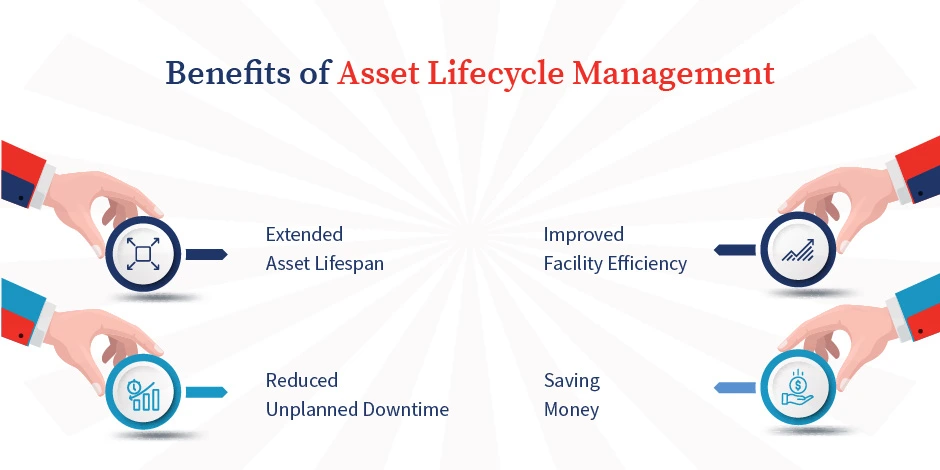
Asset lifecycle management software provides several key benefits, which may vary across industries. However, a solid, customized asset lifecycle management plan delivers the following advantages to organizations.
Extended asset lifespan
When organizations are aware of how the asset performs and under which circumstances it fails or slows down, that is valuable information. It is the source to develop a tailored plan for that equipment or a series of equipment that will maintain it throughout the entire lifecycle.
By understanding an asset’s behavior and asset tracking, organizations can elevate preventive and predictive maintenance schedules. When these practices smoothly roll across your asset lineup, the lifespan is substantially increased.
Reduced Unplanned Downtime
Traditional reactive maintenance always fixes after the disaster happens. That too, with delays, incomplete fixes, or low work quality.
Leveraging measures to prevent downtimes (preventive maintenance) helps you avoid unnecessary downtimes, which would cost thousands and even millions for some organizations.
To get hold of the unwanted downtimes, you need to plan maintenance before the need for reactive maintenance occurs. When there are fewer emergency scenarios to perform tasks, you can be assured that downtime is automatically less.
With modern CMMS solutions integrated with Digital Twins (DT), this planning can be done outside of operational hours. The data recorded in the CMMS, which includes detailed maintenance history and real-time monitoring data from sensors, helps in analyzing the assets' behavior and crafting a tailored plan for their optimal maintenance.
Improved facility efficiency
When assets are maintained better, they perform at their best condition. This enhances the quality of experience inside the facility across sectors, and achieve greater efficiency.
For example, this is very crucial for customer-facing facilities, where their experience matters the most. Under industrial setups, it enhances worker experience, allowing them to work at their full potential.
The analysis of an asset throughout its lifecycle significantly reduces unexpected failures and yields the best ROI possible. This brings us to the next point, which is what this blog is mostly about: maximizing the ROI of an asset through Asset Lifecycle Management.
Saving Money
What is misunderstood a lot in the industry is that efficient facility management is expensive. However, the cases are different when you choose the right service provider.
A greater amount of money is lost when organizations have been using a CMMS solution without knowing which part of it is going to work for them.
Efficient facility management software is only possible when you are using the features and the data flow is in synchronicity. This ensures that every maintenance taken is based on data-driven decisions and not assumptions, ensuring continuous improvement of operations.
With a reduction in unplanned downtime and preventive measures in action, a lot of unnecessary costs are eliminated, and the facility manager can maintain assets responsibly.
Further, asset lifespan increases, and there are fewer requirements for new procurement, which also reduce costs. The overall cost is substantially reduced with preventive maintenance for the IT infrastructure as well.
The perfect lifecycle cost analysis comes out when an asset is treated like an instrument. This means being aware that it needs to be monitored and maintained, to ensure assets are running smoothly.
Also, routine inspections before major operations remain at the heart of daily operational efficiency. The cost, time, and other factors associated with all of these tasks fall under Lifecycle Cost Analysis.
The University of California (UC) provided a Lifecycle Cost Analysis framework.
This is a mandatory framework to apply life cycle cost analysis of an asset for long-term economic efficiency and prompt incident management.
UC: Life Cycle Cost Analysis Process

The process includes a five-staged framework that covers the initiation and completion of a life cycle cost analysis. As defined by the UC, the process below can be used as the foundation to prepare unique frameworks tailored to individual projects.
Defining Project Goals
The first is always to define your goals and identify the requirements to achieve those.
Additionally, there should be a minimum performance requirement set for every asset. This should be done before defining the key parameters, such as ROI, Payback, and NPV.
Now, to assign specific responsibilities, the next task in this step is to identify project team roles, responsibilities, and the primary decision makers.
Once this is done, comes the task of defining the LCCA scope of work for your building systems.
Exploring Design Options
In this step, organizations need to explore various building system designs.
These also include system choices that will be the real-life, buildable alternatives for enhanced sustainability.
Some examples include:
- HVAC Option A vs HVAC Option B (high-efficiency heat pumps vs conventional systems)
- Enhanced envelope insulation vs code-minimum envelope
- On-site solar + storage vs grid-only power
- Different lighting styles
These design changes are the fundamentals of the sustainability transformation you have aimed for.
The next task in this step is to provide a qualitative assessment of the design options for technical feasibility, constructability, operational complexity, maintenance, and risk burdens.
The step concludes with selecting the top design options based on the qualitative review for smooth organization's operations.
Analyze Project Costs
In this step, BIM is needed for energy modeling of the selected designs to get into the asset lifecycle management process. If the project is renovative and is built through BIM, an as-built model will be there already.
Unless the creation of a digital twin is mandatory at this phase for analyzing the utility cost and emission projections, to achieve cost effectiveness.
BIM-driven, detailed energy models give insights into the annual energy consumption, utility costs, and carbon emissions for every individual shortlisted design.
Once the design is finalized in the above phase, the process moves to developing construction cost estimates. The initial capital cost is calculated, including equipment and materials, installation, and labor to increase productivity.
To stay ahead, several organizations also estimate operational, maintenance, repair, and replacement costs for long-term projects.
Quantify Lifecycle Cost
The UC LCCA process defines the fourth step as the evaluation and decision-validation stage.
The guidelines laid out by the UC help in the analysis, ensuring it is consistent across projects, comparable, compliant with UC policy, and that maintenance costs are justified.
The results of the analysis are shared and reviewed by various project stakeholders, such as owners, facility teams, designers, engineers, and key financial decision-makers.
Along with this, other operational and environmental considerations are considered by the asset management system. This will ensure that the new system is not operationally complex, staff can adapt, and reliability and carbon reduction goals are met.
Inform Design Decisions
Once the analysis is done, the process moves forward to these last concluding stages to manage assets.
Organizations need to prepare a concise report that clearly documents:
- The baseline and all evaluated design alternatives
- Key assumptions and analysis period
- Financial results, mentioning NPV, payback, ROI, and life-cycle cost
- Energy and utility costs, emission impacts
- Maintenance and risk costs
The final authorities/stakeholders assess this summary to make informed decisions on what performs the best and what compromises safety or costs. The useful life of an asset is determined with these decisions in this last stage, which is beneficial for enterprise asset management.
The final design decision is directed by the leadership's inputs, converting the LCCA analysis into an action-oriented framework to maximize ROI.
Asset Lifecycle Management & Cost Analysis with DT
Modern asset management software and cost analysis need Digital twin integration for the best outcomes.
It is the exact replica of a physical asset, or the whole structure, which gives real-time insights about various assets, the asset's status, and their performance. When there is effective asset management, the asset lifespan already increases.
Asset managers can have a bird's-eye view of the complete facility, along with all the assets to be monitored and maintained. And when it is integrated with current CMMS platforms (not the outdated software platforms), the complete process to optimize asset performance gets digital.
Organizations need not rely on paper-based work orders, manual task assignment, and report generation, and access proactive monitoring.
Final Thoughts
Asset life cycle management strategy is the first step towards maximizing the return on investment on a particular asset.
The data generated from the above process is used for the cost analysis and asset maintenance throughout its lifecycle. To increase the return, facility managers need to understand that an asset’s cost goes beyond its purchase.
Hence, the ROI can only be increased when the total cost is considered across an asset’s lifecycle.