

What Is Spare Parts Inventory Management and Why Ignoring It Costs You Millions
Businesses that rely on spare parts know that spare parts inventory management is of great benefit.
Any industrial or commercial setup would require an organized space where all the equipment spare parts are kept, and they are accessible at once when needed.
In modern times, there are numerous software applications in the market that automate the process of tracking and managing these spare parts.
Things like inputting, storing, and tracking the parts should be the primary focus of the software solutions. Additionally, these also offer dashboards to understand the usage of spare parts and determine the places where usage is due to poor management and where there is low stock, compared to the requirement.
Managing an inventory might look simple and can be done through paper and pen in a small business. However, if we take the example of a big industrial setup with multiple branches, managing spare parts inventory is a big deal.
Here, the business needs a solution where all the inventories are united, and a consolidated view is available. This will help the business track all at once, and never miss a stock refill or over-usage of the same.
So, what is spare parts inventory management, how does it work, the core principles, and some hacks to better manage without consuming many resources?
Before that, let’s briefly take a look at,
What is Spare Parts Inventory?
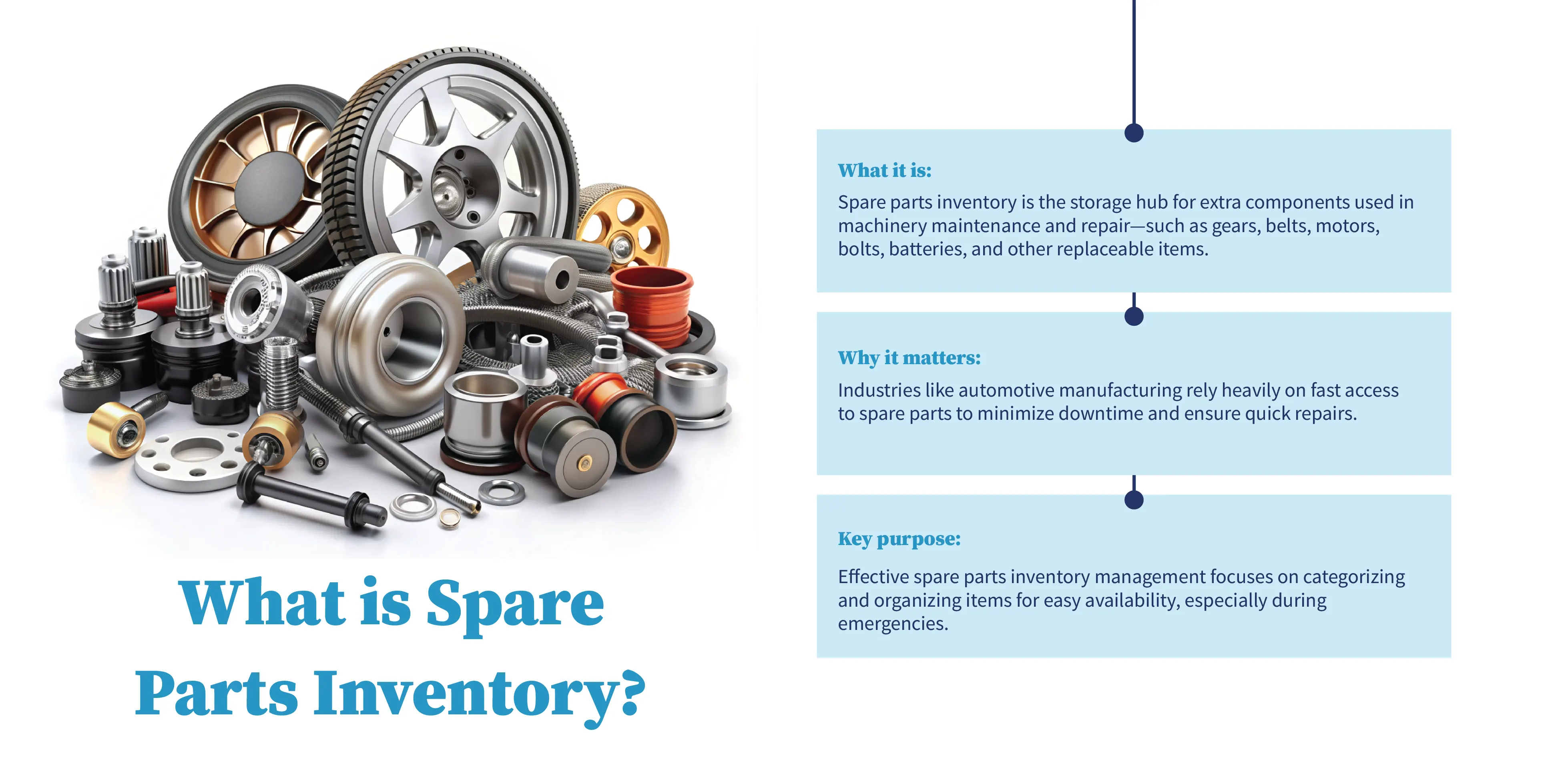
Spare parts inventory is the space where all the extra parts of various machinery are kept. Technicians use these parts during maintenance and repair; the items may include gears, bolts, belts, motors, and much more.
Automotive manufacturers have the most demand for the constant availability of spare parts and getting repairs done within a short time. Additionally, the spare parts inventory will also include other items, like robotic arm consumables, welding tips and nozzles, stamping die accessories, hydraulic and pneumatic seals, sensors used across assembly lines, conveyor rollers, and CNC tooling inserts that also require replacement after certain periods.
The categorization of these items, to keep them organized and available in cases of emergency, is what Spare Parts Inventory management aims for.
What is Spare Parts Inventory Management?

The management of the spare items, in a way that each part is categorized based on its type and priority.
Good quality management refers to parts being available on time, without causing any delays or disruption to the operations. There are basic to advanced levels of inventory management, and this depends on the solution you are using and your inventory scale.
For example, in several industrial setups, the repair or replacement of parts of certain machine parts requires immediate action. Any delay could harm the whole process, and hence, in such cases, effective management comes into play.
Items that require immediate availability should be kept handy and in front of other items. Inventory managers can do this by categorizing the items based on their priority.
There are more than one category to divide the items in an inventory, and ensure parts availability always.
Let’s look at the categories available to differentiate and manage spare parts effectively.
By criticality
Items that are not available will stop the entire operation. Such items should always be in stock, by meaningfully splitting them from the rest of the parts.
By Function
Parts associated with equipment should be categorized by their machines. For example, the mechanical parts of a particular machine should be kept aside from the electronic parts of other vehicles. Other instrumentation and control devices should also be kept separately from process-specific parts.
By Usage frequency
This is a critical step that will help businesses every hour of a busy production or operation day. Keeping the items that are required frequently at handy distances is always a good choice. While things are categorized based on their function and importance, their usage frequency matters a lot. Executing this point gives you the confidence to access spare parts within minutes of repair or replacement.
ABC Analysis
This is the classification method most inventory teams actually mean when they talk about “prioritizing” spare parts. Parts get sorted by consumption value, not just gut feel:
- A items: roughly 10-20% of your parts by count, but the largest share of your inventory spend. These get tight control, frequent counts, and dedicated reorder tracking.
- B items: moderate value and moderate usage. Reviewed periodically, not obsessively.
- C items: low-value, high-count items like fasteners and washers. Bulk-order these and don’t spend management time on them.
VED Analysis
Where ABC looks at cost, VED looks at operational risk. It stands for Vital, Essential, and Desirable:
- Vital: stockout stops production immediately. Zero tolerance for running out, regardless of cost.
- Essential: stockout causes a delay or workaround, but not a full stop.
- Desirable: convenient to have, but a stockout is manageable.
Most mature inventory programs run ABC and VED together — a part can be cheap (C) but still vital (V), and that combination is exactly what a criticality-only or cost-only system misses.
So, these are the most important categories that businesses must ensure to consider while segregating items.
Now, let’s see some ways to
Improve Spare Parts Inventory Management

Proper spare parts management is critical to seamless operations and consistent growth for the companies. Different companies have their own approach toward this; however, these best practices will suit companies across sectors.
Systematic identification of parts
Systematic identification of parts involves the following things to be covered. These are:
Creating barcodes for internal identification of parts and registering them in the system gives you more control over every movement of spare parts. Another hack to optimize stock levels is to maintain a proper Bill of Quantities and upload it to the asset maintenance management software for more detailed tracking.
Part identification also needs to account for supersession — when a manufacturer discontinues a part number and replaces it with a newer equivalent. Without a system that tracks supersession, technicians end up ordering obsolete part numbers, or worse, two different numbers for what’s actually the same part end up counted as separate stock lines.
Manage unused parts
There can be several instances where, during major overhauls or machinery failure, a lot of parts are needed. Now all of them might be used at that repair.
Here, what most businesses do is they keep the items in a cabinet or something for future use. However, no track remains of those items, which may result in buying of same items again.
Hence, such items should also be added to the inventory with proper records, ensuring that there is no loss in the procurement process.
Utilize and Manage Bills of Materials (BOM)
Just as BOQs, BOMs are equally important in managing spare parts efficiently. This is the ultimate source of truth for businesses to keep every spare part on track.
Procurements can happen as and when required, which will generate multiplier BOMs. Hence, the best way forward is to maintain a master BOM, where all the other bills will be added as they are generated. This is how you can track every part added to the inventory items with its quantity.
The current status of that stock will be visible in your inventory management system. Facility management systems like Innomaint offer advanced features to analyze and manage spare part inventory efficiently.
Maintain a Simple work order
Spare part usage can be made efficient with simple work order processes that can be followed across departments. Whenever a spare part is issued, the work order should be generated.
This will help keep track of inventory levels and maintain the right balance between overstocking and shortage, enabling minimum recorder alerts. The aim to keep this simple is because the work varies across departments, maintaining inventory accuracy.
There are departments where following a complex work order may be challenging for less timely availability. Employees may not follow the desired process, which would cause problems maintaining accurate inventories.
Set reorder points and safety stock
This is the actual math behind “never running out.” The reorder point is the stock level at which a new order gets triggered, calculated as:
Reorder Point = (Average daily usage × Lead time in days) + Safety stock
Safety stock is the buffer on top of that, sized to cover unexpected demand spikes or supplier delays. Get the lead time wrong, or skip safety stock entirely to save on carrying cost, and the reorder point stops protecting you — you’ll place the order on time and still run out before the replacement arrives.
Centralized Inventory
When all the spare parts groups are consolidated into one part, this helps manage inventory better and perform clear inventory audits. The satellite parts should also be clubbed with the centralized inventory, and businesses should provide the responsibility to a core team.
This team will only have access to the inventory control system and can view all the data. By limiting access to the inventory and setting up a core team for inventory management, companies can reduce human errors and miscommunications.
Utilize an inventory management system
Everything will be streamlined once a business starts using the inventory management system. All the data regarding the current and previous usage of inventories can be uploaded there.
Many advanced systems today use Machine Learning (ML) and Artificial Intelligence (AI) to conduct deep analyses and provide actionable insights to reduce inventory costs. Such systems make cost tracking, managing, check asset performance and maintenance far easier, and at the same time ensure that there are no errors, and also help optimize inventory levels.
So, these were the chosen best practices among many that you can use to enhance your spare parts inventory management and get rid of excess inventory.
Centralized vs. Decentralized Spare Parts Inventory: Which Is Better?
Neither model wins outright — the right answer depends on how spread out your operations are and how urgent your typical parts need is.
Centralized inventory keeps all spare parts in one location. You get lower total carrying cost, since you’re not duplicating stock across sites, plus simpler audits and one team accountable for accuracy. The trade-off: a site that needs a part urgently has to wait on transport from the central store, which is a real problem if that site is running critical, vital-classified equipment.
Decentralized inventory keeps stock at or near each site. Faster access when something breaks, no transport delay. The trade-off: you’re now carrying duplicate stock of the same parts across every location, which multiplies your total inventory spend and makes a single accurate audit much harder to pull off.
Most multi-site operations end up running a hybrid: centralize the B and C items (per the ABC classification above) where transport delay doesn’t hurt, and keep vital, high-criticality parts stocked locally at every site that runs the equipment they belong to.
Integrating Spare Parts Management with Asset Management Systems
Spare parts inventory and asset management work best as one connected system, not two separate spreadsheets that someone has to reconcile manually.
The integration point is the Bill of Materials: every asset profile should list its compatible parts, so when a work order is raised against a specific piece of equipment, the system already knows which parts fit it, checks whether they’re in stock, and reserves them automatically. Usage then gets logged back against that asset’s maintenance history, which is what makes failure-pattern analysis possible later — you can’t tell if a motor is failing early and often without usage data tied to the specific asset, not just a generic parts-consumed count.
In a CMMS or EAM platform, this usually means the asset registry and the parts inventory share the same underlying database, so a technician closing a work order and consuming a part is a single action, not two.
The Role of Technology in Spare Parts Management
A few specific technologies do most of the heavy lifting here, beyond the general “software helps” framing:
Barcode and RFID scanning removes manual counting errors at the point of issue — a part gets scanned out, the system decrements stock in real time, no end-of-shift reconciliation needed.
IoT-enabled bin sensors can weigh or measure stock levels directly and trigger a reorder alert without anyone doing a physical count, useful for high-turnover consumables like fasteners or seals.
Predictive analytics uses historical consumption and failure data to forecast demand ahead of time, rather than reordering reactively once stock hits a fixed threshold. This is where ML-based systems earn their keep: predicting that a part’s usage is about to spike because of an upcoming maintenance cycle, not just reacting after the shelf is empty.
Mobile access lets technicians check stock and request parts from the equipment they’re standing in front of, instead of walking to a terminal or calling the parts room.
Emerging Trends in Spare Parts Management
A few shifts worth watching, particularly for engineering and industrial teams planning ahead:
On-demand and 3D-printed parts. For certain low-complexity, non-structural components, some operations are now producing parts on demand via 3D printing rather than holding physical stock at all — particularly useful for older equipment where the original part is discontinued and supersession has run out of options.
AI-driven demand forecasting is moving from a “nice to have” to standard practice in larger operations, replacing fixed reorder points with dynamically adjusted ones based on real usage trends.
Circular and refurbished parts programs are growing as a cost and sustainability play — recovering and reconditioning parts from decommissioned equipment instead of buying new.
Supply chain diversification. After repeated global supply disruptions, more industrial teams are qualifying multiple suppliers per critical part rather than relying on a single source, specifically to protect the “Vital” items identified in a VED analysis.
Why You Should Not Ignore Spare Parts Management

Inefficient inventory tracking generates hidden costs that go well past the price of the missing part itself. When a critical part isn’t available during a major repair, businesses often pay a premium for expedited sourcing, and the disrupted production behind it stacks up its own costs: overtime labor, missed customer orders that erode trust, and downtime that compounds the longer it runs.
If this happens on a main drive motor in a production area, the entire operation stops. For a large industrial setup, that combination of expedited costs, lost output, and reputational damage can run into the millions, and it’s rarely visible as a single line item until someone adds it up after the fact.
Preventive maintenance and disciplined spare parts management work together to reduce this exposure. You won’t eliminate reactive maintenance entirely, but you can make it the exception instead of the norm.
Wrapping Up
Spare parts inventory management isn’t a back-office housekeeping task. It’s a direct lever on downtime, cost, and how fast your team can respond when something breaks. The organizations that treat it that way — with real classification (ABC and VED, not just a criticality guess), calculated reorder points instead of gut-feel restocking, and parts data connected to their asset records — are the ones who stop finding out about a stockout at the worst possible moment.
If you’re managing this manually or across disconnected spreadsheets, a CMMS or EAM platform is the more direct path to the outcomes described above, not a separate initiative on top of them.
Frequently Asked Questions
Spare parts inventory management is the process of organizing, tracking and controlling the supply of spare parts to ensure they are available when needed, while minimizing excess stock and reducing costs.
Effective spare parts management reduces unplanned downtime, improves operational efficiency, lowers carrying costs and ensures critical parts are available for maintenance tasks.
A CMMS helps automate tracking of spare parts, set reorder points, maintain bills of materials (BOM), streamline central inventory tracking and prevent stockouts or overstock situations.
Best practices include systematic identification of parts, managing unused parts, maintaining accurate BOMs, setting calculated reorder points, centralized inventory control, regular audits and using inventory software.
Inventory should be audited routinely based on usage frequency and business needs, commonly monthly or quarterly, to ensure records match physical stock and reduce discrepancies.
It depends on your site layout and part criticality. Centralizing lowers total carrying cost and simplifies audits; decentralizing gets urgent parts to each site faster. Most multi-site operations centralize lower-priority (B/C) parts while stocking vital, high-criticality parts locally at every site that needs them.
Through a shared Bill of Materials linking each asset to its compatible parts. When a work order is raised against an asset, the system checks and reserves stock automatically, and parts usage gets logged back to that asset’s maintenance history for later failure analysis.