

Understanding the Industrial Revolution: Impact and Importance Today
Over the years, the Industrial Revolution has occurred in phases across sectors.
With each phase of the digital revolution, the processes became more optimized, new methodologies emerged, and coordination between teams became smoother.
An industrial revolution encompasses a shift from the existing operational systems to more advanced processes. And this is an ongoing global transformation that involves digital and physical technologies.
Currently, the fourth phase of the industrial revolution, Industry 4.0, has already begun.
Firms willing to make an impact by staying ahead in this evolution should also understand the history of industrial revolutions. Technological innovations during the Industrial Revolution included James Watt's steam engine, the spinning jenny, and the water frame.
The First Industrial Revolution
The Industrial Revolution occurred approximately from 1760 to 1840.
As Britain experienced most of this revolution, it gave it a fair advantage. And to maximize this edge, they stopped the export of machinery, skilled workers, and other manufacturing techniques. Britain also had large deposits of coal and iron that provided the necessary energy and materials for industrial growth.
However, their monopoly did not last forever, as some Englishmen brought the Industrial Revolution to Belgium. These places saw the transition primarily through the mechanization of processes across sectors for industrial production.
The revolution was centered on iron, coal, and textiles. The industry saw heavy use of newly developed machinery in mining, agriculture, and energy sectors. The steam power engine came into existence during the first Industrial Revolution. The capital for industrialization in Britain was derived from wealth gained from trade and colonialism.
Once such advancements gained flow, almost a century later, the second industrial revolution started.
The Second Industrial Revolution
The second wave of evolution began in the 19th century, with technology at its center.
The industry experimented with many natural and synthetic resources. During this time, lighter metals, rare earths, new alloys, and plastic emerged. However, factory workers often faced long working hours, typically between 10 and 14 hours a day, in hazardous conditions.
New energy sources such as electricity, oil, and gas were largely used across industries. Electronic communication methods also originated in this era, such as the telegraph and telephone. Mass production made many items, including clothing and household goods, cheaper and more accessible.
The very outset of automation in the industrial sector also began with the inclusion of tech tools and computers. Additionally, basic versions of automobiles and airplanes emerged at the close of the nineteenth century.
This is why experts say that the Second Industrial Revolution is the most critical evolution phase in history.
The Third Industrial Revolution
The second industrial revolution continued till the first half of the 20th century.
In the second half of the century, the third industrial revolution began with the emergence of Nuclear energy.
New technologies such as electronics, telecommunications, and computers saw significant advances in their capabilities. Transportation improvements, such as railroads and steamships, created national and international markets.
And this opened doors to space missions and research, and development in biotechnology and diagnostics.
The era of industrial automation became even more prominent during this time, with the invention of Programmable Logic Controllers (PLCs) and Robots.
Industry 4.0
Many acclaimed industry researchers are still skeptical about Industry 4.0 being the Fourth Industrial Revolution. The transition to Industry 4.0 requires significant investment in new technologies and training for staff to effectively manage these changes.
A large portion of industry people say that, if it is, then the magnitude of this revolution is still unknown. We are currently experiencing this revolution, with the Internet being the starting point of Industry 4.0.
From the first phase of evolution, the industry has now evolved to technologies that can create virtual worlds, track and control industrial machinery with sensors, and much more.
Key Industry 4.0 Technologies
Previous industry evolutions centered around new machinery and processes. The current evolution focuses on bridging the gap between physical and digital worlds. Thus, Industry 4.0 enhances operational efficiency through improved resource allocation and reduced downtime.
When machines connect with digital interfaces, they can be operated intelligently. Every metric is trackable, along with machine status and more. Here are the nine core technology pillars that Industry 4.0 is built upon:
- Industrial Internet of Things
- Big Data and AI analytics
- Horizontal and Vertical Integration
- Cloud Computing
- Augmented Reality
- Additive manufacturing 3D printing
- Autonomous robots
- Simulation or digital twins
- Cybersecurity
So, we will discuss the Internet of Things (IoT) and the Industrial Internet of Things (IIoT). The integration of Industry 4.0 technologies can lead to significant improvements in productivity and quality control.
Connected Intelligence through IIoT
Industry 4.0 allows businesses to collect, analyze, and interpret vast amounts of data in real-time, providing actionable insights quickly. When individual technologies work together, they form a system that is self-sustaining and data-driven. At the center of this transformation lies the enabler: Industrial Internet of Things.
What is Industrial Internet of Things?
We know about IoT, which is the use of sensors to connect equipment and machines with digital interfaces. Through this, experts can control and manipulate various devices for the required output.
However, these are generally appropriate for consumer-focused applications. When IoT finds use in various industrial sectors, that is when it becomes IIoT.
MarketsandMarkets published its 2024 report, revealing that the global IoT market is set to reach an outstanding $286.3 billion by 2029, up from $194.4 billion.
When it comes to controlling advanced industrial setups, the sensors used are more powerful and accurate.
The systems employed also have the capability to analyze details and provide actionable insights faster.
IIoT for High-Risk Industrial Setups
The high-risk industrial setups, such as oil and gas, power plants, and heavy manufacturing ones, can mitigate operational failures using this.
With an advanced IIoT approach to control machines, resources, and output, they can prevent safety and financial compromises.
Setups that are operating with Industrial Internet of Things enable these benefits:
- Real-time sensors
- Predictive analysis
- Remote Monitoring
- Automated alerts and control
So, all these upper hands provide high-risk setups to transition from reactive to predictive risk prevention.
Well, we are all looking forward to the most important shift that Industry 4.0 brings.
With the help of IoT and IIoT, fundamental changes occur in how industries operate, monitor, and improve performance.
Key shifts include:
- Reactive to Predictive: Any equipment, device, or system can be designed to prevent failures. Fixing things later is an outdated way to address issues. Industry 4.0 addresses issues.
- Isolated systems turn into connected ecosystems: Machines and equipment no longer work in isolation. The IIoT framework serves as a universal intelligence that connects all the systems. While connected, the digital interface actively monitors them, ensuring sufficient outputs, along with efficient resource and power utilization.
- Manual monitoring to real-time visibility: Manual monitoring has always been the most unmanageable stress. Thanks to today’s advanced sensors that deliver accurate results even in absurd and intense conditions. This helps industrial facilities monitor equipment that is high-risk, without the need to go too close.
- Assumption-based decisions to data-driven insights: Static reports have a dynamic nature in the data, which can provide insights to professionals that can be acted upon. What the report says might not be there in the system currently, which causes a lack of action and accountability. Modern IIoT systems provide real-time data. Advanced AI and machine learning algorithms are now used by already intelligent systems to analyze and make decisions that drive measurable positive impact.
These transformations directly benefit the maintenance and facility management industry.
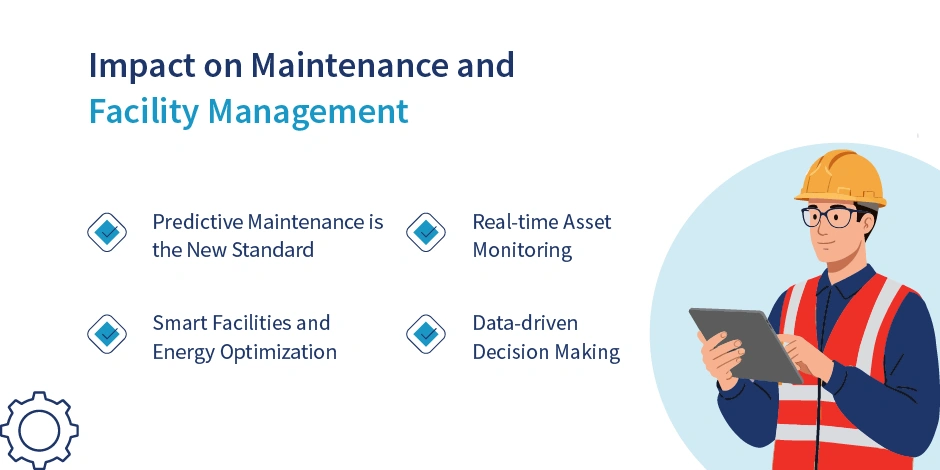
Impact on Maintenance and Facility Management
IIoT is having the most visible transformation in facility and maintenance management workflows. Industries globally are following advanced digital interfaces and real-time data from on-site sensors to carry on operations.
Predictive Maintenance is the New Standard
Predictive maintenance in Industry 4.0 uses IoT data to anticipate equipment failures before they occur.
Modern facility management requires real-time performance by measuring various parameters. These include temperature, vibration, and energy consumption; the data of which is fetched by advanced sensors. Predictive maintenance algorithms identify potential failures before they occur, allowing proactive processes that can reduce downtime by up to 50%.
These sensors are attached to the equipment that helps in:
- Detecting early signs of wear and failure
- Scheduling maintenance activities
- Reducing unplanned downtime
When facility managers are equipped with such capabilities, outcomes from daily operations become more certain.
Real-time Asset Monitoring
In industrial settings, real-time visibility is a game-changer for people who manage equipment/assets across the site. It has always been a challenge for them to keep track of assets, which are situated at long distances.
By gaining a live view of all assets, they can:
- Track HVAC performance, control electrical and mechanical systems
- Identify inefficient assets without manual inspections.
- Improve asset lifecycle and ROI drastically
IIoT integration provides much more advanced capabilities to achieve manufacturing efficiency apart from the above. We will get into those after going through smart facilities and energy optimization.
Smart Facilities and Energy Optimization
IIoT-enabled industrial systems automate buildings and also turn them into responsive facilities. This digital technology enables them to optimize their performance through data-driven decisions. Smart factories are equipped with advanced sensors, embedded software, and robotics that collect and analyze data.
When sensor data is fed into a centralized dashboard of a CMMS, the platform gives instant adjustments. Without manual intervention, facility managers can adjust occupancy, temperature, humidity, equipment usage, and daylight levels.
Some of the instant benefits are:
- Automated lighting and HVAC adjustments
- Reduced energy consumption and operational costs
- Improved sustainability metrics
These things optimize energy usage and save costs in modern industrial setups. Compared to the facilities that are manually managed, contemporary industrial operations are more advanced.
Data-driven Decision Making
The centralized dashboard that facility managers use constantly gets updated with live data. An in-built algorithm further analyzes this data to provide actionable insights for smooth operations.
With such analytical capabilities, facility managers can:
- Identify recurring risk patterns.
- Regularly optimize safety protocols for prompt response.
- Improve compliance and reporting
Since most industrial setups are high-risk, data-driven decisions provide invaluable value to risk management. Data analytics can help manufacturers investigate historical trends, identify patterns, and make better decisions.
IIoT enables real-time data collection, which enhances performance and safety in industrial setups. However, this can be taken to a more futuristic stage through the integration of Digital Twins.
IIoT with Digital Twins
Digital twins are virtual replicas of physical systems that help manufacturers optimize processes and improve productivity. This replica is not static, but a dynamic system that updates the displayed data every second.
Apart from live monitoring equipment performance and status, facility managers can:
- Simulate scenarios
- Predict outcomes
- Optimize operations before issues arise
Digital Twins matter highly in high-risk environments
While data from IIoT systems provides real-time visibility, digital twins allow controlled foresight and risk simulation. Notable benefits that industrial setups can get are:
Simulation of failure scenarios: A digital twin setup allows facility managers to simulate multiple scenarios without encountering the real-world consequences. Industrial setups face critical scenarios such as equipment failure, overload conditions, and system breakdowns. During high-risk operations, these scenarios can pose a life risk to staff. Digital twins let experts simulate these scenarios beforehand by identifying recurring patterns. This virtual simulation eliminates risks with a reactive approach, where issues are fixed after they occur.
Test maintenance strategies: Traditional maintenance approaches worked most of the time on assumptions. Historical data is used to create new maintenance strategies and perform complex tasks without any certainty. But with Digital Twins, once created, the plans can be validated against the latest operational data. This ensures that routine inspections and maintenance activities are not only planned but also effective at every stage for production processes.
Predict system behavior under stress conditions: Digital twins also help in analyzing asset behavior under varied conditions. Advanced simulation tools that connect with the replica let experts create virtual load conditions, environmental changes, and operational anomalies. Hence, they can predict asset behavior and are prepared to prevent them with enhanced certainty in each decision. Data analytics can help manufacturers investigate historical trends, identify patterns, and make better decisions.
Now, this sounds perfect for any organization willing to upgrade its operations. However, execution reality does not hit hard at the ground line.
Implementation Considerations
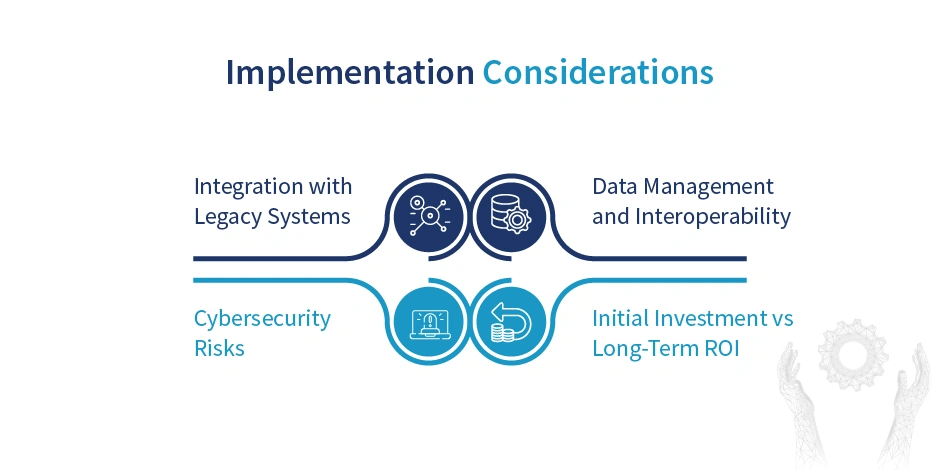
Here are some key things to consider while implementing IIoT and Digital Twins.
Integration with Legacy Systems
If you see, most industrial assets and their business processes are inherently not designed for IIoT integration. Even supply chain management can benefit from IIoT, but with process and system upgrades.
Their existing processes do not align with the specific requirements of IIoT and digital twin-based operations.
Hence, before planning the implementation, organizations must run a thorough audit. This will help understand their level of readiness for advanced technologies. Implementing Industry 4.0 solutions can be met with resistance from employees who may feel overwhelmed by new technologies.
So, before anything, any organization should develop a concrete plan for the modifications required in the existing systems.
The initial actions usually include:
- Mapping the existing and reconfiguring them
- Upgrades and replacements in hardware
- Strategizing operational disruption during integration
When organizations execute the process in phases, they can save on costs and time.
Data Management and Interoperability
Since we are talking about real-time data, IIoT systems generate huge operational data. These includes data for asset status, load capacity, failures, and detected anomalies.
If an organization already uses ERP (Enterprise Resource Planning) or BMS software, the data generated is in different formats. Hence, the existing systems often lack standardized protocols for sharing and utilizing this data for maximum efficiency.
Facility management systems like InnoMaint centralize and analyze data to eliminate interoperability issues, with minimal human intervention.
Cybersecurity Risks
Cybersecurity concerns are a significant challenge for businesses adopting Industry 4.0 technologies, as increased connectivity can expose them to cyber threats.
When organizations go digital from physical processes, data becomes vulnerable to phishing and stealth attacks. The sensors, controllers, and integrated platforms become a gateway for hackers.
Organizations need to regulate unauthorized access to critical infrastructure and control systems. Also, data breaches lead to operational disruption and loss of sensitive information, which can cost thousands of dollars.
Most legacy systems do not have the required security protocols to defend against these. Hence, upgrading security systems is also significant during IIoT integration.
IIoT and Digital twin systems demand:
- Proactive risk assessment across assets and sensor networks
- Define authorization to different networks
- Continuous monitoring and threat detection
Initial Investment vs Long-Term ROI
IIoT integration undoubtedly provides long-term value in terms of operational efficiency, predictive maintenance, and improving asset performance.
However, most organizations resist because of the initial high investment in smart machines. The upfront challenges they face include:
High investment in sensors, connectivity framework, and premium CMMS platform:
- Effort required to align legacy systems with the digital framework
- Training teams who will be responsible for managing the new systems
- Delayed ROI realization where value is unlocked with data maturity
Also, digital twin implementation requires the creation of as-built models and integration with CMMS platforms.
How InnoMaint Integrates Seamlessly with IIoT and Digital Twins
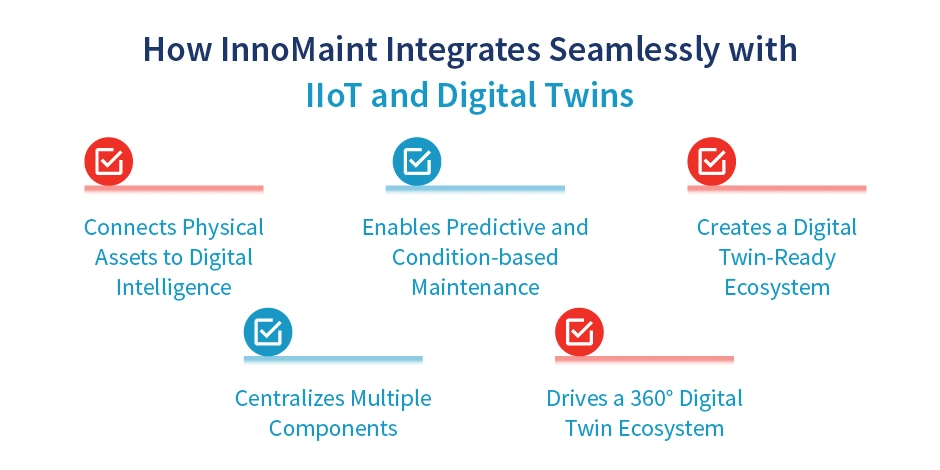
These systems generate a huge volume of data, but if it is not structured, the real value does not come. Organizing and sorting data provides greater viability, which leads to informed decisions and smart and autonomous systems.
Platforms like InnoMaint play a critical role here through:
Connects Physical Assets to Digital Intelligence
The ultimate goal is to connect physical assets with digital systems to drive advanced analytics.
Operational efficiency comes along with prompt maintenance activities for industries with mass production. Efficient operations come from proper planning and scheduling of tasks, considering other important factors.
Those are technician load, issue urgency, and available resources at the time.
Sensors mounted on assets capture real-time data, from which InnoMaint derives actionable insights with the help of artificial intelligence.
Enables Predictive and Condition-based Maintenance
Those actionable insights help organizations enable predictive actions.
Unlike traditional methods, where everything relied on schedules and reactive fixes, with InnoMaint, the process becomes intelligent.
When smart manufacturing organizations connect digital twins with this platform, they can set up work orders based on actual conditions. Real-time visibility at every factory floor allows them to do this more efficiently, leading to reduced unplanned downtime.
Organizations have always wanted this capability, but without these modern technologies, it was not possible. Thanks to these platforms, we are already in the future of smart factories.
Creates a Digital Twin-Ready Ecosystem
Since digital twins are replicas of the physical setup, they should always show the updated and latest data.
For this, InnoMaint supports continuous data synchronization between the physical and virtual environment. Facility managers can view detailed information about assets and work order status through dashboards and system-generated reports.
Through complete asset histories and performance data across production lines, they can frame strategies to prevent failures rather than reacting to them.
Centralizes Multiple Components
Industries can streamline every component of facility management, including assets, sensors, processes, and people.
In traditional approaches, these components operated in silos, preventing maintenance from being a system.
InnoMaint integrates these systems, enabling smooth data flow and automated coordination during production operations. With this smart technology, facility managers can transform insights gained from data analysis into timely actions.
Drives a 360° Digital Twin Ecosystem
InnoMaint helps connect with digital twins to offer a full-fledged ecosystem.
In that space, facility managers can have an intelligent view of the entire setup for manufacturing operations. From there, they can tap and view asset information, status, maintenance history, and perform data analytics.
Further, real-time data is more reliable compared to classic static data. From assumptions, InnoMaint transforms the complete process into a planned execution. Everything falls in place when you are sure about which assets need faster maintenance or frequent inspection.
The platform also provides mobile versions that offer field technicians instant access to work orders during critical industrial processes. They can perform tasks, ask for assistance, or update through their mobile interface. This brings accountability to the complete process, which saves cost and time.
Final Thoughts
Industry 4.0 is the latest phase of the industrial revolution, and we are currently experiencing the digital transformation. IIoT is one of the most notable technologies, which is set to transform operations and maintenance across industries. However, these systems need to be accompanied by technologies like Digital twins and InnoMaint CMMS to function as intended. Organizations across the world are still exploring these technologies, and only a few are able to achieve a full ecosystem. Industries able to run IIoT, digital twins, and CMMS platforms as one system will lead the Industry 4.0.