


How Can Operation and Maintenance Work Together with Modern CMMS?
Operations and maintenance (O&M) are the two critical aspects of modern facility management.
The synchronization between these two determines the cost-effectiveness of maintenance management. The day-to-day activities of assets need systematic care to be able to perform at optimal states.
Today's operation and maintenance deals with compliance with safety standards and coordination of maintenance activities. The traditional approaches no longer serve the maintenance requirements of currently complex facilities.
Reactive maintenance is incapable of fulfilling the needs of high-tech semiconductor facilities, and even high-stakes amenities.
Nevertheless, the primary goal is to reduce the overall maintenance costs, thereby increasing asset ROI and operational reliability.
What is Operations and Maintenance?
Every facility, whether it is residential, commercial, or industrial property, has its assets at the heart of its operation. Proper functioning in synchronization of these assets is what makes the daily operations cost-effective.
Now operations and maintenance also need to be in sync to ensure proper maintenance procedures of assets. Currently, these two processes are made to work together with the Digital Twin and CMMS (Computerized Maintenance Management) platform.
Importance and Goals of O&M
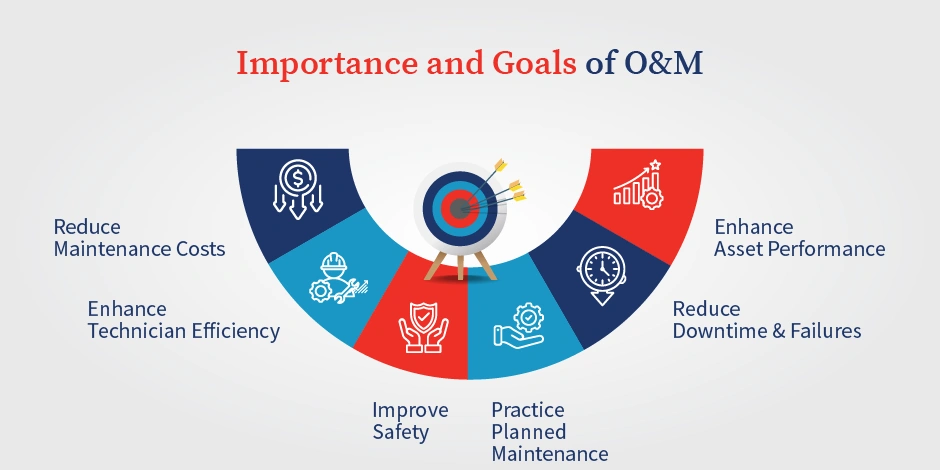
O&M today is done through a comprehensive approach, where physical assets, facilities, and equipment can be maintained effortlessly.
A set of activities is launched with a proper strategy for executing the following maintenance tasks:
- Routing cleaning
- Inspection
- Minor repairs
- Safety and Compliance
- Inventory and spare parts management
- Preventive maintenance tasks
The goal of this approach is to ensure optimized asset management, operational efficiency and productivity, reduce downtime, and extend asset life, along with safety and compliance.
Now, to ensure that facility managers execute these actions with accountability, an O&M manual is prepared.
Operations and Maintenance Manual
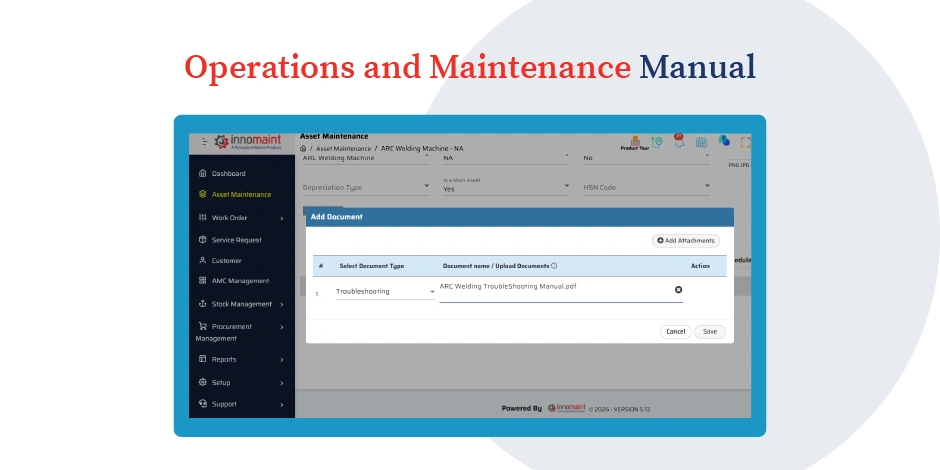
This manual is a comprehensive document with detailed instructions and guidelines for managing and maintaining assets and facilities.
It serves as the centralized source for operations and maintenance personnel to retrieve information on how that asset functions and instructions for repairing certain specialized equipment
Improving O&M with CMMS for Reduced Downtime & Costs
When a CMMS platform is integrated with Operations and Maintenance management, it benefits several aspects of modern facility management improvement. These are:
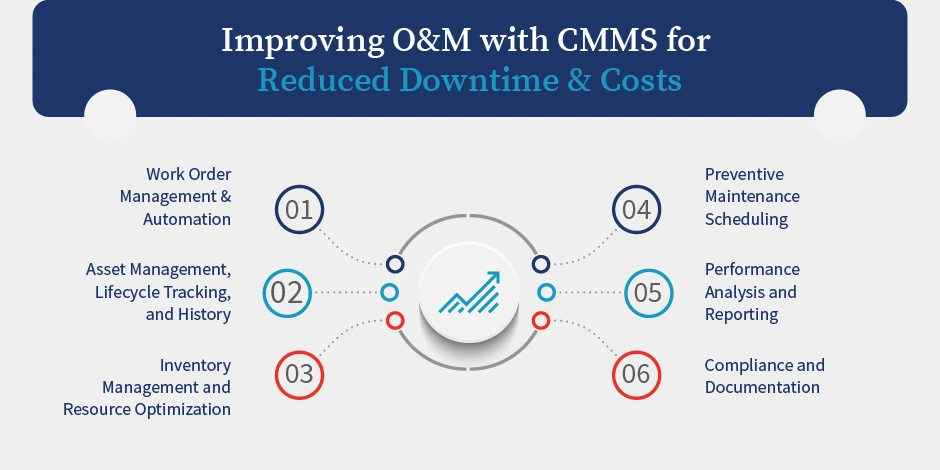
Work Order Management & Automation
With work order management integrated in modern CMMS platforms, managing operations and maintenance feels like a breeze. Compared to traditional, paper-based work orders, which are incomplete in information, current work order management systems log every detail of a work order.
Modern CMMS systems automatically generate work orders and notify technicians through the mobile application.
For example, if an industrial equipment reaches 500+ operating hours, the system will generate a work order for inspection or preventative maintenance operations.
This kind of automated execution drastically reduces the downtime, which arises during problem identification and resolution in reactive maintenance.
Asset Management, Lifecycle Tracking, and History
CMMS solutions integrated with Digital Twin enable asset management through lifecycle tracking and maintenance history.
When facilities manage assets considering these two critical data sets, it becomes more effective and cost-efficient.
Facility managers get detailed maintenance, replacement, and repair data about an asset throughout its lifecycle to date. It is like a detailed medical record that provides detailed information about maintenance action, repair, modification, and inspection logs with timestamps, technical information, and notes from technicians. And the best thing is that only authorized persons can access this data.
The maintenance history data provides managers with a comprehensive understanding of individual asset behavior. This data helps them form preventive maintenance strategies for extending an asset's lifecycle and making maintenance cost-effective.
Inventory Management and Resource Optimization
CMMS systems enhance operations and maintenance (O&M) through inventory management and resource optimization.
Whenever a machine requires a part replacement, the system takes the inventory data into consideration. There is a separate log for this task, where every detail, such as parts used, parts out of stock, etc.
This helps them keep track of spare inventory, avoiding the unavailability of components and materials in emergency situations.
CMMS solutions also provide detailed dashboard-level insights on available technician resources and the workload on each of them. Facility managers can use these insights to utilize the available resources efficiently, assigning tasks based on the current workload.
Preventive Maintenance Scheduling
Traditional reactive maintenance strategies now fall short in maintaining complex facilities. It causes delays in response, which further affects the downstream operations processes.
Also, despite the technician's location on-site, tasks are assigned without considering the workload in the traditional maintenance program.
However, current CMMS systems help in scheduling maintenance tasks considering multiple parameters. These include: calendar time, asset runtime, production cycles, and other behavioral conditions.
Here, a structured approach takes place, which helps organizations practice efficient maintenance tasks.
Performance Analysis and Reporting
Operations and Maintenance (O&M) goes to the next level with powerful analytical capabilities. Current CMMS systems convert the maintenance data into actionable insights.
It changes the complete scenario, where decisions are made through assumptions turn into data-driven choices. Facility managers can use the comprehensive data from CMMS to optimize maintenance strategies, identify trends, and allocate resources efficiently.
This is very crucial as labor hours are always different for every individual equipment. The analysis of the utilized hours is critical for allocating resources efficiently.
However, this analysis, through paper-based and fragmented data, is impossible to execute. For this, maintenance managers need properly logged data, which is structured as per key performance indicators.
Compliance and Documentation
Compliance records are immensely critical in modern complex facility management. Most of the industries such as manufacturing facility and semiconductor ones, are regulated and require documented maintenance activities, store certificates, and track calibration requirements.
The CMMS systems generate comprehensive compliance reports, which are a valuable dataset for audits and inspections. Several organizations fail to provide a detailed report, which results in fines and, in extreme cases, the shutdown of facilities.
For instance, in the healthcare sector, this data is necessary to demonstrate quality maintenance of critical medical equipment, quality control, and ensure compliance.
So, these were the ways that O&M can be enhanced and made efficient for modern complex facilities.
However, a lot of organizations still consider several aspects of Operations and Maintenance wrong. Here are some of the common misconceptions about O&M.
Common Misconceptions about O&M
Out of the several reasons, these are the ones that make most O&M strategies fail.
- Operations and maintenance are independent departments and are better when managed independently. The reality is that these are inevitably connected in modern facilities. The type of maintenance needed always emerges from the kind of maintenance operations services.
- The second misconception is that these two are reactive practices. However, if issues are not prevented, downtime will not decrease, and the operation will not be efficient. Hence, today's CMMS systems provide you with tools to analyze maintenance data that can be further utilized to create preventive maintenance strategies.
- Maintenance costs are overhead after purchasing the asset in a business. However, the current standard is to determine the cost of an asset throughout its lifecycle. The practices of maintaining and operating assets can be optimized, monitored, and planned for cost efficiency.
Final Thoughts
While Operations & Maintenance are inevitably linked, a CMMS system is required for running both in synchronicity. And, while the industry might think these are overhead costs, the comprehensive data from facility management systems such as InnoMaint will help them strategize the entire process.