Pinnacle Infotech Solution acquires Innomaint, ushering in a new phase in Digital Twin & Facility Management

Explore the Acquisition
Revolutionize Field Service with Cutting-Edge Technology for Customer Focus

Revolutionize Field Service with Cutting-Edge Technology for Customer Focus

workorder management software

The Customer at the Center: How Technology is Revolutionizing Field Service Operations

In today’s fast-paced international, consumer expectations are higher than ever, and companies are turning to the era to revolutionize subject carrier transport. By putting the customer in the middle, businesses are leveraging advanced tools and structures to beautify efficiency, enhance conversation, and offer a seamless career experience. This shift isn’t always best reworking how discipline services are added, however, additionally setting new benchmarks for client pride.

Embracing Mobility for Real-Time Solutions

Field provider shipping is not restricted to clipboards and paper logs. The creation of cellular technology has empowered technicians with real-time access to crucial information, enabling them to diagnose and solve troubles instantly. Mobile packages provide a unified platform for accessing service histories, manuals, and client profiles, ensuring that technicians are well-organized before they even step foot on-site.

The Power of Predictive Maintenance

Predictive protection, powered by means of the Internet of Things (IoT) and system gaining knowledge of, is a recreation-changer inside the discipline carrier industry. By studying facts from linked devices, agencies can predict device disasters earlier than they manifest. This proactive approach reduces downtime and minimizes disruptions, leading to higher consumer pleasure and value financial savings.

Enhanced Communication and Transparency

Effective verbal exchange is the spine of advanced discipline carrier shipping. Modern communique gear, such as computerized messaging structures and customer portals, preserve customers knowledgeable approximately the popularity in their service requests. This transparency builds consider and continues clients inside the loop, putting off the frustration of uncertainty.

Optimizing Workforce Management

Technological improvements in personnel management software programs permit for smarter scheduling and dispatching of field provider technicians. These structures bear in mind different factors inclusive of technician abilities, area, and task urgency to assign the right person to the proper venture. This optimization now not most effective increases efficiency however additionally guarantees that purchaser troubles are addressed directly and efficaciously.

Data-Driven Insights for Continuous Improvement

The integration of facts analytics in area carrier shipping offers treasured insights into performance metrics and consumer conduct. By analyzing provider traits and feedback, businesses can perceive areas for development and put in force strategies to beautify service quality. This information-pushed approach fosters continuous development and aligns carrier delivery with client wishes.

Integrating QR Codes for Seamless Information Access

Another innovative tool for improving provider transport is the use of QR codes. Technicians can hyperlink a URL to a QR code, which clients can scan to access specific service reviews, manuals, or remarks forms immediately. This approach not only saves time but also ensures that clients have clean access to important statistics, further improving provider enjoyment.

The Future: Augmented Reality and AI

Looking ahead, technologies like augmented reality (AR) and artificial intelligence (AI) are poised to revolutionize field service operations. AR can offer technicians with real-time visual steering, while AI-pushed chatbots can help with troubleshooting and patron inquiries. These innovations promise to elevate the field service experience to new heights.

Conclusion

The revolution in subject carrier transport pushed by way of generation is essentially reshaping the patron revel in. By embracing mobile solutions, predictive preservation, enhanced verbal exchange, optimized body of workers management, and records-driven insights, organizations are placing the customer at the center of their operations. As we look to destiny, rising technology like AR and AI will keep pushing the limits of what’s viable, ensuring that field service operations stays efficient, powerful, and consumer-centric.

By leveraging those technological advancements, groups can not only meet but exceed patron expectations, ensuring long-term loyalty and achievement in a competitive marketplace.

Looking for a Solution to Upkeep your Field Service Operations?

The Future of Field Service Management: Enhancing Customer Relationships & Embracing Innovation

The Future of Field Service Management: Enhancing Customer Relationships & Embracing Innovation

workorder management software

The Future of Field Service Management: Enhancing Customer Relationships & Embracing Innovation

Today, the concept of field service management is actively changing, and such organizations are becoming much more important revenue producers.

This is not simply the new ‘flavor of the month’; rather, it is fast becoming a necessity as organizations identify the opportunity to significantly leverage service and dispatch scheduling operations into direct contributors to their bottom line.

workorder management software

Here are some of the ideas that we expanded on in this blog; let’s begin…

Service Can Extend and Enhance the Current Relationship with The Customers

There is the growing appreciation of investing in a FSM software as a way of building customer intimacy.

Every day managers and executives of organizations are waking up to the fact that field service is not only a problem-solving model, but it has potential to be a rich source of customer satisfaction and growth.

Building on this, companies willing to proactively invest in product servitization can use a field service management solution to build a ‘win-win’ opportunity furthering the client relationship.

Manufactures who incorporate services into their products have a chance of developing better customer relations and customer satisfaction.

Service Is Therefor a Growth Factor

The conversation also included the fact of huge possibilities of investing in digital tools in order to enhance the effectiveness of services and their implementation, such as advancements in AI.

Technologies of today allow technicians to rise to the occasion, to improved productivity and ultimate perfection.

A good example is the advancement in the application of artificial intelligence in field services, which point to actual gains in servicing efficiency and in general performance.

It is believed that this trend will persist in the future, which would mean that the field would combine advanced technology with man’s knowledge and skills.

The work has suggested that there is one area that requires particular attention in the case of AI and other similar innovations: this is how these tools are introduced into the process and communicated to the field technicians.

Field Service Management Software Has to Be Built into Digitalization

workorder management software

When assessing the concept of digital change, the disintegration of functional silos and development of a seamless customer journey has become a promising model to generate ever greater customer value.

One such example of a benefit that can be captured is to provide more self-service by field technicians and end users.

However, this is only possible when multiple systems and integrated data source feed across more than one department.

One of the key parts of this strategy is the transfer of field service data across the scope of the organization.

The elimination of these silos makes it easier to approach service delivery because there is lot of integration that is done.

And it is this ethos of collaboration that introduces a Service Lifecycle Management approach and links service to engineering.

Such a logical progression conforms to an organization’s digital thread strategy which is fast emerging as an innovative way of synchronizing service operations with the general organizational vision.

Embracing Change Management

The interview also made a point out of stressing not only the acceptance of change but its effective administration.

The word of warning emphasized on the fact that when embarking on the adoption of new technologies or other organizational transformations, profound change management strategies must be put in place.

As it has been evidenced by various studies, the institutional framework for implementing Change Management can help the organization to observe better results from new activities.

Communication is a vital aspect of the change process and therefore setting expectations and managing change is a critical success factor in the achievement of the full potential of FSM strategies.

Looking towards 2024 the big picture of Field Service Management is set to deepen its penetration and experience enhanced innovations.

The changes that have occurred in the way FSM organizations operate and their focus on generating revenue, the centrality of the customer relationship and the emergence of digital technology all suggest that the current environment requires flexibility and innovation.

To overcome issues of silo mentality, to adopt technologies, and to manage change successfully, organizations can pave the way to the FSM revolution and continue to be successful into the future.

Author’s Bio:

Justin William, a dedicated Garden city injury lawyer, has over 15 years of experience advocating for accident victims. In his free time, Justin enjoys gardening and hiking, which reflect his commitment to balance and well-being both personally and professionally.

Want to Transform Your Field Service Operations for Greater Success?

Top 7 Reasons to Upgrade Your Facility Management Software

Top 7 Reasons to Upgrade Your Facility Management Software

Top 7 Reasons to Upgrade Your Facility Management Software

Essential Facts Concerning Upgrade of Facility Maintenance Management Software

Just improving your FMMS facility management software can be a game changer when it comes to having efficient operations.

Here are 7 key reasons why it’s worth considering an upgrade:

1) Automation Can Increase Efficiency

For the smooth flow of the system, the automation of such activities increases efficiency. Advanced FMMS can perform simple activities which include creating work orders, scheduling of maintenance plans and coming up with an asset tracking system.

This is less time consuming for your team and eliminates a lot of work that would otherwise be done manually. When your equipment is on automatic maintenance, equipment is serviced as scheduled, and with automated tracking, there are less rates of delays or mistakes as compared to manual systems.

2) Greater Clarity of Data and Reporting

Modern FMMS systems make it possible for you to monitor your data in real-time, and even understand dashboards. In other words, you can monitor key performance indicators (KPIs) and identify problems, or potential developments, more easily. Whether the resource being managed is equipment, the budget or the productivity of the technician, the information you get empowers you to make the right decisions and optimize your resources.

3) Efficiently Managing the Assets and Equipment Resources

Sophisticated FMMS has functions like predictive maintenance finally IoT capability that enables equipment monitoring in real time fashion. It allows you to overcome some issues in advance, avoid a large number of failures, and, therefore, save on repairs. It also means your equipment does not degenerate quickly because it is properly taken care of before it develops faults.

4) Scalability And Flexibility

A modern FMMS could develop in parallel to your organization. Regardless of the number of buildings you are running, upscaling most software give an option for handling higher numbers of assets, tasks or users. It also means that you will not need another system as you grow in business, because your FMMS is expandable.

5) Mobility For Field Workers

With improved FMMS versions, technicians can view work orders, modify job statuses and with the office through their mobile devices. This entails that there is improved remote-working efficiency since workers can tackle problems on the move, and in shorter time, without having to go back to the office for progress reports.

6) Good Practice in Compliance and Documentation

Modern FMMS therefore facilitates compliance monitoring and keeping up to date with safety and compliance regulations. It’s easy as it helps to automate the inspection, monitor safety compliance, and keep all your documents electronically.

This assists you to comply to regulatory expectations and anytime you are conducting your audit these are less likely to have fines or safety issues.

7) IoT and application software Integration Can Complement Other Business Tools

Newer versions of FMMS can interface with other systems, such as the Service Request Management App, Supplier Management System, or other Proprietorship Management Software.

This makes all this work in unison, be it for tracking your finances, handling your utilities, or even for the interchanging of information between sectors. These enhance the data flow and support your whole team in their work.

IoT-enabled FMMS platforms promote seamless communication between connected devices, business stakeholders, and the environment, creating a unified ecosystem. It helps widen the boundaries of facility management and provides better control over utility and resource consumption.

Over To You

Updating your Facility Maintenance Management Software (FMMS) is a strategic decision that brings about changes for the better in your maintenance functions. Deciding which software has these valuable features, such as automation, portability, predictive maintenance, and compatibility will make your facility strong in the long run. Whether you need improved asset management, increased use of data, or a solution that can be scaled up this can be improved through upgrading the FMMS.

It’s not just being able to keep up to par; it’s about setting the pace in the ever-changing world of facility management. Therefore, as you are weighing down the 7 compelling reasons for undertaking this change, do not just focus on the benefits of a new release of CMMS software but the long-term productivity of the business.

Author’s Bio:

John Adams is a technology enthusiast, self-care blogger, and paralegal at a Personal Injury law firm. He writes about educational updates, astrology, social and legal challenges with the goal of assisting readers in finding intelligent solutions to problems rather than difficult ones. He also enjoys giving his personal thoughts on technological advancements and life hacks.

Want to Upgrade Your Facility Management Software Today?

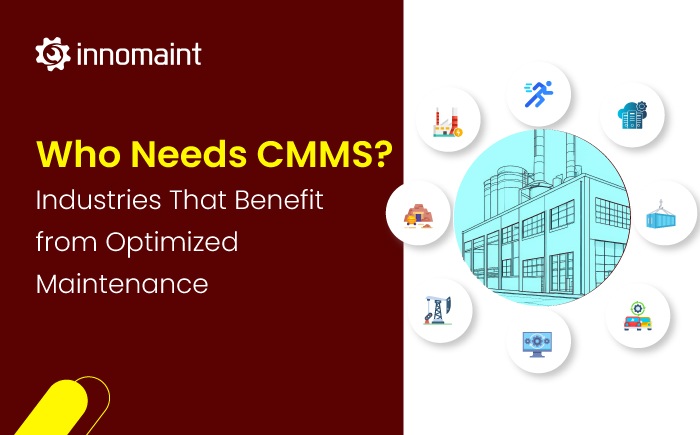
Who Needs CMMS? Industries That Benefit from Optimized Maintenance

Who Needs CMMS? Industries That Benefit from Optimized Maintenance

Who Needs CMMS? Industries That Benefit from Optimized Maintenance

Businesses that want to optimize both maintenance and facility efficiency must utilize Computerized maintenance management systems (CMMS) as their essential operational tool. A Computerized maintenance management system delivers multiple advantages that enable companies of different sizes to improve their operational efficiency and minimize downtime.

Who Needs CMMS

The software designed to perform maintenance management benefits multiple industries including manufacturing and production sector and the transportation and logistics industry as well as banks alongside construction and hospitality establishments along with retail businesses. Organizations can reach their best possible productivity outcomes through maintenance management using this tailored central platform.

List of Industries That Benefit Most from Optimized Maintenance   

The following list includes several primary industries which gain advantages through maintenance solutions:

Manufacturing Industry

A manufacturing CMMS system becomes essential in the manufacturing industry because equipment failures and downtime can lead to catastrophic consequences. The expense of equipment failure stands too high for manufacturing businesses to handle repeatedly. Manufacturer delays together with downtimes cause production interruptions and order completion deadlines get missed.

Manufacturing industries benefit from preventive maintenance software through the deployment of multiple maintenance protocols as well as spares stocking for component inventory and completion of scheduling and work orders and planning functions. Manufacturers achieve both operational control and industry standards compliance through application of CMMS for manufacturing operations.

Field Service

Organizations offering field service of their own or branded products, including HVAC, elevator, electrical appliance, and other repair services, derive significant benefits from CMMS solutions. Technicians working on-site gain real-time access to work orders, inventory stock, service histories, etc., to discharge duties to their best.

A CMMS provides digital checklists easily accessible via mobile which is important for systematic execution of tasks without skipping any steps and in proper logical sequence. It helps customers and managers track the routes taken by technicians to help them in route optimization. It promotes the culture of managing work orders electronically, reducing paperwork and making audits easier.

It provides forums for technicians to be in tune with latest trends and share knowledge among the peers. It simplifies reporting making it error-free using automation. With preventive maintenance alerts and low stock reorder alerts companies can speed up fixes and improve first-time fix rates, leading to excellent service outcomes and increased customer satisfaction.

Facility Management

Facility management is gaining traction these days as an essential business function that goes much beyond maintaining the physical fabric of the building.

A CMMS helps facility managers oversee all types of maintenance tasks across locations from the convenience of mobile app. By scheduling and assigning preventive maintenance work orders, while on the move, facility managers can ensure the continuous functionality and upkeep of facility assets and systems.

Modern CMMS systems provide features for managing AMC, tracking payments, and outsourcing selective tasks. It helps enforce compliance with legal and organizational norms while reducing liability risks.

Additionally, CMMS platforms provide customizable Dashboards offering a wide variety of KPIs and metrics on the volume and quality of work, maintenance costs, labor productivity, asset performance, etc., enabling facility managers to make data-driven decisions that optimize operational efficiency and reduce costs.

Oil and Gas Industry

Complex operational facilities in the oil and gas industry depend on several heavy-duty machines including pumps and refrigeration appliances as well as turbines and transformers along with generators. The business needs executable equipment maintenance practices which allow uninterrupted flow and reduce operational costs.

The maintenance solution for the oil and gas sector minimizes operational costs while meeting safety standards and helps service operations eliminate large parts of unpremeditated equipment maintenance and handle emergencies promptly.

Mining Industry

Advanced specialized equipment forms a fundamental requirement for mining industry organizations since it does in the oil and gas sector. The machines remain in peak condition due to proper maintenance methods which improve their performance while extending both their dependability and lifetime.

Unanticipated machine breakdowns result in major issues such as equipment blockages together with operational delays and staff safety incidents that lead to monetary losses exceeding millions of dollars. The equipment dependability together with safety and operational efficiency receives maintenance through dedicated software solutions operated by mine operators.

Power Generation

Industry Power plants exist under strict control through multiple efficiency and production and security standards defined by government regulations. All power plant management and maintenance protocols exist as essential non-flexible requirements to account for the dangerous nature of operations.

A complete maintenance process stands essential at all power plants and such procedures can get managed by maintenance platforms. Through the solution organizations keep track of regulatory requirements while handling their staff requirements and protecting both employees and the public alongside machine operational standards.

Shipping Industry

The majority of worldwide products go through ports because container ships function for port operations. Malfunctions or breakdowns of equipment produce damage to shipping containers that generates substantial financial losses for all involved parties.

The management solution for transporting ports and terminals allows maintenance of equipment including forklifts reach stackers mobile cranes and many more. The reliability of assets increases because high-quality equipment gets maintained and cargo damage decreases and container mistreatment disappears.

Fleet Management Industry

Fleet operation between safety standards and maintenance costs requires vigilant effort to maintain. Fleet managers should focus on protecting employees and equipment but also minimize shutdown expenses for their organization. The system enables complete component inventory control and tracks expenses for vehicles and shops as well as authorization of warranty requirements and their management.

Communication & Data Centers

Data and communication centers require their uptime to be the strongest priority. The normal operation and customer contentment deteriorate following equipment breakdowns. All mission-critical assets need proper maintenance to reach their peak operational levels and minimize disruptions such as servers and communication lines and backup generators among them. The right CMMS software creates this result.

Sports Industry

Seating condition along with playing field quality serves as the main surface-level subject when people discuss stadiums and sports arenas. Keeping in mind that stadium maintenance extends beyond the two surface-level items remains essential. Through this practice managers gain better capability to schedule and evaluate maintenance activities covering sports facility lighting and scoreboards alongside bars and sound systems and restroom equipment.

IT Industry

Activities within the IT sector are built from machinery as well as computers and electronic equipment. Such long-term assets need perfect function to achieve their desired operational outcome. An interruption will create workflow disruption and productivity loss when maintenance fails to happen regularly. The solution provides the following advantages to IT departments: These experts & professionals can keep track of asset and machine condition. IT teams should establish maintenance schedules and open work orders for operational procedures. Rapid identification and swift response to immediate problems enables faster resolution for the needs of the situation. application of data enables people to arrive at well-informed choices.

Conclusion

Evidence shows that most business sectors gain significant advantages when examining the extensive adoption of all-inclusive maintenance management software across various industries. The software system helps maintain a smooth maintenance process while preventing equipment failure and breakdown occurrences. It enhances the organization’s workflow. The organization should focus on better daily operations combined with reductions. A critical report system found in this software proves essential for making key company decisions. The system serves two main applications which are asset management and inventory management. Cloud-based technology save the server by maintaining all data stored on their securely. The system possesses global availability and users can reach it from all locations worldwide. The system enables the business to reach new heights of production efficiency. Your business could rise to an entirely new position in the market with its help.

The Future of Facilities: How Tech is Transforming Building Operations

The Future of Facilities: How Tech is Transforming Building Operations

workorder management software

The Future of Facilities: How Technology Is Transforming Building Operations

workorder management software

The field of facility future management, the practice has undergone far-reaching transformation, driven in large part by the innovation and application of these disruptive technologies. There is nothing more than just altering the view of FM. The landscape of the FM is redefined via digital transformation to help facilities accomplished desired environmental status, performance and optimization.

Here’s How Technology is Transforming Facility Operations:

  • Internet Of Things (IoT) Integration – Such smart network is built over data collection from the sensors and various smart devices that provide real-time picture of the facility environment, utility consumption, and facility operations. Facilities management can now track and control everything they need such as energy, water or gas, perform better preventive maintenance and resource allocation online. The connectivity presents us the feature of smart facilities which can sense the air quality and provide recommendations to improve the air quality.
  • Data Analytics to Capture the Data – Although being flooded with data collecting devices has made data analysis one of the best knowledge sources that improves a company’s performance significantly. By using predictive analytics, facilities managers can avoid system malfunction or strongly optimize the energy consumption and the result will be saving the expenses and successfully reducing the footprint environmental.

workorder management software

  • Business process and workflow automation: Businesses can automate repetitive tasks effortlessly for error free operations with solutions for their specific requirements. Workflow automation is a low-code solution that shortens the development cycle, saves time, and helps achieve quick results. It helps teams to focus on core innovations.
  • Cloud Computing Cloud-Based Building Operations – is based upon while they are the main area for which the tasks are conducted. This advance provides a way for team cooperation, information exchange, and mobile control, giving managers a chance to respond to any issue and handle the operations even though they are far away.
  • AI And Machine Learning Algorithms-  now have many engines to do the same, learning models that find patterns and make decisions are better than ever. In building operations, all these technologies can enhance the efficiency of building control systems, optimize maintenance schedules with predictive management, and even enhance the security systems by the means of facial recognition. 

An AI enabled visitor management system can detect face masks worn by visitors entering the facility and alert on entries without due authorization or overstays. An AI powered occupancy management software can alert facility managers upon overcrowding in any section of the facility.

 According to a Gartner article, 70% of manufacturing data recorded by software applications remains unused or underutilized. A CMMS can bridge the gap with Artificial Intelligence (AI) technologies and Machine Learning (ML) algorithms. Such a CMMS can help recognize the vehicle number plates and self-improve the performance.

The AI algorithms can analyze real-time data to recognize patterns, anticipate failures, and prescribe optimal maintenance strategies.

  • Green Technology and Sustainability – The advancement of green technology is the paving the way for the implementation of sustainable operational procedures into building operations. While it is true that smart systems which help for the smart management of heating, ventilation, air conditioning (HVAC), lighting, and water usage not only they save resources, but they also are in green building standards, consequently contributing to the healthier planet.
  • VR and AR Make It Possible to Adapt the Maintenance and the Training Procedures – in Facility Management in the future where the Field Staff Perform their Routine Works. These tools mimic environments to help training processes safety wise, training will not involve accidents. AR in particular will place digital information on the current world rather than the virtual world, for example, in the training of repairing and maintenance.
  • Mobile Technology Digital Devises –has enhanced the extent to which facilities manager function, effectively enabling them to be reactive, approving workflows and monitoring control systems through phones and tabs. Through management mobility solutions, the managers can tackle the matters in such a quick manner and gain control of the facilities at any location.

Conclusion

Therefore, we could justifiably conclude that technology isn’t just cutting-edge; it increasingly enhancing buildings and complex management. It’s a transformation that is coming along with the creation of intelligent units that save energy, move with flexibility, and adapt to the environment of its occupants. With rapidly changing technological trends, the capacities and roles of facilities management & building operations is set to evolve in time, creating an environment where buildings are not merely the spaces but are dynamic systems of life that improves the quality of lives for all inhabitants.

Author’s Bio:

Mark Berry is a technology enthusiast, self-care blogger, and paralegal at a Filling Bankruptcy. He writes about social and legal challenges with the goal of assisting readers in finding intelligent solutions to problems rather than difficult ones. He also enjoys giving his personal thoughts on how technology is transforming building operations & changing the environment of the world.

Want to Discover how cutting-edge technology can transform your facility operations.

The Maintenance Journey: From Reactive to Predictive and Beyond in Business Operations

The Maintenance Journey: From Reactive to Predictive and Beyond in Business Operations

workorder management software

The Role of Automation in Successful Preventive, Condition-Based, and Reactive Maintenance

Maintenance is vital for any facility if pieces of equipment are essential for routine operations. Maintenance reduces the operational expenses of a business when done wisely.

Maintenance can be divided into two categories, namely proactive maintenance strategies and the reactive maintenance approach, depending on how organizations want to plan their type of maintenance. Reactive maintenance may not help in the long-term upkeep of a business. For the upkeep of non-critical assets, you can use reactive maintenance as reactive maintenance is cost-effective.

In this blog, let us focus on reactive maintenance. The reactive maintenance approach is performed only when equipment issues crop up, often requiring emergency repairs that are both time-sensitive and costly.. You wait for equipment failure to repair assets to standard operating conditions.

Reactive maintenance lowers costs, consumes fewer resources, requires no prior planning, and is not associated with complex schedules. Let’s analyze various types of maintenance under the reactive category and how automation plays a role in managing them efficiently..

Various types of reactive maintenance techniques are:

1. Breakdown Maintenance

In Breakdown maintenance, the asset has stopped working and calls for repair. Maintenance teams repair it as per the asset priority. They attend to high-priority assets quicker and those with lower priority at leisure, based on asset need. The technique is applied for non-operational and repairable assets.

2. Run-to-Failure Maintenance

The run-to-failure maintenance technique inclines towards planned maintenance. An asset is permitted to run till break down after which it is repaired or replaced. Assets are kept on standby to compensate production until the teams repair failed assets.

3. Corrective Maintenance

Corrective maintenance is a reactive maintenance technique that provides a temporary solution to the problem. The maintenance team does not focus on the root cause of the problem. It does not apply to extreme disruptions of performance.

Corrective maintenance tasks can either be planned or unplanned. Corrective maintenance is performed under these circumstances:

There are three situations when corrective maintenance occurs:

  • When an issue is detected through condition-based monitoring
  • When techs detect a potential fault during routine inspections
  • When actual equipment breakdown occurs without posing any safety threats.

4. Emergency Maintenance

This is the most urgent type of maintenance, where failure results in halted operations and demands emergency repairs.
It is a maintenance activity wherein a critical asset has failed suddenly. It needs to be restored to normalcy for the direct impact on the production and credibility of the business. Emergency maintenance is of high priority and usually expensive.

Benefits of Reactive Maintenance

While reactive maintenance vs proactive maintenance is a commonly debated topic, the former makes sense in cases where replacement saves time and money over repair. Though maintenance teams must perform a high degree of proactive maintenance compared to reactive maintenance, the latter offers some benefits:

1. Low Initial Costs

A notable benefit is that reactive maintenance frees you up from initial investments or upfront costs. However, the long-term expenses may shoot up and become unpredictable.

2. Owing to a simple strategy reactive maintenance does not require planning and scheduling beforehand. Tasks consume less time and resources for maintenance tasks.

The reactive maintenance strategy follows a simple approach that doesn’t require advance planning or scheduling. While it may seem time- and resource-efficient initially, it often leads to unexpected downtime and higher long-term costs.

3. Limited Maintenance Crew

You can outsource maintenance work and avoid frequent expenses. Staffing needs are less compared to preventive and predictive maintenance.

Disadvantages of reactive maintenance

  1. Sudden breakdowns will require calls during odd hours.
  2. Maintenance task reassignments may clash with production schedules.
  3. Maintenance scheduling and streamlining is difficult with reactive maintenance.
  4. As you are unsure of your maintenance needs, it is difficult to allocate resources. Inventory management becomes highly ineffective.

How to perform reactive maintenance as early as possible?

As a general rule of thumb, always prefer preventive maintenance over reactive maintenance techniques  as it is cheaper in the long run.

An organized approach to maintenance management is the only solution. Traditional methods using heaps of paper, spreadsheets, mobile calls, e-mails, etc., are highly inefficient. CMMS software can help you out in the following ways:

Whether you carry out maintenance in-house or outsource it, completely or partially, you can prioritize tasks and define a service-level agreement (SLA) outlining maximum response times, multiple reminders & escalations to receive timely mobile alerts on violations, etc.

CMMS software provides real-time visibility into the current workload of technicians. Not just that! View continuous updates on routes until they arrive at your premises. The ability is essential to get the techs to work at the earliest with transparency on travel.

You can precisely measure the unplanned downtime, time technicians worked on various reactive maintenance tasks, their attendance, obtain work estimates, etc. This information is needed to bargain service costs and reinstating assets to production cycles at the earliest.

With historical data on asset performance serving as a baseline, you can view valuable KPIs and metrics that a CMMS application calculates automatically to choose the best technician for work.

A CMMS provides all the information and processes required to manage service contracts, renew contracts, and track payment details.

It is easy for maintenance supervisors to produce accurate records on maintenance work and get the work approved by senior management. Production houses can also help technicians with clear-cut step-by-step instructions along with multimedia illustrations and comments which help in preserving the quality of fixes.

The maintenance management software stores all the needed information to carry out work orders quickly and effectively such as user manuals and documents in a centralized repository for uninterrupted access and progress on reactive work orders.

Create a culture of excellence in maintenance

While automating reactive maintenance is important, it is highly recommended that facilities incline more toward preventive/condition-based maintenance. Generate important reports on proactive, condition-based, and reactive maintenance in a few clicks to plan training requirements, perform internal audits, analyze past work orders for continuous improvements, etc.

To understand how automation supports each type of maintenance, explore our CMMS for Manufacturing that empowers teams to seamlessly switch between reactive, preventive, and condition-based workflows.

Optimize the teams’ workload and oversee work progress while on the go or away from the facility. Get a clear glimpse of the progress of outstanding proactive and reactive maintenance tasks with the power of the mobile app.

When you have a lot of equipment, automation of maintenance workflows is a must to keep the ball rolling in production with minimal impacts due to downtime.

Discover How Businesses Transition from Reactive to Predictive Maintenance

Try Innomaint EAM Software Today!