Why Preventive Maintenance Software Is Essential for Production and Operations Management
Facility management has become one of the most critical areas for modern structures around the world.
Whether it is a high-stakes metro station, a mixed-use building, or a healthcare facility, all these are managed through intelligent digital systems.
According to Kings Research’s latest market intelligence study, released on 6th October, 2025, the global Facility Management market, valued at 1.79 billion in 2022, is expected to grow to USD 3.59 billion by 2030.
The Smart Facility Management market report from Data Horizon also states that approximately 65% of smart FM deployments are done with AI or machine learning.
This opens the door for preventive maintenance by detecting anomalies beforehand. AI does this by understanding previous patterns of equipment failure or anomaly.
It analyzes the various conditions that gave rise to such anomalies and learn from them. Later, once such situations are detected, it notifies the FM manager before a breakdown or fault occurs.
Amongst these advancements, the use of an integrated facility management software is accelerating sharply.
WiFiTalents says that on a global industry level, 85% of the facility management companies use an integrated management software.
The integration of IoT sensors and Facility Management Software, like Innomaint, is bringing Preventive Maintenance into action.
What is Preventive Maintenance (PM)?
As we can assume by the name, in simple words, preventive maintenance is reliability centered maintenance where any breakdowns and equipment failures are prevented beforehand.
This includes a strong plan for maintaining each and every equipment, including checking of HVAC and electrical systems.
Currently, preventive maintenance includes the use of automation, the Internet of Things (IoT), artificial intelligence, and data analytics.
Such technologies allow receiving seamless data in real-time, intelligent interpretation of that data, and rolling out automated maintenance notifications. We will explore in detail the contribution of each of these technologies in supporting preventive maintenance.
Now, preventive maintenance shows a rapid adoption in various industries, which has led to different types of it. Lets uncover the different types of preventive maintenance below.
Five Different Types of Preventive Maintenance

Various industries require a slightly different strategy for preventive maintenance. While aloof the below strategies will fall under PM, they are tweaked as per the required industry.
Usage-based Maintenance
Usage-based maintenance is the approach of maintaining equipment, with a primary focus on its usage. In several industrial settings, the equipment and machinery undergo huge usage on a daily basis; likewise, in corporate setups there are HVAC systems and lighting.
Further, the well-functioning of a machine also depends on the environmental and interior conditions of a factory. In such scenarios, facilities need to be managed based on the amount of equipment usage and even usage patterns.
The key factors considered in this type of maintenance include hours of operation, production cycles, and specific usage thresholds.
Time-based Maintenance
Time-based maintenance is comparatively easy to plan and can be easily automated through a CMMS platform like InnoMaint. The strategy works for machinery or facilities that have pre-defined maintenance timeframes.
These are either recommended by the manufacturer themselves, historical failure patterns, regulatory compliance, or asset criticality.
However, these maintenance actions are generally simple and include inspection, lubrication, replacement, or calibration. Now, the question is, do the above actions really work in times of critical operations?
The answer is yes, as the facilities that need time-based maintenance usually have components like filters, belts, or pumps, which need to be replaced or at least cleaned periodically, as per the pressure of daily operations.
Condition-based Maintenance
Condition-based maintenance uses continuous monitoring to function properly.
This approach utilizes live data of machine performance and specific component health, ensuring that if there are any anomalies, facility managers can promptly get a notification and assign tasks to technicians without any delays.
Here come IoT sensors into play, because of the requirement for real-time data from equipment and different facilities across a built environment.
AI-powered facility management platforms analyze this data and provide actionable insights, ensuring that every maintenance requirement is met on time.
Predictive Maintenance
Predictive maintenance also includes monitoring the condition of every asset in real-time.
This gives a more balanced and certain approach, ensuring that no gap is left behind. The system analyzes various components of the system, makes calculations, and based on that, provides predictive suggestions for maintenance.
Several facility management systems, these days, offer advanced analytics. It helps in predicting issues before they occur, which leads least downtime and maximum productivity.
Predictive maintenance optimizes the complete lifespan of facilities, ensuring they have the least downtime.
Prescriptive Maintenance
Prescriptive maintenance is a step ahead of predictive maintenance, and it brings more certainty.
While predictive maintenance identifies failure beforehand and reduces the risk of unexpected downtimes, the prescriptive approach provides periodic actions that will cause fewer inconsistencies.
This helps in increasing the asset’s lifespan substantially and creates a production environment that never fails.
Now, these being the five different types of preventive maintenance plans, let’s look at the benefits of adopting preventive maintenance.
Benefits of Preventive Maintenance Listed Below
Out of the several advantages, here we will be listing the key ones that are enough to consider preventive maintenance as your next maintenance approach.
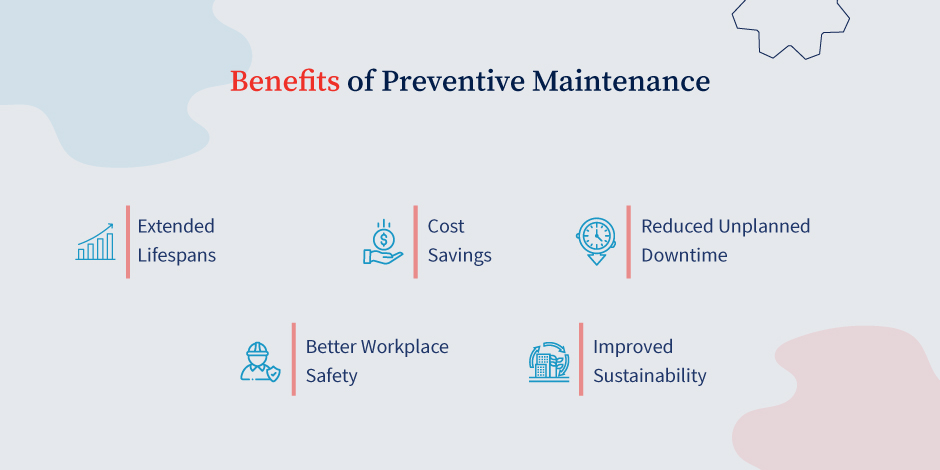
Extended lifespans
Preventive maintenance, as we discussed earlier, is the best option if you want to increase asset lifespans, get optimal performance and also perform periodic maintenance. Depending on the sector, when you choose the correct preventive plan and make it operational in the right software application, all the worries are eliminated.
Cost Savings
With preventive maintenance processes, costly repairs or malfunctions are identified before they happen. This is what saves a lot of unnecessary repair and spare parts costs that would have been wasted when assets are not maintained properly.
Unnecessary maintenance costs are incurred on industrial setups when they are maintained with a reactive approach. Instead of avoiding failures, they are fixed at the expense of unexpected parts change or fixing errors that delay operations.
Hence, with a preventive maintenance approach, these things are eliminated, and setups across sectors can achieve seamless operations.
Reduced Unplanned downtime
When facility managers monitor to see when assets require preventive maintenance and actively decide on the insights provided by the AI analysis. The system is working in the background, collecting data, and analyzing it.
Such a proactive approach helps in avoiding issues that are likely to occur if not maintained properly. There are unexpected downtimes caused due to always-on operations, which impose a heavy load on machines.
However, preventive maintenance eliminates these risks and enables seamless operations.
Better Workplace safety
There are industries where equipment or any machinery failure creates life-risk situations. A crane failure can result in grim situations, which can completely stop operations.
An intelligent preventive maintenance program helps reduce such unexpected things in high-risk situations. These measures will prevent any accidents or injuries on-site due to faulty equipment. Hence, preventive maintenance reduces risks on-site and also keeps the reputation high.
Improved Sustainability
When assets are maintained properly through preventive maintenance tasks, it extends their lifespan. This, in turn, reduces the waste generated from unnecessary repairs, extra spare parts, etc. In various industrial settings, poorly maintained equipment generates residues in the form of smoke or ground wastes, which impact the surrounding environment. Hence, preventive maintenance also impacts the sustainability factor of assets across sectors.
Now that we know about the different types of preventive maintenance and their benefits, let’s look at a comparison to see how preventive maintenance competes with reactive maintenance.
Preventive Maintenance Vs Reactive Maintenance
Out of the several differences, the key element that makes preventive maintenance better than reactive or corrective maintenance is the “timing” factor. Reactive maintenance means “run-to-failure”, where repair is only done when there is a failure.
Technicians rush to the equipment or asset and perform the fixes or replacements. This type of work costs more than preventive maintenance. This is because a comprehensive preventive maintenance strategy addresses keeping specific parts of an asset in optimal conditions through scheduled checkups, cleans, lubrications, or even minor replacements.
Whereas, when these actions are overlooked, and a major failure occurs, reactive maintenance acts as the costly savior.
Let’s take the example of a car, where routine maintenance, like oil changes, is necessary to keep the engine in good health in the long run. However, if those regular inspections are overlooked, the engine may seize at any time, causing a risky situation and costing far more than an oil change.
Preventive maintenance is the new order of maintenance, which keeps the assets in proper condition.
What is Preventive Maintenance Software?
A “Preventive Maintenance Software” is a CMMS (Computerized Maintenance Management Platform), which operates heavily depending upon AI analysis and algorithms.
A good preventive maintenance software should be a package of asset health and performance tracking features that allows you to keep an eye on every machine during operations and management.
The software should give a maintenance technician seamless access to critical information, such as serial numbers, warranties, and maintenance history, which is a good preventive maintenance examples.
Let’s see in detail the qualities of a good preventive maintenance software.
Key Elements of a Good Preventive Maintenance Software
Work Order Management: This feature is essential to form efficient and productive asset operations for maintenance teams. The computerized maintenance management system must allow you to effortlessly create work orders, assign them to technicians, and track their work progress or location in real-time.
Scheduling: When we are adapting, preventive maintenance scheduling is a key factor for enhancing equipment lifespan. Scheduling the right actions at an accurate interval enhances the critical assets’ lifespan substantially. The software you are installing should allow you for planned maintenance and preventative maintenance schedules, ensuring that no inspections or routine checks are missed for unexpected equipment failures. The work order management features add more benefit here by allowing facility managers to track tasks in real-time.
Reporting Feature: Even when we have real-time asset health and performance data, with AI-driven analysis, reporting is needed. The reason behind this is that a report provides detailed data on equipment performance, work order status, and the complete maintenance trends, identifying the gaps in it and making the overall proactive maintenance strategy process better.
Mobile Accessibility: Many sectors require having assets at different locations, and assigning a facility manager and technicians at every location can be too costly. Here, preventive maintenance software with mobile accessibility allows for real-time tracking and assigning of work orders regardless of the location. This is a game-changer for such organizations, where the technicians will also have access to a mobile version of the preventive maintenance software. They can update task status, give updates, and also add comments in case of any additional assistance.
Custom Preventive Maintenance Workflows for Productions and Operations Management
Preventive maintenance works differently across sectors, and therefore, a good software application should allow you to customize workflows for critical equipment. Customizing regular preventive maintenance workflows includes determining whether the organization needs to have real-time data from assets or whether they have assets in different locations. If an organization has assets in different locations, its workflow for routine maintenance tasks will be different from one that has all its assets in a single site. Additionally, different equipment across sectors might not need IoT sensors, or their maintenance schedule might be different. In that case, the software application should allow the facility manager to easily customize minor to major things and make facility management effortless.
Wrapping Up
Preventive maintenance software is a need for modern facility management. Today’s smart equipment and assets require real-time monitoring and scheduled maintenance by maintenance personnel. The traditional approach has expensive repair costs, and preventive maintenance is the only way out for equipment reliability. It helps avoid unexpected failures, ensuring minimum equipment downtime and no costly emergency repairs.