How Can Operation and Maintenance Work Together with Modern CMMS?
By Yadavan Dharmarajan |
Operations and maintenance (O&M) are the two critical aspects of modern facility management.
The synchronization between these two determines the cost-effectiveness of maintenance management. The day-to-day activities of assets need systematic care to be able to perform at optimal states.
Today's operation and maintenance deals with compliance with safety standards and coordination of maintenance activities. The traditional approaches no longer serve the maintenance requirements of currently complex facilities.
Reactive maintenance is incapable of fulfilling the needs of high-tech semiconductor facilities, and even high-stakes amenities.
Nevertheless, the primary goal is to reduce the overall maintenance costs, thereby increasing asset ROI and operational reliability.
What is Operations and Maintenance?
Every facility, whether it is residential, commercial, or industrial property, has its assets at the heart of its operation. Proper functioning in synchronization of these assets is what makes the daily operations cost-effective.
Now operations and maintenance also need to be in sync to ensure proper maintenance procedures of assets. Currently, these two processes are made to work together with the Digital Twin and CMMS (Computerized Maintenance Management) platform.
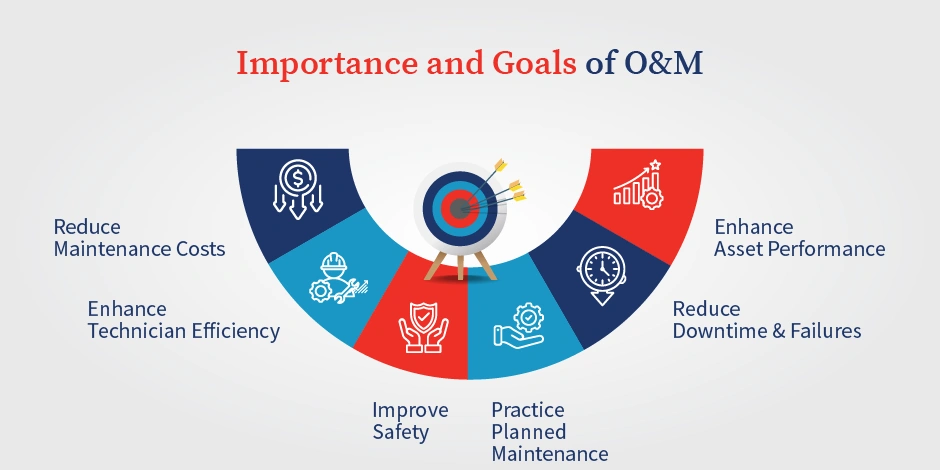
Importance and Goals of O&M
O&M today is done through a comprehensive approach, where physical assets, facilities, and equipment can be maintained effortlessly.
A set of activities is launched with a proper strategy for executing the following maintenance tasks:
The goal of this approach is to ensure optimized asset management, operational efficiency and productivity, reduce downtime, and extend asset life, along with safety and compliance.
Now, to ensure that facility managers execute these actions with accountability, an O&M manual is prepared.
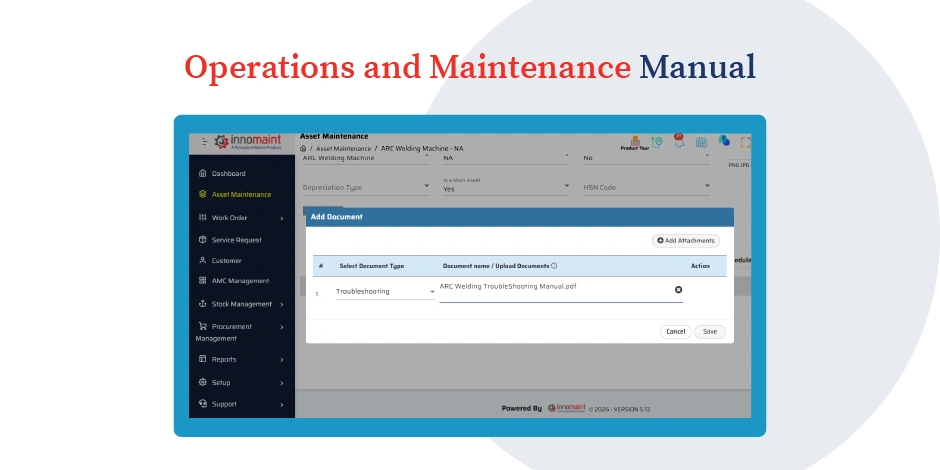
Operations and Maintenance Manual
This manual is a comprehensive document with detailed instructions and guidelines for managing and maintaining assets and facilities.
It serves as the centralized source for operations and maintenance personnel to retrieve information on how that asset functions and instructions for repairing certain specialized equipment
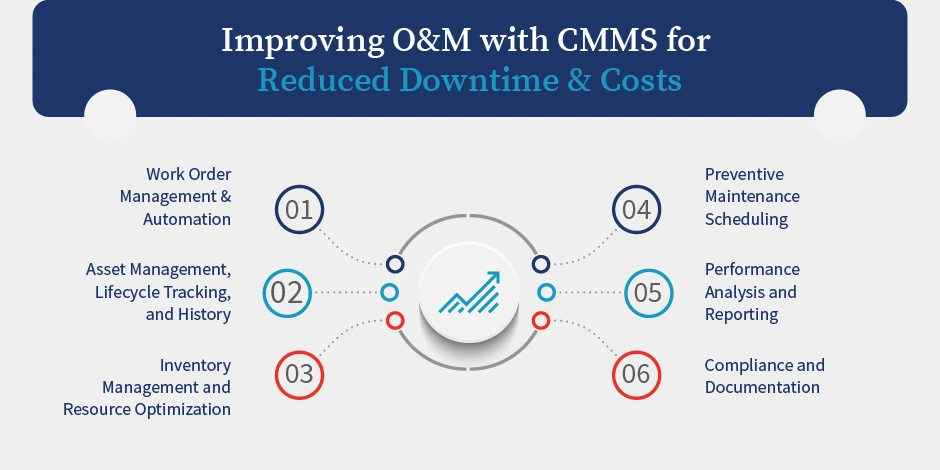
Improving O&M with CMMS for Reduced Downtime & Costs
When a CMMS platform is integrated with Operations and Maintenance management, it benefits several aspects of modern facility management improvement. These are:
Work Order Management & Automation
With work order management integrated in modern CMMS platforms, managing operations and maintenance feels like a breeze. Compared to traditional, paper-based work orders, which are incomplete in information, current work order management systems log every detail of a work order.
Modern CMMS systems automatically generate work orders and notify technicians through the mobile application.
For example, if an industrial equipment reaches 500+ operating hours, the system will generate a work order for inspection or preventative maintenance operations.
This kind of automated execution drastically reduces the downtime, which arises during problem identification and resolution in reactive maintenance.
When facilities manage assets considering these two critical data sets, it becomes more effective and cost-efficient.
Facility managers get detailed maintenance, replacement, and repair data about an asset throughout its lifecycle to date. It is like a detailed medical record that provides detailed information about maintenance action, repair, modification, and inspection logs with timestamps, technical information, and notes from technicians. And the best thing is that only authorized persons can access this data.
The maintenance history data provides managers with a comprehensive understanding of individual asset behavior. This data helps them form preventive maintenance strategies for extending an asset's lifecycle and making maintenance cost-effective.
Inventory Management and Resource Optimization
CMMS systems enhance operations and maintenance (O&M) through inventory management and resource optimization.
Whenever a machine requires a part replacement, the system takes the inventory data into consideration. There is a separate log for this task, where every detail, such as parts used, parts out of stock, etc.
This helps them keep track of spare inventory, avoiding the unavailability of components and materials in emergency situations.
CMMS solutions also provide detailed dashboard-level insights on available technician resources and the workload on each of them. Facility managers can use these insights to utilize the available resources efficiently, assigning tasks based on the current workload.
Preventive Maintenance Scheduling
Traditional reactive maintenance strategies now fall short in maintaining complex facilities. It causes delays in response, which further affects the downstream operations processes.
Also, despite the technician's location on-site, tasks are assigned without considering the workload in the traditional maintenance program.
However, current CMMS systems help in scheduling maintenance tasks considering multiple parameters. These include: calendar time, asset runtime, production cycles, and other behavioral conditions.
Here, a structured approach takes place, which helps organizations practice efficient maintenance tasks.
Performance Analysis and Reporting
Operations and Maintenance (O&M) goes to the next level with powerful analytical capabilities. Current CMMS systems convert the maintenance data into actionable insights.
It changes the complete scenario, where decisions are made through assumptions turn into data-driven choices. Facility managers can use the comprehensive data from CMMS to optimize maintenance strategies, identify trends, and allocate resources efficiently.
This is very crucial as labor hours are always different for every individual equipment. The analysis of the utilized hours is critical for allocating resources efficiently.
However, this analysis, through paper-based and fragmented data, is impossible to execute. For this, maintenance managers need properly logged data, which is structured as per key performance indicators.
Compliance and Documentation
Compliance records are immensely critical in modern complex facility management. Most of the industries such as manufacturing facility and semiconductor ones, are regulated and require documented maintenance activities, store certificates, and track calibration requirements.
The CMMS systems generate comprehensive compliance reports, which are a valuable dataset for audits and inspections. Several organizations fail to provide a detailed report, which results in fines and, in extreme cases, the shutdown of facilities.
For instance, in the healthcare sector, this data is necessary to demonstrate quality maintenance of critical medical equipment, quality control, and ensure compliance.
So, these were the ways that O&M can be enhanced and made efficient for modern complex facilities.
However, a lot of organizations still consider several aspects of Operations and Maintenance wrong. Here are some of the common misconceptions about O&M.
Common Misconceptions about O&M
Out of the several reasons, these are the ones that make most O&M strategies fail.
Operations and maintenance are independent departments and are better when managed independently. The reality is that these are inevitably connected in modern facilities. The type of maintenance needed always emerges from the kind of maintenance operations services.
The second misconception is that these two are reactive practices. However, if issues are not prevented, downtime will not decrease, and the operation will not be efficient. Hence, today's CMMS systems provide you with tools to analyze maintenance data that can be further utilized to create preventive maintenance strategies.
Maintenance costs are overhead after purchasing the asset in a business. However, the current standard is to determine the cost of an asset throughout its lifecycle. The practices of maintaining and operating assets can be optimized, monitored, and planned for cost efficiency.
Final Thoughts
While Operations & Maintenance are inevitably linked, a CMMS system is required for running both in synchronicity. And, while the industry might think these are overhead costs, the comprehensive data from facility management systems such as InnoMaint will help them strategize the entire process.
READY TO SIMPLIFY MAINTENANCE OPERATIONS?
See how Innomaint CMMS helps maintenance teams reduce downtime, control costs, and stay audit-ready.
Asset Lifecycle Management (ALM): The Life Cycle Cost Analysis (LCCA) Framework to Maximize ROI
By Yadavan Dharmarajan |
In 2026, the cost of an asset goes beyond its purchase price.
Organizations are seeing that a greater percentage of the total expense of an asset throughout its lifecycle comes after installation.
If you are an organizational owner and your operations depend heavily on continuous asset functioning, the upcoming years demand the adoption of Asset Lifecycle Management, integrated with Life Cycle Cost Analysis (LCCA).
If organizations want to maximize the ROI from assets, the focus should be on the complete lifecycle of an asset.
This indicates active monitoring, tracking the work order count for that particular asset, and using this data for analysis of the cost. The process also includes the cost of replaced parts or parts that were procured actively on demand.
Unplanned Downtime Leads to Inefficiencies
While the operational complexity of assets is increasing, the cost of unplanned failures is also taking a leap, leaving organizations unaware of the extra expenses.
An estimate from Siemens shows that unplanned downtime now costs large organizations nearly 11% of their annual revenue. On a global level, this manifests into 1.5 trillion US dollars yearly.
Global News Wire published another 2025 report from Fluke, which reveals 61% of manufacturers faced unplanned downtime, costing the sector a total of up to 852 million US dollars every week.
And these losses will escalate predictably, signifying that traditional reactive asset management is no more effective. There is a concerning gap in how assets are planned, operated, and evaluated across the lifecycle.
Life Cycle Cost Analysis becomes an essential component in 2026, and the seamless integration of a solid framework is even more critical to maximize ROI from assets.
Now, before we dive into the framework, let's start with the fundamentals.
What is Asset Lifecycle Management?
Think of it as the upgraded version of typical Asset Management practices.
The basics remain the same, where facility managers initiate the purchase of equipment, utilize, monitor, maintain, and replace an asset.
Now, in Asset Lifecycle Management, this data is used strategically to optimize an asset's useful lifecycle further, to maximize the ROI. Here, the cost of maintaining this asset is calculated over its lifecycle, integrated with planning and maintenance to maximize asset lifespan and ROI.
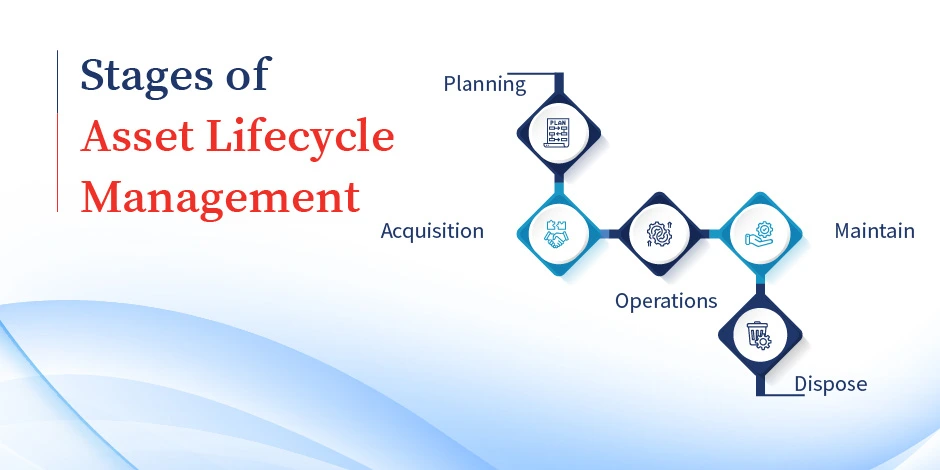
Now, there are five key stages in this process.
Stages of Asset Lifecycle Management
An asset goes through mainly five stages of the lifecycle management process for optimal asset health. This is also the same for IT assets, where operational efficiency is a must. Understanding the significance of each step is essential to making a difference in the current ROI. Let's delve into the steps of execution:
Planning
It all starts with buying the assets in the first place. If there is a significant financial investment required, the planning phase will take longer to explore and choose an option that will best fulfill the needs and avoid costly repairs.
The planning phase is where the organizations determine asset requirements, specifications, installation cost, and usage. This identification of asset information is necessary for asset procurement, in terms of capacity gaps, serves expectations, growth, and risk management plan is crucial.
Acquisition
This step not only involves purchasing the asset, but also planning for its installation. In most industrial setups, the process of getting an asset into operation requires great attention.
Across large organizations, skilled technicians facilitate this process of installation. If available in-house, fine, or else need to be hired. and this directly adds to the asset's lifecycle costs as well.
Hence, it also affects the initial budget that is planned for the new asset to get into operation.
Operations
Once the asset is installed and the organization is using it, it is time to assess its maintenance needs. This will help you come up with plans that will be best for the asset lifecycle.
For organizations that are already using CMMS (Computerized Maintenance Management System) and Digital twin solutions for maintenance, determining a strategy for the asset becomes easier. The maintenance system will give them detailed insights that are the basis of understanding the type of maintenance strategy that will work for that asset.
Preventive or predictive maintenance strategies are beneficial to enhance maintenance effectiveness, reduce unplanned downtime, and maximize ROI.
Maintain
When the maintenance plan is ready, you can start following it for maintenance practices. The plan ensures timely maintenance prompts are given on time.
It also keeps the routine maintenance tasks allotted to technicians, which ensures that all the assets of the organization are up and running efficiently. The work orders in the plan will be different for every equipment line-up.
Dispose
The last stage comes at a point when the equipment is no longer in a state of further maintenance. Here, the most financially sound decision becomes the eventual disposal of the machine; however, considering the above factors before that:
Can the asset be resold for a limited price?
Is it in a condition to be purchased by refurbishing companies?
Are there environmental concerns to be taken while disposing of the equipment?
Is there any additional cost for the removal of the equipment?
So, these were the fundamental stages that need to be executed to maximize ROI from a given asset.
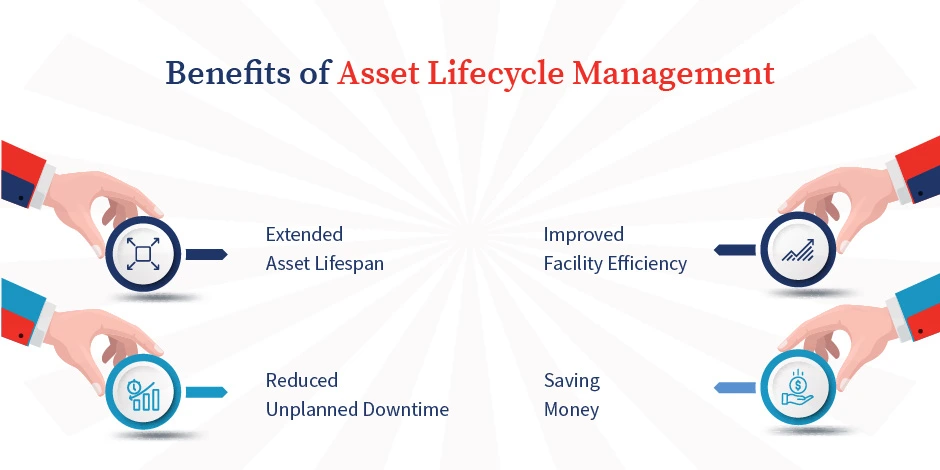
Benefits of Asset Lifecycle Management
Asset lifecycle management software provides several key benefits, which may vary across industries. However, a solid, customized asset lifecycle management plan delivers the following advantages to organizations.
Extended asset lifespan
When organizations are aware of how the asset performs and under which circumstances it fails or slows down, that is valuable information. It is the source to develop a tailored plan for that equipment or a series of equipment that will maintain it throughout the entire lifecycle.
By understanding an asset’s behavior and asset tracking, organizations can elevate preventive and predictive maintenance schedules. When these practices smoothly roll across your asset lineup, the lifespan is substantially increased.
Reduced Unplanned Downtime
Traditional reactive maintenance always fixes after the disaster happens. That too, with delays, incomplete fixes, or low work quality.
Leveraging measures to prevent downtimes (preventive maintenance) helps you avoid unnecessary downtimes, which would cost thousands and even millions for some organizations.
To get hold of the unwanted downtimes, you need to plan maintenance before the need for reactive maintenance occurs. When there are fewer emergency scenarios to perform tasks, you can be assured that downtime is automatically less.
With modern CMMS solutions integrated with Digital Twins (DT), this planning can be done outside of operational hours. The data recorded in the CMMS, which includes detailed maintenance history and real-time monitoring data from sensors, helps in analyzing the assets' behavior and crafting a tailored plan for their optimal maintenance.
Improved facility efficiency
When assets are maintained better, they perform at their best condition. This enhances the quality of experience inside the facility across sectors, and achieve greater efficiency.
For example, this is very crucial for customer-facing facilities, where their experience matters the most. Under industrial setups, it enhances worker experience, allowing them to work at their full potential.
The analysis of an asset throughout its lifecycle significantly reduces unexpected failures and yields the best ROI possible. This brings us to the next point, which is what this blog is mostly about: maximizing the ROI of an asset through Asset Lifecycle Management.
Saving Money
What is misunderstood a lot in the industry is that efficient facility management is expensive. However, the cases are different when you choose the right service provider.
A greater amount of money is lost when organizations have been using a CMMS solution without knowing which part of it is going to work for them.
Efficient facility management software is only possible when you are using the features and the data flow is in synchronicity. This ensures that every maintenance taken is based on data-driven decisions and not assumptions, ensuring continuous improvement of operations.
With a reduction in unplanned downtime and preventive measures in action, a lot of unnecessary costs are eliminated, and the facility manager can maintain assets responsibly.
Further, asset lifespan increases, and there are fewer requirements for new procurement, which also reduce costs. The overall cost is substantially reduced with preventive maintenance for the IT infrastructure as well.
The perfect lifecycle cost analysis comes out when an asset is treated like an instrument. This means being aware that it needs to be monitored and maintained, to ensure assets are running smoothly.
Also, routine inspections before major operations remain at the heart of daily operational efficiency. The cost, time, and other factors associated with all of these tasks fall under Lifecycle Cost Analysis.
The University of California (UC) provided a Lifecycle Cost Analysis framework.
This is a mandatory framework to apply life cycle cost analysis of an asset for long-term economic efficiency and prompt incident management.
UC: Life Cycle Cost Analysis Process
The process includes a five-staged framework that covers the initiation and completion of a life cycle cost analysis. As defined by the UC, the process below can be used as the foundation to prepare unique frameworks tailored to individual projects.
Defining Project Goals
The first is always to define your goals and identify the requirements to achieve those.
Additionally, there should be a minimum performance requirement set for every asset. This should be done before defining the key parameters, such as ROI, Payback, and NPV.
Now, to assign specific responsibilities, the next task in this step is to identify project team roles, responsibilities, and the primary decision makers.
Once this is done, comes the task of defining the LCCA scope of work for your building systems.
Exploring Design Options
In this step, organizations need to explore various building system designs.
These also include system choices that will be the real-life, buildable alternatives for enhanced sustainability.
Some examples include:
HVAC Option A vs HVAC Option B (high-efficiency heat pumps vs conventional systems)
Enhanced envelope insulation vs code-minimum envelope
On-site solar + storage vs grid-only power
Different lighting styles
These design changes are the fundamentals of the sustainability transformation you have aimed for.
The next task in this step is to provide a qualitative assessment of the design options for technical feasibility, constructability, operational complexity, maintenance, and risk burdens.
The step concludes with selecting the top design options based on the qualitative review for smooth organization's operations.
Analyze Project Costs
In this step, BIM is needed for energy modeling of the selected designs to get into the asset lifecycle management process. If the project is renovative and is built through BIM, an as-built model will be there already.
Unless the creation of a digital twin is mandatory at this phase for analyzing the utility cost and emission projections, to achieve cost effectiveness.
BIM-driven, detailed energy models give insights into the annual energy consumption, utility costs, and carbon emissions for every individual shortlisted design.
Once the design is finalized in the above phase, the process moves to developing construction cost estimates. The initial capital cost is calculated, including equipment and materials, installation, and labor to increase productivity.
To stay ahead, several organizations also estimate operational, maintenance, repair, and replacement costs for long-term projects.
Quantify Lifecycle Cost
The UC LCCA process defines the fourth step as the evaluation and decision-validation stage.
The guidelines laid out by the UC help in the analysis, ensuring it is consistent across projects, comparable, compliant with UC policy, and that maintenance costs are justified.
The results of the analysis are shared and reviewed by various project stakeholders, such as owners, facility teams, designers, engineers, and key financial decision-makers.
Along with this, other operational and environmental considerations are considered by the asset management system. This will ensure that the new system is not operationally complex, staff can adapt, and reliability and carbon reduction goals are met.
Inform Design Decisions
Once the analysis is done, the process moves forward to these last concluding stages to manage assets.
Organizations need to prepare a concise report that clearly documents:
The baseline and all evaluated design alternatives
Key assumptions and analysis period
Financial results, mentioning NPV, payback, ROI, and life-cycle cost
Energy and utility costs, emission impacts
Maintenance and risk costs
The final authorities/stakeholders assess this summary to make informed decisions on what performs the best and what compromises safety or costs. The useful life of an asset is determined with these decisions in this last stage, which is beneficial for enterprise asset management.
The final design decision is directed by the leadership's inputs, converting the LCCA analysis into an action-oriented framework to maximize ROI.
Asset Lifecycle Management & Cost Analysis with DT
Modern asset management software and cost analysis need Digital twin integration for the best outcomes.
It is the exact replica of a physical asset, or the whole structure, which gives real-time insights about various assets, the asset's status, and their performance. When there is effective asset management, the asset lifespan already increases.
Asset managers can have a bird's-eye view of the complete facility, along with all the assets to be monitored and maintained. And when it is integrated with current CMMS platforms (not the outdated software platforms), the complete process to optimize asset performance gets digital.
Organizations need not rely on paper-based work orders, manual task assignment, and report generation, and access proactive monitoring.
Final Thoughts
Asset life cycle management strategy is the first step towards maximizing the return on investment on a particular asset.
The data generated from the above process is used for the cost analysis and asset maintenance throughout its lifecycle. To increase the return, facility managers need to understand that an asset’s cost goes beyond its purchase.
Hence, the ROI can only be increased when the total cost is considered across an asset’s lifecycle.
FROM PROCUREMENT TO RETIREMENT. SIMPLIFIED.
Gain complete control over your asset lifecycle. From onboarding and performance tracking to cost optimization and end-of-life decisions
Work Order Management: Definition, Importance & Best Practices
By [post_author] |
In modern facility management, tasks are assigned as work orders. The latest CMMS (computerized maintenance management system) solutions in the industry, along with Digital Twins, enable preventive scheduling and maintenance. All these further contribute to work order management practices in large facilities in the US. Stats from the Global Growth Insights say nearly 65% of organizations are using CMMS to structure their work orders, track, and execute better. This allows managers to assign tasks to technicians based on various parameters that support enhanced productivity and efficiency. There are preventive maintenance work orders, which are used to schedule routine servicing for all of your equipment.
What is a Work Order?
Every task assigned to a technician, whether it is to perform maintenance, repair, or inspection, is documented in the system as a work order.
Work orders provide valuable insights to facility managers, including task details, assigned personnel name, resources utilized, location, and scheduling.
These are essential for an organization’s maintenance strategy to track progress and organize maintenance activities with greater control, driven by accurate data.
Now, as new features and capabilities are getting added to the premium Digital Twin-integrated CMMS system, work orders cannot be of a single type.
For example, in large semiconductor or industrial facilities, there are intricate machineries that need to be monitored and maintained, to keep operations smooth, as downtime would cost thousands and sometimes millions of dollars.
So, here are the types of work orders.
Types of Work Orders
Depending on the organization’s size and the industry it operates in, the work order prevalence changes. For instance, a semiconductor facility will generate a higher volume of routine cleaning-related work orders due to its processes that are vulnerable to microscopic contamination.
Compared to this, a hazardous chemicals manufacturing company will require more safety-related work orders. Hence, the understanding of the following eight types of work orders is essential before handling them.
These types of work orders are typically associated with routine inspections from technicians and are part of reactive maintenance. It helps organizations from various industries address issues that may generate downtime downstream. During an inspection, a technician uses various tools and their experience to find issues in equipment or specific equipment parts of existing systems. Once the assessment is done, corrective maintenance work orders are generated to either fix the parts or replace the equipment. However, these are different from emergency work orders. Emergency work orders are created in response to an unexpected breakdown.
Electrical Work Order
These are tasks assigned to repair or install electrical equipment, including lighting, power supplies, sockets, and all other electrical appliances.
General Work Order
General work orders are those nonurgent tasks, including pest control, painting, minor carpentry, and signage installation, etc. These are low-risk tasks and hence do not fit into a more specific category. Such tasks are common in commercial, hospital, and healthcare facilities.
Inspection Work Order
These types of work orders are more common in facilities that practice predictive or routine preventive maintenance. When there are inspections needed as part of the structure of such type of maintenance, a series of tests is performed.
Renowned CMMS solutions have the ability to provide detailed test series for each equipment to technicians. Inception work orders help identify anomalies, risks, and provide detailed insights into asset performance and other functionality issues.
Preventive Maintenance Work Orders
These are the scheduled work orders for different equipment, aiming to maintain their functionality optimally. These work orders are also focused on extending equipment lifetime, with customized scheduling of preventive maintenance tasks
Organizations looking forward to decreasing downtime, maintaining regulatory compliance, and cutting down maintenance or technician expenses, understanding preventive work orders is a must.
Safety Work Orders
These orders are solely focused on worker safety, including any equipment malfunctioning, and in high-risk environments, safety work orders are the sole focus of some firms.
People working with high-risk equipment or who need to maintain a safe distance from a certain area, safety work orders create structured tasks that ensure these areas are maintained.
Special Project Work Orders
These work orders are related to the projects undertaken to modernize and advance facilities. It includes installing new equipment for extended services, increasing resources for more productivity, etc.
We mentioned earlier in this blog about the work orders being documented with their details. But there is a process specific to every industry that defines how work orders are requested, performed, and documented.
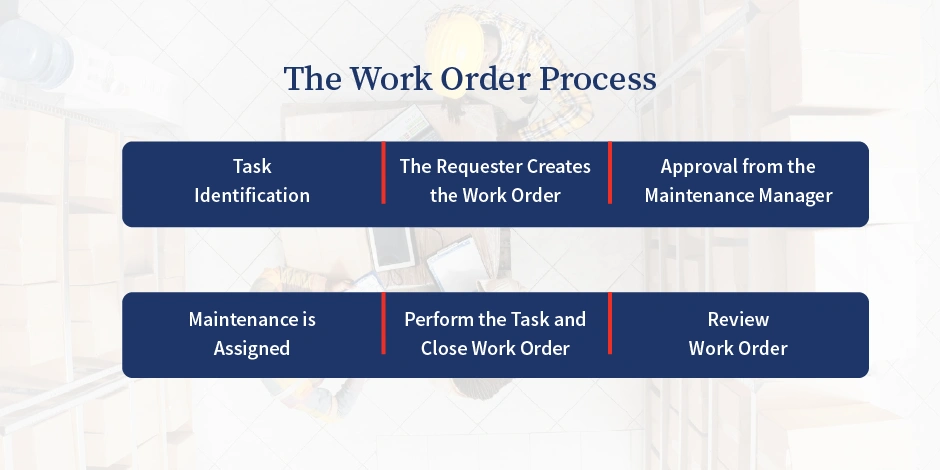
The Work Order Process
The work order is the fundamental element of the maintenance data, based on which further things are calculated. The work order document becomes the primary mode of communication and documentation of the method.
Task identification
This is very natural in every process, whether an organization is installing a CMMS software or assigning work orders. The first step is to identify that there is a requirement for work to be done. Now, this can be prompted in several ways. There are malfunctions to be noticed in time-based usage and usage-based cues. Facilities that use IoT sensors’ real time data for monitoring get notifications from the CMMS system itself that a task has to be performed.
It indicates the equipment, the location, and the available technicians to be assigned. If there are multiple notifications generated, the system also mentions the priority of the tasks.
The requester creates the work order
Now, the requester receives the work order details from the system and creates the basic form of the work orders. The basic information included, the location of the asset, the issue/maintenance task required, details about the situation, photographs and videos if applicable, and any other important information. Today’s system, with IoT sensors and Digital Twin integration, provides more detailed and accurate responses for smooth tasks.
Approval from the Maintenance Manager
The next step that immediately comes is to approve the request. This step is mandatory because it filters unnecessary work orders from inexperienced requesters before submitting work requests. There are several cases when work order notifications are interpreted falsely.
If the maintenance manager finds any discrepancies, they send back the requests to the requester for reanalysis. Also, the other way happens when there are any requests for special parts or tools from the spare parts inventory management. The maintenance manager is the authority who will approve that specific part or tool request in this step and also elevate asset management practices.
Maintenance is Assigned
In today’s CMMS systems, maintenance is assigned automatically through the system. However, if that is not set up in your organization, the work order needs to be assigned manually. The automated system is more intelligent in determining the following factors:
Urgency
Readiness of the team/current workload
Overall impact of the issue
Available technician’s skillset
In case of manual assignments, the relevant authority has to consider the above factors before assigning the maintenance task.
Perform the Task and Close Work Order
Once the work is assigned, the technician gets a notification on their phone through the CMMS mobile version. CMMS mobile apps make it easy for field technicians to access manuals and update statuses on-site, improving efficiency.
CMMS on mobile devices also enhances field access and control, which is why around 52% of users now manage tasks via mobile devices, says Industry Research.
The installed application shows them an easy interface with all the details and some options. These options indicate whether the work is accepted and started by the technician, and if there are multiple sub-work orders under one, there are also options to mark them closed for each.
Also, if required, once the maintenance work is finished, technicians can upload photos and other details to document their work. The details include the time spent on performing maintenance, resources purchased, and images purchased or videos. In modern CMMS, digital trails automatically record maintenance actions with timestamps, aiding in compliance during audits.
Review Work Order
This is the last step, when the technician closes the work orders, and the maintenance manager is notified about that. He checks the status for quality assurance, and the work order stops periodically, with the asset going back to its normal operational state. The asset continues to function until another issue arises, and the work order process restarts for continuous improvement.
Since the start of the process, when the basic work order is created, the data and its accuracy become a fundamental factor for the whole process to progress smoothly. Organizations need to understand the details required in a work order to fully automate the process, ensure transparency, and effectiveness of the process.
So, here is a detailed look at the details required for the work order for that effective communicator.
Information Should a Work Include
The information in a work order management software should not be vague; rather, it must contain clear action steps. In order to get the work order successfully closed, all the necessary details should be accurate and well-structured. The work order management software increases data access by centralizing work order information, allowing technician members to track and edit tasks in real time. Not only should it guide the technicians, but also become valuable data for compliance, accountability, and long-term asset maintenance through the work order management system.
Here is the checklist:
Clear Task Description
Asset Details
Priority Level
Estimated labor and parts
Assigned technician or team
Estimated completion time
The start, due dates, and completion date
Notes of completion and follow-ups, if there are
If you see, the above points do not miss any of the details that would hamper the work order execution. The most critical among these are the priority level, estimated labor and parts, the data showing follow-ups if those were required, and the technician’s name or the team assigned. These provide confidence to the technicians in executing the work and thereby maintaining compliance, quality, and operational efficiency.
Importance of Work Orders
Today’s CMMS software solutions enable proactive maintenance. These features operate, and their effectiveness depends on the accuracy of maintenance data. The maintenance data further depends on the work order request form. If a task is assigned and executed without any documentation, that is not a work order. Also, the details mentioned in the work order should be accurate and reviewed. The work requests serve data for labor cost reduction, and hence, most organizations across industries are shifting to predictive and preventive maintenance. And this is because preventive maintenance can result in a 20% reduction in equipment downtime, which it does by centralizing asset history and automating schedules. Integrated with Digital Twin, the CMMS software helps them have complete control and visibility of their asset infrastructure and the current status of operational tasks.
Hence, work orders are inevitably important to modern facility management, and they form the heart of maintenance operations.
If you want to further explore the different areas that work orders introduce benefits to, read this blog focused solely on the importance of work orders.
Best Practices to Include in Your Work Order Management
There are types of work order management practices, but here are the key things to include in your customized strategy and existing processes. These include:
Standardizing the field and templates
Before starting to use the CMMS system, the first step is to define a format. If there is no standardized approach to how task descriptions would be created, assets would be tagged, and what technicians should include in notes, everyone will have their own style.
This inconsistent form will fix the failure of the maintenance process even before it has started. Hence, there should be a consistent format that is readable and action-oriented.
Link Work Orders to Asset History
If we see from a technical perspective, the technicians would always perform better when they have the asset history. This gives them detailed insights into the maintenance activities, revealing what happened previously, which parts were affected, which parts were repaired for the moment, but now require a change, etc. This allows them to make data driven decisions, increasing the effectiveness of the process.
This detailed data often reveals the root cause of the issue, which also changes the action to be taken. Hence, your maintenance data should be well-structured without any human error, and the CMMS should be connected to the maintenance history for the technicians to access information readily.
Including photos or attachments
When made a practice, it increases productivity substantially. This includes adding pictures, manuals, or wiring and equipment diagrams when executing service requests.
Automate preventive work orders
Today’s CMMS system is capable of automating work order assignment. This makes the process smoother, ensuring that the accountability is auto-generated by the system. InnoMaint is a system that offers automation routine maintenance, work order management, status update, and closure, allowing organizations to take steps before problems lead to massive failures.
Track Time Cost and Completion
When closing the work order, the maintenance team should review it, considering the following details. These are the time spent on the task by the maintenance staff, the materials used, and if there were deals or follow-ups needed. This helps them refine the process eventually, ensuring quality and regulatory compliance.
Training teams
This practice involves teams knowing the system well, where they will be operating on a daily basis. Organizations should invest in training teams on how to fill out work orders, ensure compliance, report any discrepancies, and treat the service operations in a disciplined way.
Wrapping up
To conclude, the work order management process is an essential feature to optimize maintenance in today’s facility management. It includes maintaining proper formats for work orders/ service tasks, which will further ensure data consistency that is needed for predictive maintenance. Since organizations are aiming for preventative maintenance in 2026, work orders are the heart of maintenance operations across industries.
Frequently Asked Questions
Why is work order management important?
Work order management enables organizations to follow a structured process for their maintenance operation. It is usually done through CMMS software like InnoMaint, which allows advanced work order management systems.
What problems arise from poor work order management?
Organizations with poor work order management encounter missed and delayed responses, repeated breakdowns, a lack of accountability, and higher operating costs.
What are the common types of work orders?
Organizations across sectors use various types of work order management principles, like corrective work orders, preventive work orders, emergency work orders, inspection, and general work orders.
How does CMMS improve work order management?
CMMS platforms digitize the complete process, which enables tracking and accountability in real-time. With the use of IoT sensors, the platform reflects real-time data and responses from technicians on-field to assign, track, and measure work orders.
Why are mobile devices crucial for today’s work order systems?
Mobile device access allows for enhanced field accessibility. Facility managers can track technicians and update them on tasks and the status of equipment in real-time.
How can companies automate work order management for maintenance teams?
Companies can automate work order management by implementing a CMMS platform that centralizes the entire maintenance workflow. Automation enables auto-creation of work orders from asset schedules, meter readings, or IoT alerts, ensuring issues are captured before failures occur.
The system automatically assigns tasks based on priority, technician availability, and skill sets, while mobile access allows technicians to receive updates, log work, and close tasks in real time. This reduces manual effort, improves response time, and ensures consistent, accountable maintenance operations.
NEED A WORK ORDER SYSTEM THAT ACTUALLY DELIVERS RESULTS?
Plan, assign, track, and close work orders seamlessly while managing assets, compliance, and preventive maintenance in one CMMS.
The Complete Guide to CMMS Software in 2026: Selection, Implementation & Optimization
By [post_author] |
You will often hear industry people say that around 70% of CMMS (Computerized Maintenance Management System) implementations collapse in practice.
Gregory Perry, Senior Capacity Assurance Consultant, Fluke Reliability, in his white paper publication, mentions the same.
Now failure has a different face here; it does not mean that the CMMS crashes, the project is cancelled, or the system is removed from operation.
At the core, the issues are different, and most firms aspiring to use CMMS or have already implemented it are unaware of them.
From the point of view of non-maintenance stakeholders in a firm, the system is live and in operation. However, the CMMS system operates irrelevantly, barely fulfilling the gaps for which it was implemented initially.
The system is not driven in the accurate direction; instead, it is just running, creating a fake sense of computerized management.
Buying and implementing a CMMS software does not fix the issues; instead, it exposes those.
What is a CMMS?
CMMS, or a Computerized Maintenance Management Software/System, is a complete framework to manage organizational assets, reduce downtime, increase operational efficiency, and much more.
It is a software or platform (different from Enterprise Resource Planning software) acting as a bridge between facility managers, the assets, facilities, or equipment, and the technicians.
Creating a cohesive system ensures consistent data exchange, accountability, and structure in the daily maintenance operations of firms across industries.
How does a CMMS work?
The capabilities of a CMMS software are assigned to various modules within it. Every module is connected to the other, working as a single system and supporting the tasks of other modules. Let’s go for a brief rundown of the fundamental modules present in every good CMMS:
Work Order Management
This module creates an environment for facility managers to create, assign, and track maintenance tasks.
Advanced versions of this module also support tracking of the technician’s location in real time. However, its capabilities go beyond simple task tracking, where it creates a structured workflow.
It further ensures that the workforce is not exploited by prioritizing tasks, assigning them based on skill and workload. Through this, the platform/system helps avoid resource clashes and is beneficial during peak hours, when operational consistency is critical.
Asset Registry
The asset registry module creates the foundational data on which the maintenance intelligence runs to improve asset reliability.
However, this foundation data is not disorganized; instead, it is structured and consolidated data that includes asset metadata, maintenance history, warranties, manuals, and performance data (with detailed graphs for analysis). This data also helps in asset lifecycle management systems for physical assets.
The asset data registry helps the CMMS system offer actionable insights to facility managers for informed decision-making across maintenance, operations, finance, and capital.
Condition Monitoring
This part of a CMMS platform lets you shift from traditional time-based maintenance to condition-based maintenance.
The features require IoT sensors that send live data from the assets to the system. The data includes detailed metrics about the current temperature, pressure, and other essential states that determine asset health.
Analyzing that data allows teams to understand underlying failure causes, detect anomalies early (Preventive Maintenance), and solve issues before they escalate into major ones.
Predictive maintenance
Modern CMMS platforms come with this advanced module that runs on Artificial Intelligence (AI) and Machine learning (ML) algorithms.
A 2024 State of Industrial MaintenanceReport indicates that approximately 30% of the facilities use predictive maintenance.
PdM, or Predictive maintenance software, is growing, but it is still not widely adopted. Several organizations still use a run-to-failure approach, and some preventive maintenance. But if we see on a global level, only a minority of companies have integrated predictive maintenance.
Reports and Analytics
If you have all the operational data along with the maintenance data structured in a system, it becomes a great source for analysis and reporting.
Both the data sets can be tallied, which helps in identifying operational issues that can be complemented by restructuring particular maintenance tasks. This gives a firm control over both the primary aspects, which are: maintenance and operations.
And this happens based on defined KPIs or Key Performance Indicators, such as MTBF.
(Mean Time Between Failures), MTTR (Mean Time To Repair), downtime, and expense trends. This data on a dashboard dissected by intelligent AI and ML algorithms makes today’s maintenance smart, secure, and highly cost-effective.
Mobile Maintenance
Maintenance occurs at the site, and not in a room. Machines, equipment, surface issues, or undergo breakdowns where the groundwork happens.
And technicians rely on that, which means there is a gap between the system and the field. Today’s CMMS platforms bring mobile access to technicians in the field.
They can access asset information with a simple barcode scan, update work status, send a notification for additional assistance, capture photos, and send to managers all within their mobile devices. Every action is part of a structured workflow and remains in a single place, which can be tracked afterwards. This will improve communication among technicians and facility managers, ensuring task accuracy.
When technicians perform these actions, they are creating structured operational data, which becomes the foundation for acquiring more advanced capabilities.
However, here is where most organizations fail, as
“they talk about the importance of AI-integrated CMMS, but do not address the fact that it needs structured and consistent data to deliver accurate predictive and automation insights.”
This is what organizations need to understand before they go for a costly, unplanned CMMS implementation for proactive maintenance.
So, this guide is for operational leaders, maintenance managers, and other roles who are responsible for results and not just reports.
The guide will teach you how to “not digitize” your facility maintenance chaos further and instead perform a meaningful CMMS implementation.
Let’s see how to select, implement, and optimize CMMS software for 2026 and beyond.
But before that, let’s understand why CMMS software is no longer a work-order system; instead, it is now a Decision Engine.
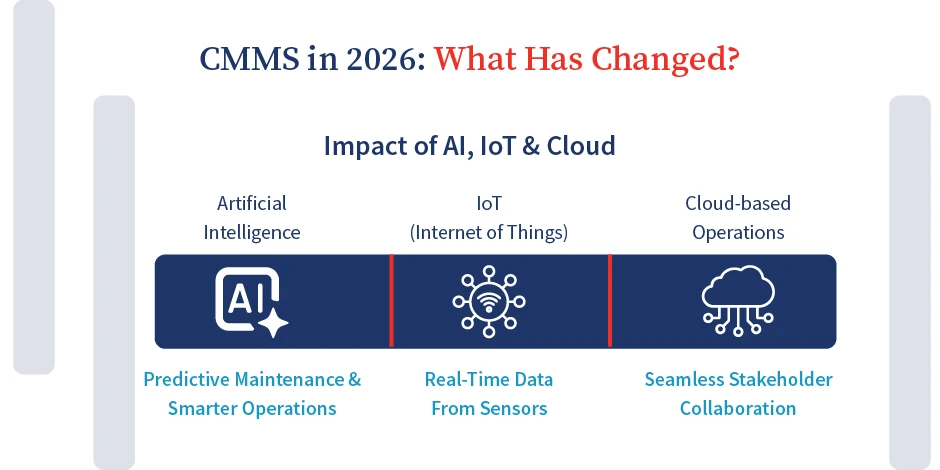
CMMS in 2026: What Has Changed
Out on the internet, most CMMS-related content talks about digitizing work orders, logging failures, tracking labor, and generating compliance reports.
It reads like it is stuck in 2015, while the value of CMMS systems has shifted drastically in 2026.
The old model CMMS answered, “What has happened?”
Modern CMMS adds value by answering, “What should be done next and why?”
If your system in 2026 only manages work orders, it is operationally irrelevant.
Today’s systems not just store and display maintenance history, but interpret that data, and answer the following questions:
Why did those failures happen?
Are Preventive Maintenance schedules under-maintaining assets?
What patterns need to be fixed in order to reduce downtime?
Without analysis of the maintenance data, everything is noise.
In 2026, CMMS software is an intelligent layer controlling maintenance and not just recording data.
It now leverages that data to come up with actionable operational insights, helping facility managers make sound decisions. An Enterprise Asset Management (EAM) cannot deliver the outcomes that a CMMS would deliver.
This changes the early origin nature of CMMS, making it a decision engine from a clerical or digital logbook tool.
Impact of AI, IoT & Cloud一
Artificial Intelligence
Industry people expected AI (Artificial Intelligence) to predict failures once integrated with CMMS systems.
But in reality, maintenance data quality deficits keep stalling AI readiness from the core.
In 2026, it is more sobering than promising; not because AI integration was unsuccessful, but because AI itself faced difficulties in operation.
Artificial Intelligence revealed that most organizations do not have their maintenance data structured.
There are inconsistencies in failure codes, vague work order descriptions, and empty root cause fields.
While humans can work with this type of data with experience and intuition, AI would not be able to do that.
The uncomfortable truth for most organizations is that AI exposes weak and undisciplined maintenance operations.
IoT (Internet of Things)
Talking about IoT, its integration added to the data volume from assets. Maintenance systems receive real-time data from sensors, but without the capacity to contextualize that.
Organizations need to understand that data volume will not enhance decision capability, but data clarity will.
IoT solutions provided continuous condition data, surfacing failure signals earlier; however, no clue for organizations on when to act, who is responsible for risky decisions, and how different maintenance tasks should be prioritized.
Cloud-based Operations
Cloud technology also has a profound impact on IoT, as it makes cloud based CMMS more readily deployable, but we will explore what it has not fixed.
It made integrations easier and installed updates faster, with more seamless stakeholder collaboration. However, it did not fix things like poor maintenance workflows, bad data discipline, and a lack of accountability.
These aspects require foundational work, which many organizations step back from.
Having a system ready to embrace the perks of a CMMS software is critical.
Before you even talk to vendors, frame a strategy to fix gaps in your maintenance operations so they do not backfire.
As per a recent survey by another recognized CMMS platform, like Innomaint, 70% of CMMS projects fail to launch.
You have already locked in failure by investing in CMMS without a plan!
Firms cannot resist the temptation to jump right into deploying the first-appealing CMMS they find.
This is where they make an irreversible mistake, which guarantees disappointment rather than a successful CMMS in operation.
This is what no CMMS vendor wants you to read一
Failed maintenance software implementations do not arise from bad software or non-dedicated facility managers.
Vendors do not want to air these, as it will reveal that most firms lack the foundational readiness to buy and deploy a CMMS solution.
The Readiness Checklist:
Maintenance Maturity
Before implementing a CMMS solution, your maintenance practices should be mature enough to be system-driven.
If most of the tasks are still reactive maintenance instead of planned, or technicians follow a traditional job, CMMS will suck.
Organizations should have an operational, basic preventive maintenance intelligence spearheaded by humans.
If a firm has it, it reveals that there is structured data logging from equipment, which is further analyzed to identify patterns, and scheduled maintenance is planned accordingly and reduce inventory costs.
If all this is done manually beforehand, little tweaks here and there would make the CMMS implementation seamless. Once operational, organizations can yield their full potential and witness their maintenance transforming from manual to automated.
Data Hygiene
If an organization actively maintains logs, tracks failure and maintenance history, with detailed data, it is a huge plus with little concern for data garbage. It is also a great data source for detailed asset tracking.
Garbage data grows faster than good data, and CMMS implementation multiplies the already available data.
Hoping CMMS will fix,
Duplicated asset names,
Missing manufacturer or machine model info,
Or, inconsistent failure codes are false optimism.
Data hygiene matters as AI and ML-based analytics depend on consistent and structured data.
Organizations need to establish new data protocols, fix current ones, and make maintenance data operationally meaningful.
What is the minimum readiness threshold?
An organization that can confidently answer the number of assets maintained, their position, and can judge what good and failed maintenance looks like for their setup.
Clarity in Asset Prioritization
Most organizations casualize the criticality of assets and asset history.
If every machine and equipment is critical, then nothing is prioritized in reality, and there will be no positive impact on equipment lifespan.
They will not find measurable results even after their CMMS software is fed with good, structured data.
However, asking these questions before the implementation will simplify execution:
Do our assets have a documented ranking system based on risk?
Can we clearly distinguish between failures that stop production vs. those that delay?
Are safety and compliance measures defined for the CMMS?
For instance, before choosing your CMMS solution, you must have sought out which inspections should not be missed, which incidents should be reduced, and most importantly, which regulations apply.
Along with this come the people who will be adapting the new CMMS workflow, leaving behind their existing work traditions.
Workforce Capability
Even after structuring data, defining sharing protocols, and prioritizing assets, a big void of ambiguity still remains.
The people who are expected to use the CMMS are expected to adapt; organizations do not address whether the existing workforce is ready to adapt to the new technique.
While this is a pressing concern, something else is even more critical.
It is not only about the willingness to adapt, but your maintenance personnel should have behavioral readiness, skill alignment, and accountability clarity.
CMMS forces organizations to maintain a structure, which clarifies who owns what.
It eliminates operations on unofficial authority; for example, before CMMS, the senior technician would decide the tasks, and the planner created the maintenance requests and even approved them.
Powerful maintenance management software like Innomaint forces realignment of your maintenance practices and roles.
Messed-up operational structure undermines CMMS implementation success, even if there is premium software, a good budget, and vendor support.
Below are some red flags that, if present in your system, there is no point in moving forward now with the deployment.
Red Flags That Guarantee CMMS Implementation Failure
Most of these are not risks, but gaps that slowly derail your CMMS from providing measurable outcomes.
Deciding to clean data after going live
The single area that is overlooked is the primary reason for failure.
Several organizations do not have a documented asset list, locations are inconsistent, and failure codes are undefined. With this data, a CMMS would never work the way intended; instead, it would burn capital and demotivate owners, further increasing the chaos that they intended to alleviate with a CMMS.
Selecting the solution before process definition
If the workflow of an organization is not structured, CMMS implementation is destined to fail there.
These solutions demand defined hierarchies and departmental structure, which, if not there, will shatter the whole system.
Most firms think that CMMS can be managed by the IT team, which is a big red flag. This is because the team is not trained to follow maintenance workflows.
Unlike dedicated maintenance teams, that team will measure success by “system live”, rather than by the number of work orders executed and maintenance data consistency.
Implementing CMMS without a goal
Implementing a CMMS with the notion that ‘we need a CMMS’ is not going to work in 2026.
Modern CMMS platforms now offer advanced maintenance strategies, with their features being more targeted to particular tasks. This is done for better outcomes by the integration of cloud, artificial intelligence, machine learning, and IoT.
So, today it is not just a software that you will be using, it is a complete system, which consists of high-ROI capabilities that are guaranteed to be wasted if your goal is unclear.
The best way is to audit your current state to identify breakdown patterns, data gaps, compliance risks, and other process inefficiencies that could be addressed with a CMMS implementation.
But once you have defined the goals, this question follows immediately:
How Can We Implement the CMMS Now?
A publication published by an expert from Noria Corporation revealed that 80% of CMMS implementations fail. What organizations need to understand is that the process is not a software rollout; instead, it is a controlled operational transition.
Your implementation will roll out in phases rather than all at once. So let’s start with:
Assigning Clear Ownerships
Before the technical steps required for the CMMS Software to get running, such as configuration, training, or data entry, you need to decide on the roles and responsibilities.
Forget about the CMMS benefits; if the ownership is messy, the implementation will itself stall.
For instance, a clear structure would be:
Executive sponsors take the role of removing obstacles and enforcing the adoption from various aspects.
The Maintenance owner has full control over the workflows, regulatory compliance, and intended outcomes.
CMMS Administrator focused on system configurators and overall governance.
Define the Problems the CMMS Would Solve
The thing most organizations do wrong is to look at the CMMS maintenance software features. They fantasize over those and ignore whether they have a practical implementation or not.
The right step is to identify the problems and then look for a solution that solves those. With this approach, the true solution will surface, instead of you being the victim of persuasion by CMMS vendors.
Before choosing a solution, firms should be clear about:
Which reasons are causing the maximum downtime?
Which assets cause repeated failures?
In which areas is the maintenance work still reactive?
Prepare the Minimum Viable Data
We discussed this in an earlier point, where we learned that cleaning the data after going live is pointless.
However, trying to clean years of maintenance data inconsistencies will delay the implementation endlessly.
Here, the strategic way is to aim at organizing the critical data, which includes:
Important assets for operation
Basic asset hierarchy
Core preventive/ maintenance tasks
Standard failure codes
If you aim for the perfect moment for implementation, that will not exist unless you start. Make the data usable, and then always look for improvement scopes to make the system truly aligned with maintenance operations with minimal disruption.
Standardize the workflows before CMMS Configuration
In case of a standardized workflow being missing, the CMMS will fail to operate on its full potential.
A documented, standard workflow ensures team alignment, communication, and quick execution of work orders for administrative tasks.
Before configuring your CMMS with an uncertain workflow, standardize and document the following things:
Work request raising process
Work orders approval process
Work order prioritization
Recording of completion
Since these processes are elemental to the platform’s functioning, establish these workflows firmly and then configure.
Go Pilot Before Wide Implementation
When the workflows are finally standardized, data is made usable, and goals are defined, now comes the step for implementation.
However, being over-enthusiastic can kill the process before it starts.
Hence, go for a phased implementation by choosing one plant, department, or asset group. When you run the system for 60-90 days, you can validate that:
Workflows are working
Fix data issues
Adjust training based on workforce reaction
These factors will define the system’s stability, from which you can gradually scale it for the whole organization and achieve successful implementation.
Once the CMMS is operational, a post-decision doubt comes as a nightmare for the owners. They become uncertain of whether it will work or not, and give the calculated ROI.
Simply put, an optimized CMMS provides good Return on Investment.
ROI Calculator: Core Task in CMMS Implementation
Organizations aim for maintenance improvements while implementing a CMMS. But they are focused on transferring those into numbers, which could actually define business improvement.
This should be done at the stage where you have chosen the optimal CMMS platform. Right after that, the next step is to quantify the “why” before buying. A genuine ROI calculator will help you create a baseline for accountability.
It helps team maintenance managers capture metrics, tally them with the expected value, and define what success will be measured against.
When calculating ROI, always go for one that works on maximizing the labor resources, has automated report generation, cuts production costs, and more.
Several organizations think that Enterprise Asset Management (EAM) can serve the purpose of a CMMS. But here’s where they differ:
Comparison Between CMMS & EAM
Aspect
CMMS
EAM
Core Purpose
Execute and control the maintenance activities, along with asset management
Manages assets for their entire lifecycle
Primary focus
Maintenance operations
Asset strategy and maintenance
Asset Criticality
Maintenance focused
Focused on an asset’s impact on the business
Reporting Agenda
Operational efficiency
Strategizes only over asset performance
Cost
Lower
Higher
Get this e-book right now for free if you want to explore the capabilities of an EAM further.
Optimizing Your CMMS Platform
When your implementation is stabilized, the optimization can begin. It means increasing planned, high-value maintenance and reducing the avoidable failures.
So it starts with,
Stabilize the Foundation First
Before starting the optimization process, organizations need to stabilize their existing systems.
Here are things that you need to ensure:
The CMMS data should be the single source of truth
Work order statuses are up to date
Preventive maintenance is reliably tracked
Asset hierarchy is defined
Shifting from Reactive to Planned
Most of the organizations have their maintenance activities reactive. It means that once the problem has arisen, only then are the maintenance tasks conducted.
Even if preventive maintenance (PM) has been adopted, the schedules often fail to deliver measurable outcomes, reducing maintenance costs.
The target of facility managers should be to make 70% of the work planned and 30% of the work reactive to make it their best CMMS software implementation.
The CMMS platform will do the tedious work of analyzing reactive failure patterns, suggest PM schedules to reduce repeated failures, and eliminate tasks that do not prevent failure.
Improve Work Order Quality
If your work order quality is poor, the data generated and recorded will be useless for the maintenance professional.
The outcomes will be inaccurate, and slowly, the workforce will try to disregard the implementation, which leads to the failure of reliability centered maintenance.
If your work orders are vague, incomplete details are entered, and closed without enough details. To combat such practices, the maintenance processes should be disciplined, and so should the workers.
To improve the work order quality, there are some actions you need to perform:
Standardizing failure and cause codes
Proper completion notes
Eliminate empty fields in work orders
Use KPIs for Improvement and Not Just Reporting
Most organizations think the Key Performance Indicators are to be used for detailed reporting.
Yes, that is true; however, if that detailed report does not satisfy the ROI, then there is no use for it. But the real effectiveness of analyzing the KPIs comes when you review them weekly or monthly, based on the requirement for advanced analytics.
Since these indicators are owned by specific roles, you can easily identify the team creating conflict, from where you can resolve the situation. These KPIs are also helpful to analyze maintenance costs.
Here are the key KPIs you should measure:
PM Compliance
Planned vs Reactive Work Ratio
MTBF and MTTR
Work order backlog health
Maintenance cost per asset
So, these were the four key ways you can optimize your CMMS workflow and operations to maximize the ROI and reduce costs.
Now, before we step back and summarize, let’s see the impacts of CMMS on a real project.
With a rigorous production process, this top-tier socks manufacturer and exporter faced challenges in managing the large number of machines from a single point. They could not generate maintenance reports from remote locations and had to rely on floor staff for reports.
Additionally, their line supervisors faced resistance while assigning tasks to engineers per the machine arrangements.
Being an advanced CMMS solution, Innomaint offered them its built-in EAM solution. Aligning with our strategies, they saw
a 20% increase in asset lifespan,
a 15% increase in productivity,
and achieved automation.
Read the full case studyhere to explore how we raised the standards of their maintenance program.
Final Thoughts
While CMMS (facility management software) can bring a paradigm shift in your maintenance operations, you need a proper plan before implementation and going live. The best way is to identify the mistakes that make most of the CMMS maintenance programs fail. Once you identify those, you can plan accordingly without touching those failure points and seamlessly move through the implementation, go-live, and optimization process.
Frequently Asked Questions
Does a small business need a CMMS?
Small owners want to become global and stay relevant, for which they need to embrace the potential of modern technology. While for them, powerful software solutions are expensive, modern platforms offer the flexibility to purchase the required modules and not the complete software.
How can a CMMS track asset history?
When work orders are assigned and completed for a particular asset, InnoMaint CMMS logs that under the specific asset history data. And this is possible because everything happens under a single system. So, whenever it is required, authorities can access that with the help of maintenance managers.
Why do many CMMS Projects fail?
Most organizations treat their CMMS project as a software deployment. In contrast, it is the initiation of a complete system that works on disciplined maintenance actions and records.
Which Key Performance Indicators (KPIs) matter the most?
Here are the key KPIs that matter the most:
Work Effectiveness
Schedule Compliance
Maintenance-to-Failure Control
Decision Latency
Data Discipline & Quality
Cost Control
Which industries benefit the most from using a CMMS?
Industries with asset-intensive operations, high uptime requirements, and compliance needs benefit the most from using a CMMS. This includes manufacturing, facility management, healthcare, energy and utilities, pharmaceuticals, food processing, transportation and logistics, and large campuses. A CMMS helps these industries reduce downtime, automate preventive maintenance, improve compliance, and gain real-time visibility into asset performance.
LOOKING FOR A CMMS THAT ACTUALLY WORKS?
Manage assets, work orders, preventive maintenance, and compliance in one powerful CMMS platform
What Is Spare Parts Inventory Management and Why Ignoring It Costs You Millions
Businesses that rely on spare parts know that spare parts inventory management is of great benefit.
Any industrial or commercial setup would require an organized space where all the equipment spare parts are kept, and they are accessible at once when needed.
In modern times, there are numerous software applications in the market that automate the process of tracking and managing these spare parts.
Things like inputting, storing, and tracking the parts should be the primary focus of the software solutions. Additionally, these also offer dashboards to understand the usage of spare parts and determine the places where usage is due to poor management and where there is low stock, compared to the requirement.
Managing an inventory might look simple and can be done through paper and pen in a small business. However, if we take the example of a big industrial setup with multiple branches, managing spare parts inventory is a big deal.
Here, the business needs a solution where all the inventories are united, and a consolidated view is available. This will help the business track all at once, and never miss a stock refill or over-usage of the same.
So, what is spare parts inventory management, how does it work, the core principles, and some hacks to better manage without consuming many resources?
Before that, let’s briefly take a look at,
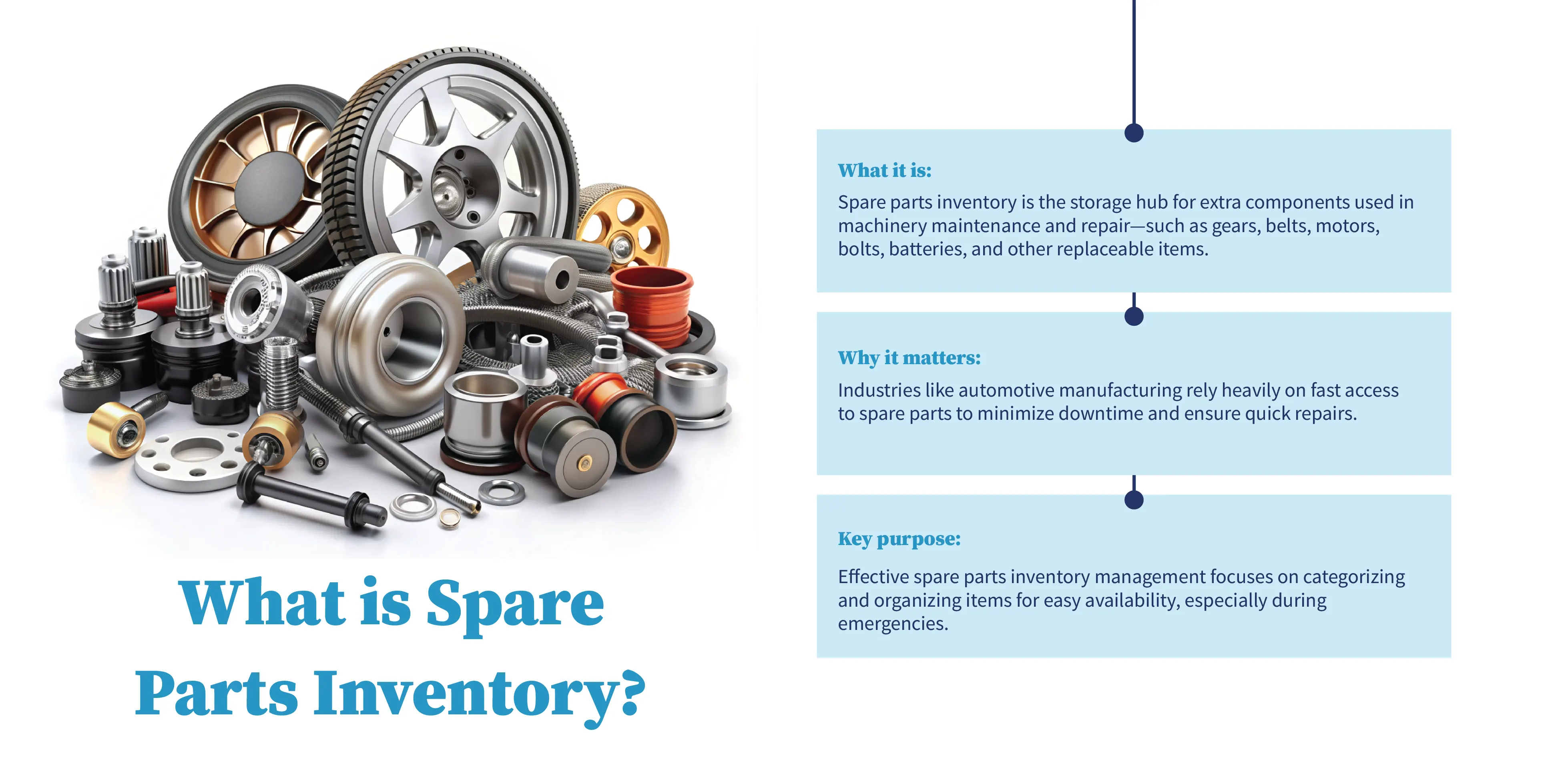
What is Spare Parts Inventory?
Spare parts inventory is the space where all the extra parts of various machinery are kept. Technicians use these parts during maintenance and repair; the items may include gears, bolts, belts, motors, and much more.
Automotive manufacturers have the most demand for the constant availability of spare parts and getting repairs done within a short time. Additionally, the spare parts inventory will also include other items, like robotic arm consumables, welding tips and nozzles, stamping die accessories, hydraulic and pneumatic seals, sensors used across assembly lines, conveyor rollers, and CNC tooling inserts that also require replacement after certain periods.
The categorization of these items, to keep them organized and available in cases of emergency, is what Spare Parts Inventory management aims for.
What is Spare Parts Inventory Management?
The management of the spare items, in a way that each part is categorized based on its type and priority.
Good quality management refers to parts being available on time, without causing any delays or disruption to the operations. There are basic to advanced levels of inventory management, and this depends on the solution you are using and your inventory scale.
For example, in several industrial setups, the repair or replacement of parts of certain machine parts requires immediate action. Any delay could harm the whole process, and hence, in such cases, effective management comes into play.
Items that require immediate availability should be kept handy and in front of other items. Inventory managers can do this by categorizing the items based on their priority.
There are more than one category to divide the items in an inventory, and ensure parts availability always.
Let’s look at the categories available to differentiate and manage spare parts effectively.
By criticality
Items that are not available will stop the entire operation. Such items should always be in stock, by meaningfully splitting them from the rest of the parts.
By Function
Parts associated with equipment should be categorized by their machines. For example, the mechanical parts of a particular machine should be kept aside from the electronic parts of other vehicles. Other instrumentation and control devices should also be kept separately from process-specific parts.
By Usage frequency
This is a critical step that will help businesses every hour of a busy production or operation day. Keeping the items that are required frequently at handy distances is always a good choice. While things are categorized based on their function and importance, their usage frequency matters a lot. Executing this point gives you the confidence to access spare parts within minutes of repair or replacement.
So, these are the most important categories that businesses must ensure to consider while segregating items.
Now, let’s see some ways to
Improve Spare Parts Inventory Management
Proper spare parts management is critical to seamless operations and consistent growth for the companies. Different companies have their own approach toward this; however, these best practices will suit companies across sectors.
Systematic identification of parts
Systematic identification of parts involves the following things to be covered. These are:
Creating barcodes for internal identification of parts and registering them in the system gives you more control over every movement of spare parts. Another hack to optimize stock levels is to maintain a proper Bill of Quantities and upload it to the asset maintenance management software for more detailed tracking.
Manage unused parts
There can be several instances where, during major overhauls or machinery failure, a lot of parts are needed. Now all of them might be used at that repair.
Here, what most businesses do is they keep the items in a cabinet or something for future use. However, no track remains of those items, which may result in buying of same items again.
Hence, such items should also be added to the inventory with proper records, ensuring that there is no loss in the procurement process.
Utilize and Manage Bills of Materials (BOM)
Just as BOQs, BOMs are equally important in managing spare parts efficiently. This is the ultimate source of truth for businesses to keep every spare part on track.
Procurements can happen as and when required, which will generate multiplier BOMs. Hence, the best way forward is to maintain a master BOM, where all the other bills will be added as they are generated. This is how you can track every part added to the inventory items with its quantity.
The current status of that stock will be visible in your inventory management system. Facility management systems like Innomaint offer advanced features to analyze and manage spare part inventory efficiently.
Maintain a Simple work order
Spare part usage can be made efficient with simple work order processes that can be followed across departments. Whenever a spare part is issued, the work order should be generated.
This will help keep track of inventory levels and maintain the right balance between overstocking and shortage, enabling minimum recorder alerts. The aim to keep this simple is because the work varies across departments, maintaining inventory accuracy.
There are departments where following a complex work order may be challenging for less timely availability. Employees may not follow the desired process, which would cause problems maintaining accurate inventories.
Centralized Inventory
When all the spare parts groups are consolidated into one part, this helps manage inventory better and perform clear inventory audits. The satellite parts should also be clubbed with the centralized inventory, and businesses should provide the responsibility to a core team.
This team will only have access to the inventory control system and can view all the data. By limiting access to the inventory and setting up a core team for inventory management, companies can reduce human errors and miscommunications.
Utilize an inventory management system
Everything will be streamlined once a business starts using the inventory management system. All the data regarding the current and previous usage of inventories can be uploaded there.
Many advanced systems today use Machine Learning (ML) and Artificial Intelligence (AI) to conduct deep analyses and provide actionable insights to reduce inventory costs. Such systems make cost tracking, managing, check asset performance and maintenance far easier, and at the same time ensure that there are no errors, and also help optimize inventory levels.
So, these were the chosen best practices among many that you can use to enhance your spare parts inventory management and get rid of excess inventory.
Now, the question is why you should not ignore the spare parts inventory management, and why that may cost you millions.
Why You Should Not Ignore Spare Parts Management
Inefficient inventory tracking generates hidden costs that are impossible to avoid. This is because the primary thing is not the availability of the backorder of the spare part.
In case of major hauls, if the part is not available or to be it, the business needs to pay double the price to the seller. The unnecessary inventory costs lie in the disrupted production, which leads to several other cost overheads.
These include overtime working of laborers, which may spark outrage, missed customer orders that will eat away at reputation and trust, and unplanned downtime. All these form the bigger picture of the problem, which was once just a missing spare part in the inventory.
And the greater fact is that this happens several times, without maintenance teams realizing the bigger impact of this. Hence, the losses will cost you thousands, even millions of dollars in gigantic setups.
Using a spare part management system always keeps things on track and never lets you miss any part.
If this happens in the case of main drive motors in production areas, the entire operation comes to a halt. This triggers great losses for industrial setups across sectors, which are hard to get covered.
Embracing preventive maintenance can minimize these risks, control costs and reduce downtime. Managing spare parts inventory efficiently goes hand-in-hand with preventive maintenance and inventory counts. Though it is not possible to completely eliminate reactive maintenance, preventive maintenance can be the approach for the majority of your maintenance tasks.
Wrapping Up
Choosing the right parts inventory management system brings real transformation. Many organizations offer a custom dashboard that gives a clear view of all aspects. Spare parts inventory management is a crucial thing for any business, and especially for the automotive industry; this is a huge game-changer. As we discussed, inefficiency can cause expensive overheads and also downgrade the company’s reputation. Hence, it is always better to work the smarter way with CMMS or EAM software, automated spare parts inventory software, and eliminate manual approaches.
Frequently Asked Questions
What is spare parts inventory management?
Spare parts inventory management is the process of organizing, tracking and controlling the supply of spare parts to ensure they are available when needed, while minimizing excess stock and reducing costs.
Why is spare parts inventory management important for industries?
Effective spare parts management reduces unplanned downtime, improves operational efficiency, lowers carrying costs and ensures critical parts are available for maintenance tasks.
How can a CMMS help with spare parts inventory?
A CMMS helps automate tracking of spare parts, set reorder points, maintain bills of materials (BOM), streamline central inventory tracking and prevent stockouts or overstock situations.
What are the best practices for managing spare parts inventory?
Best practices include systematic identification of parts, managing unused parts, maintaining accurate BOMs, centralized inventory control, regular audits and using inventory software.
How often should spare parts inventory be audited?
Inventory should be audited routinely based on usage frequency and business needs, commonly monthly or quarterly, to ensure records match physical stock and reduce discrepancies.
STOP LOSING MONEY ON POOR SPARE PARTS CONTROL
Track spares, avoid stockouts, reduce over-inventory, and link parts directly to maintenance work orders.
Predictive Maintenance Software: The Future of Smart Asset Management in Industry 4.0
The age of reactive maintenance is gradually coming to an end. Businesses can no longer afford to wait for assets to fail. We are in an era defined by real-time data, artificial intelligence (AI), and the Internet of Things (IoT). Organizations are adopting predictive maintenance, a strategic approach.
The predictive maintenance technology has become the backbone of modern asset management, enabling decision-makers to anticipate equipment failures, optimize uptime, and reduce operational costs. Predictive maintenance solutions redefine operational efficiency. They find applications across various industries, including manufacturing plants, energy grids, and transportation hubs. Their usage is becoming inevitable in the digital age.
What is Predictive Maintenance?
Predictive maintenance (PdM) is a proactive maintenance approach that hears the signals from assets. It does so by using IoT sensors, real-time equipment data, and AI-driven analytics. It predicts the likelihood of failure and triggers maintenance schedules dynamically rather than relying on fixed schedules. As predictive maintenance tools monitor the actual equipment condition, they help facility managers make data-backed maintenance decisions at the right time. They analyze vibration, temperature, pressure, and acoustic patterns to figure out warning signs long before breakdowns.
Predictive maintenance empowers business leaders with the information needed to operate assets at peak performance. You can schedule maintenance immediately upon need without having to wait for the turn of static schedules. Predictive maintenance provides the right balance between peak performance and optimal maintenance costs. The technique eliminates the need to overdo preventive maintenance. Predictive maintenance suits large factories where the initial installation costs of predictive maintenance setup are not a matter of concern.
How Predictive Maintenance Software Works?
Predictive maintenance software bridges sensors and assets. It gathers asset condition and performance data continuously. The data flows through IoT gateways into a centralized system integrated with an Enterprise Asset Management (EAM) or Computerized Maintenance Management System (CMMS) like Innomaint.
This data is fed to machine learning algorithms and AI predictive maintenance models. They promptly identify deviations and anomalies. A CMMS stores and manages data in a way that can be readily accessed, processed, and analysed.
Upon detection of a potential failure, the system automatically triggers alerts and work orders, allowing maintenance teams to intervene at an opportune moment.
The closed feedback loop involving data capture, analysis, prediction and action makes predictive maintenance a powerful part of digital transformation strategies.
Predictive Maintenance vs Preventive Maintenance
Predictive and preventive maintenance both tend to be on the proactive side, but they serve different purposes.
Preventive maintenance is either time-based or usage-based. Maintenance technicians will carry out the tasks repetitively. But sometimes the equipment might not need this task. On the positive side, preventive maintenance ensures maintenance tasks are not ignored for long. But it often leads to unnecessary maintenance and wasted resources.
Unlike preventive maintenance, predictive maintenance relies on real-time data and condition monitoring. It recommends maintenance only when there is actual evidence of wear or impending failure.
Parameter
Preventive Maintenance
Predictive Maintenance
Approach
Time or usage-based
Condition-based
Data Dependency
Historical
Real-time
Cost Efficiency
Moderate
High
Downtime Risk
Medium
Low
Technology
Basic CMMS scheduling
AI and IoT
Outcome
Reduces breakdowns
Prevents approaching failures
The transition from preventive to predictive maintenance is the need of the hour. It is the transformation from guesswork to certainty.
Key Predictive Maintenance Technologies
The success of predictive maintenance hinges on several interconnected technologies. Each of these has a say in shaping raw data into actionable insight.
1. IoT and Condition Monitoring
IoT sensors are the frontline components of predictive maintenance. They are miniature devices that track critical parameters such as vibration, temperature, pressure, humidity, etc., in real time. In most cases, the sensors are mounted on equipment. The host assets can send and receive data to and from a central cloud server.
IoT gateway devices can be fitted to both new and old assets. They’ll work perfectly well along with any asset. IoT gateway devices include cameras and microphones that gather and transmit real-time data based on their operational states.
2. Artificial Intelligence (AI) and Machine Learning
AI-based predictive maintenance tools learn from historical equipment data and use this knowledge to forecast failures. Machine learning models update their knowledge over time. They improve prediction accuracy with every dataset. This is where Innomaint’s AI for predictive maintenance scores with pattern recognition and anomaly detection capabilities to prevent unplanned downtime.
3. Digital Twins
A digital twin is a virtual replica of a physical asset. It simulates various possible operating conditions. Engineers visualize how an asset might behave under various scenarios and stress. The specialty of Digital Twins is that engineers can obtain the inferences without risking the real equipment. The Digital predictive maintenance capabilities of the Digital Twin find application in sectors like aviation, manufacturing, oil & gas, etc.
4. Data Analytics and Cloud Integration
Predictive maintenance data analytics enables enterprises to think beyond basic monitoring. They can gather, organize, and transform raw data from sensors into useful insights. A correlation is established between equipment performance, standard parameters, historical failure patterns, and real-time anomalies. Maintenance managers can gain a 360-degree view of asset health. Such rich insights entail accurate forecasting, reduce false positives, and most importantly, prioritize the right interventions at the right time. Another remarkable benefit of data analytics is that it reveals trends and new chances for growth that might not be obvious.
Cloud-based predictive maintenance solutions centralize data from multiple industrial units, remote sites, and distributed assets into a single unified environment. This eliminates the practice of working in silos, accelerating maintenance turnaround time. The cloud favors remote diagnostics, collaborative workflows, and seamless integration with ERP, EAM, and CMMS systems. So maintenance teams and supervisors can access updated data and real-time intelligence from anywhere.
5. Vibration and Thermal Analysis
Variations in vibration patterns are early signals of mechanical wear. Vibration analysis for predictive maintenance finds applications in turbines, motors, and compressors.
Benefits of Predictive Maintenance Software
The advantages of predictive maintenance software extend far beyond defeating downtime. Investment in predictive maintenance , in fact, impacts every level of operations for multiple industries. A 2022 Deloitte report quantifies the improvements as below:
15% reduction in downtime
20% increase in asset productivity
30% reduction in inventory levels(as the need for stocking parts that might be rarely required decreases)
Better operational visibility
With increased visibility into field assets and other off-site equipment, OEMs and third-party service providers can deliver greater value.
Optimized costs and performance
Predictive maintenance saves you money and helps you get more use from existing assets. It helps extend asset’s life span.
More empowered teams
As predictive maintenance software forewarns maintenance teams on potential faults, it reduces:
Instances of breakdowns
Planned preventive maintenance
Unplanned downtime
Predictive maintenance solutions empower teams to know exactly how close the equipment is to failure. The use of AI helps forecast future asset operations with greater certainty. This benefit is needed these days, where unpredictable weather, pandemic, and sociopolitical pressures are common.
Reduced Equipment Failures
Predictive maintenance aids in providing a swifter response to problems with its intelligent workflows. Improving the efficiency of maintenance operations increases productivity. There is a significant upshot is improved metrics such as mean time between failures (MTBF),mean time to repair (MTTR), etc.
Optimized Maintenance Costs
Performing maintenance upon needed slashes labor, parts, and service costs. Predictive maintenance can reduce maintenance expenses by up to 30%.
Extended Asset Lifespan
As the predictive maintenance setup monitors assets continuously, maintenance managers can ensure they operate within safe thresholds, reducing avoidable wear and tear.
Reinforces Safety
Predictive maintenance tools help organizations upkeep equipment reliability and uphold safer work environments. They help with regulatory compliance, too!
Sustainability and Energy Efficiency
Lesser interventions mean saved energy, too! By preventing over-maintenance, predictive maintenance contributes to lower carbon emissions, thereby aligning with global ESG goals.
Data-Driven Decisions
Predictive maintenance analytics provide a holistic view of equipment performance. Such insights come in handy in better planning, budgeting, and risk management.
How to Implement Predictive Maintenance?
Adopting predictive maintenance into the maintenance workflow isn’t just about deploying technology or installing hardware. It is rather a strategic transformation. It involves the following steps:
1. Define Objectives and Scope
Identify the assets that are mission-critical to your business. Determine the scope of predictive maintenance. Prioritize predictive maintenance techniques for assets whose downtime is relatively costlier or whose failure poses safety risks. Choose the parameter that is to be monitored. Maintenance supervisors must choose this parameter / technique carefully. For example, infrared thermography is best for heat exchangers or electrical panels that tend to leak air or steam. Vibration analysis is recommended for rotating machinery- but not all! There is a nuance here. For equipment rotating slower than 5 rpm, acoustic analysis / oil analysis is preferable over vibration analysis.
2. Deploy IoT Sensors and Set Up Connectivity
Install IoT-based predictive maintenance sensors for real-time asset monitoring. Be careful in choosing the right sensor for the equipment. Integrate them with your Innomaint EAM or CMMS platform for seamless data flow. Ascertain network stability and cybersecurity from the first day, as they are important concerns.
3. Establish Maintenance Protocols
Once the predictive maintenance setup detects and raises alerts on anomalies, formulate automated or semi-automated workflows for responding to alerts. Choose a system that generates maintenance schedules, assigns technicians, and triggers purchase orders, minimizing manual intervention. With the passage of time, predictive algorithms develop into a self-learning maintenance ecosystem.
What are the common predictive maintenance challenges?
The right predictive maintenance strategy shall ensure long-term scalability and success.
Let’s discuss the hurdles in the path to implementing predictive maintenance management system and the ways to conquer them:
i) Data Volume and Quality:
Predictive algorithms are centered on accurate, high-quality historical and real-time data. Data integrity is important for arriving at good predictions. Devise a data governance strategy to ensure consistency and reliability of data.
ii) IoT Device Integration:
Legacy machines are often devoid of digital interfaces. IoT gateways bridge this gap, connecting analog systems to modern predictive maintenance platforms. Emphasize simplifying the connectivity to access any IoT data source without hurdles.
Focus on device security to become immune to cyber-attacks while promoting interoperability across devices. Remember that you may need to scale up in the future. Adopt asset performance management solutions that feature advanced device management and rigid connectivity capabilities. Look for asset performance management solutions that can distill data for non-technical audiences to understand and manipulate.
iii) Algorithm Selection:
Choose the right algorithms matching specific assets to reap success.
iv) Handling change resistance:
It is a usual practice for employees to resist adopting new technologies. Plan and invest in systematic training. Strong leadership skills and transparent communication are vital to navigate the resistance for successful implementation.
v) Initial costs
The startup costs of predictive maintenance infrastructure might be high. But it is justifiable as the investment can be recovered within 6–12 months with reduced downtime and extended asset longevity. The setup costs cover upgrading outdated technology and integrating monitoring systems.
vi) Cybersecurity Risks:
As more assets go online, data protection concerns emerge. Choose predictive maintenance software from companies that offer robust encryption and access controls.
Predictive Maintenance Use Cases Across Industries
Predictive maintenance is transforming nearly every asset-intensive sector. Here’s how it plays out across industries:
1. Manufacturing
In the manufacturing sector, even a short unplanned downtime can cause significant production and supply chain disruptions. Predictive maintenance techniques enable early fault detection for CNC machines to assembly line robots. IoT-based predictive maintenance alerts promote operational continuity and reduce scrap rates.
2. Energy and Utilities
In the energy sector, predictive maintenance tools can be used to monitor turbines, transformers, and substations. Predictive maintenance analytics can uncover blade imbalances and gearbox wear, preventing catastrophic failures.
3. Transportation and Rail
Predictive maintenance analytics indicate rail track deformations, void formation, and brake issues in advance. The IoT-driven analytics improve passenger safety and extend the life of rail infrastructure.
4. Oil and Gas
The process of oil drilling makes the assets weary. The sudden failure of assets can be dangerous. Predictive maintenance helps monitor oil temperature, gearboxes in drilling equipment. You can integrate vibration analysis and thermal sensors. The timely alerts help operators avert leakages, unplanned shutdowns, and save maintenance costs by up to 40%.
5. Aviation
Aircraft predictive maintenance uses digital twins and AI to forecast failures in engines, landing gear, and avionics. Airlines bank on PdM to reinforce safety, reduce delays, and optimize maintenance schedules.
6. Automotive and Heavy Equipment
Automotive manufacturers use AI predictive maintenance to analyze sensor data from robots and conveyor systems. Predictive maintenance helps automobile manufacturers monitor spot-welding guns that do 15,000 welds in a day. The hints on nearing failures minimize the failure of these assets and enhance quality assurance.
The Future of Predictive Maintenance
The convergence of AI, IoT, and digital twins marks the future of predictive maintenance. The interconnected ecosystem predicts, prescribes, and prevents failures as per Industry 4.0 principles.
The emerging trends include:
* AI-powered root cause analysis that provides recommendations in addition to the detection of approaching failures.
* Edge computing, for faster data processing near the asset itself.
* Integration of Industry 4.0 predictive maintenance, integrating with ERP and supply chain management systems for end-to-end visibility.
* Sustainability analytics, linking maintenance performance to ESG metrics.
* Digital twin predictive maintenance combined with augmented reality for technician training and visualization.
Whether you operate in manufacturing, automobile, energy, or oil & gas sectors, Innomaint helps you suppress and stay ahead of equipment failures. You thus ensure every asset performs at peak efficiency. Monitor asset health data live from a centralized location with enterprise-wide visibility. Achieve measurable ROI through reduced downtime and lower maintenance costs. Keep assets healthy, costs low, and productivity high by choosing Innomaint.
Frequently Asked Questions
What is predictive maintenance software?
Predictive maintenance software is a maintenance management solution that uses real time sensor data, Internet of Things (IoT) devices, and AI driven analytics to forecast when equipment is likely to fail. Instead of relying on fixed schedules, it monitors actual asset condition, detects early warning signs such as abnormal vibration or temperature, and recommends interventions only when they are really needed.
How does predictive maintenance software work?
Predictive maintenance software continuously collects condition and performance data from assets through IoT sensors and gateways. This data flows into a central platform, often integrated with an Enterprise Asset Management (EAM) or Computerized Maintenance Management System (CMMS), where AI and machine learning models analyze patterns and anomalies. When the software detects a potential failure, it automatically triggers alerts and work orders so maintenance teams can intervene at the most opportune time.
What is the difference between predictive and preventive maintenance?
Preventive maintenance is time or usage based and follows predefined schedules, regardless of the asset’s real condition, which can sometimes lead to unnecessary work. Predictive maintenance is condition based and uses real time data from sensors to identify actual signs of wear or impending failure, so teams perform maintenance only when there is clear evidence that it is needed. This reduces wasted effort, minimizes downtime risk, and improves cost efficiency compared with purely schedule driven maintenance.
What technologies are used in predictive maintenance software?
Predictive maintenance software helps organizations reduce unplanned downtime, extend asset lifespan, and optimize maintenance costs. By acting before failures occur, it improves key performance metrics such as mean time between failures (MTBF) and mean time to repair (MTTR), lowers spare parts inventory requirements, and reduces the need for over maintenance. It also enhances safety, supports regulatory compliance, improves energy efficiency, and gives decision makers better visibility for planning and budgeting.
What are the main benefits of predictive maintenance software?
Any asset intensive industry can benefit from predictive maintenance software, including manufacturing, energy and utilities, transportation and rail, oil and gas, aviation, and automotive and heavy equipment. In these sectors, IoT based condition monitoring and predictive analytics help detect early faults in turbines, transformers, CNC machines, robots, drilling equipment, and rail or aviation assets, preventing costly disruptions and improving service quality.
How can an organization implement predictive maintenance?
To implement predictive maintenance, organizations should first define clear objectives and identify critical assets where downtime is most costly or risky. They then deploy appropriate IoT sensors and connectivity, integrate data streams with an EAM or CMMS platform, and configure AI or analytics models to monitor key parameters. Finally, they set up automated workflows that convert alerts into work orders, assign technicians, and trigger purchases so that insights from the predictive system translate into timely maintenance actions.
What are the common challenges in adopting predictive maintenance software?
Common challenges include handling large volumes of sensor data, ensuring data quality, integrating IoT devices with legacy equipment, and selecting the right algorithms for different assets. Organizations also face change management issues when teams resist new ways of working, as well as high initial setup costs for sensors, gateways, and connectivity. Cybersecurity is another key concern because more connected assets mean more potential entry points for attacks, so strong encryption and access controls are essential.
How fast can companies see ROI from predictive maintenance software?
Many organizations recover their initial investment in predictive maintenance within 6 to 12 months, thanks to reduced downtime, fewer breakdowns, and lower maintenance and inventory costs. Industry studies show that predictive maintenance can cut downtime by around 15 percent, increase asset productivity by about 20 percent, and reduce inventory levels by roughly 30 percent, which all contribute to a strong and measurable return on investment.
Is predictive maintenance suitable only for large enterprises?
Predictive maintenance was initially adopted by large factories and asset heavy enterprises because of the upfront cost of sensors and infrastructure, but modern cloud based platforms and modular IoT solutions have made it more accessible for mid sized businesses too. Companies can start with a limited scope by monitoring their most critical assets, prove value, and then scale gradually as savings from reduced downtime and extended asset life fund further investment.
To Automate Your Predictive Maintenance Process
Try Innomaint Equipment Maintenance
Management System for Free