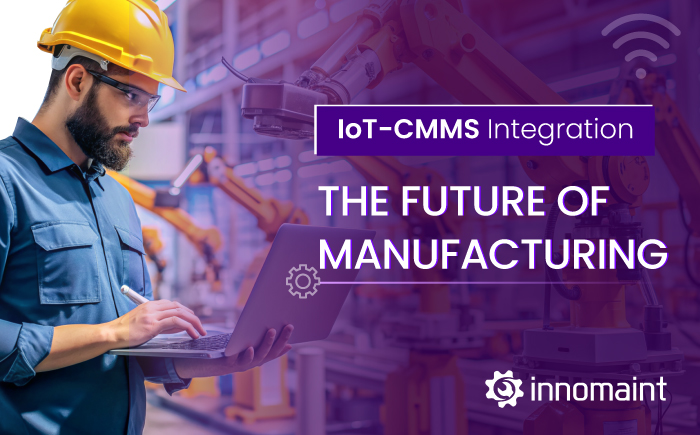
IoT-CMMS Integration: The Smart Manufacturing Solution to Reduce Unplanned Downtime in Industry 4.0
What’s the latest trend in manufacturing?
If you’ve been keeping an eye on the latest trends in manufacturing, there is no wonder you would have probably heard a lot of buzz about IoT and CMMS.
They’re akin to the dynamic duo poised to revolutionize the way you manage and maintain manufacturing plants.
Let’s dive into how integrating these technologies can propel your Industry 4.0 maintenance strategy and help you reduce unplanned downtime in manufacturing through IoT predictive maintenance and condition based monitoring.
What is IoT?

The Internet of Things (IoT) is a network of physical devices that can access internet.
Each device is capable of gathering and sharing data to the cloud application.
How nice would it be if all your machines, tools, and even the factory environment itself are capable of communicating seamlessly, providing real-time insights and triggering automatic actions based on pre-set conditions?
Sounds pretty futuristic, right?
What is CMMS?

CMMS – Computerized Maintenance Management System, as well known to the business community, helps you schedule, track, and optimize all maintenance activities including preventive, condition-based, and corrective maintenance. When integrated with industrial IoT sensors, your CMMS becomes a machine health monitoring software capable of triggering automatic work orders based on real-time equipment conditions.
Very few CMMS in the market offer out-of-the box IoT capabilities that is the talk of the town.
Owning a IoT powered CMMSis like having a reliable and intelligent super-organized personal assistant for your plant’s upkeep.
Why Integrate IoT and CMMS?
Now, here’s where the magic happens. Integrating IoT with CMMS induces a whole new level of efficiency and intelligence to your maintenance operations.
It not only makes maintenance supervision easier but transforms how you do things altogether.
Let’s dive into the benefits:
1. Predictive Maintenance
Predictive maintenance is a game-changer.
IoT devices continuously monitor equipment health, predicting when the time for maintenance is due based on advanced data analytics.
This means lesser likelihood of equipment failures and restraining the otherwise expensive breakdown expenses.
Imagine how wonderful it is to predict nearing failures even before it displays signs of trouble!
2. Enhanced Data Analytics
With IoT, you’re not just collecting data – you’re collating actionable insights.
These insights can be fed into your CMMS to optimize and redefine maintenance schedules, improve equipment lifespan, and reduce downtime.
3. Improved Asset Management
Integrating IoT with your CMMS provides a holistic view of your stationary and mobile assets.
You’ll know the exact status, location, and performance of each piece of equipment.
Such a convenience aids in quicker identification of assets, better asset utilization for best serving the business purpose and more efficient use of resources.
4. Increased Efficiency and Productivity
Automation is the key to efficiency. IoT-enabled CMMS can automate routine maintenance tasks based on manufacturer ‘s recommendation, machine usage, or custom schedules allowing your team to focus on more strategic activities.
Real-time alerts ensure issues are addressed promptly, minimizing disruptions to your production line.
5. Cost Savings
The improvements discussed above can lead to significant cost savings.
Fewer breakdowns, optimized maintenance schedules, and better asset management mean lower repair costs and less downtime.
It’s a win-win situation for your bottom line.
Real-World IoT Applications
Let’s look at how some real-world manufacturing plants are benefiting from IoT-CMMS integration:
Case Study 1: Automotive Industry
The automotive industry derives a slew of benefits from the IoT-CMMS integration. Few are:
- An automotive manufacturing plant can monitor critical equipment like assembly robots with IoT sensors.
- The real-time data allowed them to predict potential failures, reducing unplanned downtime by 40% and extended equipment lifespan by 20%.
- Heavy vehicle sensors can collect data about the physical and psychological conditions of the driver to provide extra support and security to them.
Case Study 2: Food and Beverage Industry
In the food and beverage sector, equipment reliability is crucial for maintaining product quality and compliance with health regulations.
With the advent of IoT technology, food businesses enjoy these never before benefits:
- Constant monitoring of refrigeration units prevents temperature fluctuations, preserving product and reducing waste by 30%.
- Some smart sensors can even detect pathogens along the supply chain and help control their spread contributing to food hygiene.
- Ensure food authenticity with IoT badges attached to food packets as a digital identification mark which benefits wholesalers and consumers.
How about the challenges in IoT implementation?
There are few considerations.
1. Data Security
Data security concerns proportional to the number of devices connected.
Ensure your IoT devices and CMMS are equipped with robust security measures to maintain the confidentiality of sensitive information.
Beyond security, CMMS integration with ERP systems like SAP, Oracle, or Tally unlocks a unified view of maintenance costs, procurement, and asset lifecycles, a critical capability for plant managers aiming to align smart manufacturing solutions with financial reporting.
2. Integration Complexity
Integrating IoT and CMMS can be complex, if your existing systems are outdated.
Consider working with experts who specialize in IoT-CMMS integration to streamline the process.
3. Employee Training
New technologies require new skills. Invest in training your team to ensure they are comfortable and proficient with the new system.
This will make the transition smoother and maximize the benefits.
4. Decide on parameters
The first right step toward a successful IoT implementation is to figure out the specific parameters that you need to monitor.
This may include temperature, pressure, humidity, air quality, location, water flow, energy consumption, and other metrics.
The useful parameters may vary depending on the application or industry.
6. Data Accuracy
Once the parameters are identified, the next step is to define the required data accuracy.
For example, if the solution is monitoring temperature, the accuracy requirement could be ±0.5°C.
Please click here for further information on implementation of IoT solutions.
IoT: The overshadowing future of manufacturing
In a nutshell, using IoT powered CMMS for manufacturing plants will provide you the much needed winning edge over competition.
The future of manufacturing is smart, connected, and data-driven.
So, take the plunge and explore the incredible potential of IoT-CMMS integration.
It isn’t just about keeping up with trends – it’s about staying ahead of the curve and transforming your plant into a model of modern manufacturing excellence.
Here’s to a smarter, more efficient future!