How IoT-Connected CMMS Improves Asset Tracking, Preventive Maintenance, and Productivity
Modern day Businesses prefer to manage the maintenance sphere of their operations from a centralized cloud based database using a CMMS. Internet Of Things(IoT) is an advanced technological feature whereby the devices in the facility can be totally connected via internet and interact smartly with each other. IoT integration offers a host of benefits infusing a radical change in style of management.
What is IoT Asset Tracking?
IoT Asset Tracking uses smart sensors and cloud-based CMMS platforms to provide real-time visibility into the location, condition, and performance of assets. Each asset is fitted with a sensor or RFID tag that transmits data to the centralized CMMS. This ensures that businesses always know where critical assets are, how they are performing, and when they need preventive maintenance.
Key Benefits for Businesses
Reduced Asset Loss & Misplacement – No more wasted hours searching for equipment, tools, or vehicles. IoT instantly pinpoints asset locations.
Optimized Maintenance Planning – Real-time health data helps schedule preventive maintenance before failures occur, avoiding costly breakdowns.
Improved Asset Utilization – Managers can monitor usage patterns, ensuring assets are used efficiently instead of sitting idle.
Compliance & Safety – Accurate records of asset usage, maintenance history, and performance ensure compliance with safety and regulatory standards.
1. Minimize operational costs
IoT equipped devices can help businesses to monitor equipments continuously and check for failures or deviations in alignments on the production line. It can improve electrical efficiency of the facility by cutting off the power supply to the unit whenever the usage is unnecessary.
2. Insights into dynamics
It is an advantage to continuously be aware of what’s going around in and around your industry. This may be data pertaining to road traffic in your area or the crowd density inside the facility at any given moment of time etc. Â
Every facility with a physical space for displaying the business ware & huge halls thronged by customers should be aware of the customer traffic to get a handle on their business. This applies to shopping malls, retail chain of stores, restaurants, library, sporting venue, bank etc which deal with huge flow of people in and out of the facility.
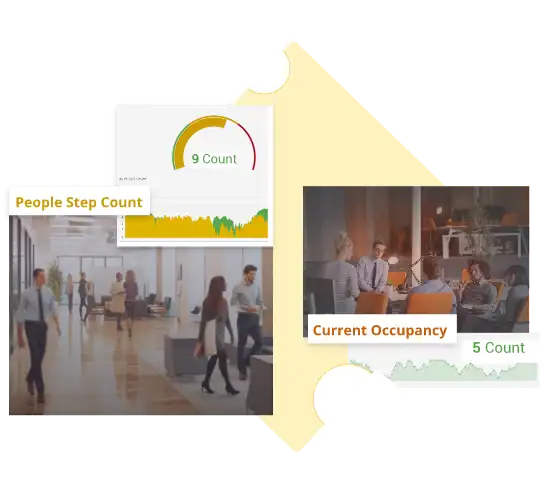
There are sophisticated CMMS which in conjunction with sensors for capturing visitor traffic & people count can let you aware of trends on visitor traffic such as peak hours, individual sections of the facilities that attract people etc. With this valuable data on People Counting data you can deploy your staff efficiently to improve conversion rates & profits.  The count of humans who have entered into a restricted premises can be calculated with more than 95% accuracy. You can exploit the data on these dynamics to arrive at well informed decisions.
3. Robust Building Management System
Able to view energy reports from multiple substations. It can support for unlimited concurrent users.Reduces the cost of third party licenses. A well monitored automated HVAC system can go a long way in optimizing a building’s energy-efficiency, without compromising on the thermal comfort of the users. HVAC is an essential component of Building Management Systems (BMS) . Data loggers provide reliable evidence of system operations. They aid in identification of HVAC equipment operation & faults, if any.
4. Vehicle management system
IOT integration in a CMMS can automatically recognize number plates & extract the registration number of the vehicles. This is achieved by attaching an RFID tag  containing a unique authentication code to the vehicle thus providing for secured transportation.
5. Welding Quality Management
By means of sensors the power consumed by welding machines can be monitored. Based on power consumption welding quality of the machine can be determined.
6. Proper Metering Infrastructure
Smart metering solution can address the challenges faced by businesses without a proper metering infrastructure. Invoices can be generated by tabulating the energy consumption by different devices leading to power savings for the facility and country as well.
7. Use More Assets
IoT presents an opportunity to track assets using sensors. Once the assets are connected to the Internet of Things, you’ll in fact begin learning the efficient usage of assets than ever before due to improved seamless connectivity. The real-time insights help you in locating assets easily & scheduling planned preventive maintenance tasks.
8. Remote Monitoring
Remote monitoring can prove to be a daunting task. IoT instills a feel of continuity and excellent coordination between the main office and what goes on out in the field. The cloud gives employees with mobile devices access to the information they need to carry out their job. The fitted sensors lets managers track the whereabouts of employee, their activities etc. You are also in a convenient position to anticipate additional manpower requirement.
9. Improved Productivity
Productivity is a major advantage offered by Internet of Things. Â IoT is capable of providing the training for employees that they need immediately to complete tasks, at hand.
10. Figure out Issues
There may be various underlying issues within your business which may escape your notice unless unless you are well-connected into real-time data. You can exploit data that comes in from mobile devices, sensors and other derivative reports. Collating all of this can be used to figure out potential problems enabling you to provide intuitive & outstanding customer service. This also aids in reviewing & changing  current business models for betterment.
11. Low-Cost Technologies
It is a misconception to think that IoT technology is expensive. The technologies are becoming more and more affordable these days. You can choose one that complements your in-house capabilities. Sensor costs are falling, data storage is more affordable, and computing power is increasing. Many businesses have already framed plans to take advantage of the IoT. It’s time for your business to embrace it and achieve more success.
Real-World Use Case
Manufacturing plants often face challenges with unplanned downtime caused by equipment breakdowns. By deploying IoT sensors on mission-critical machinery, a CMMS like Innomaint continuously monitors vibration, temperature, and power consumption. The system detects early warning signs of wear and automatically creates a work order before the machine fails.
This approach has helped many manufacturers reduce unplanned downtime by up to 30%, extend equipment lifespan, and keep production lines running smoothly.
Retail & Facilities Management
Retail chains and large facilities use IoT sensors for people counting and asset tracking. By monitoring foot traffic in different store sections, managers can optimize staff deployment, improve customer experience, and prevent bottlenecks. In parallel, IoT sensors track critical HVAC and lighting systems to ensure uptime, safety, and energy savings.
Frequently Asked Questions
IoT helps reduce operational costs by continuously monitoring equipment performance, detecting inefficiencies, and automating energy usage. Businesses can cut downtime, reduce manual inspections, and optimize resource consumption, which directly lowers maintenance and operational expenses.
IoT integrated with CMMS offers predictive maintenance, real-time asset tracking, energy efficiency, and improved decision-making. It also provides remote monitoring, automated work order creation, and better team collaboration for cost-efficient maintenance management.
IoT sensors enable real-time asset tracking, ensuring businesses always know the location and condition of critical equipment. Preventive maintenance is optimized through data-driven alerts, helping schedule repairs before breakdowns occur, thus extending asset life and reducing downtime.
Yes, IoT has become increasingly affordable for SMBs. With falling sensor costs, cloud-based CMMS platforms, and scalable subscription models, small and medium businesses can now adopt IoT solutions without heavy upfront investments.
IoT improves productivity by automating routine tasks, providing real-time data insights, and ensuring maintenance teams have access to accurate information. Employees can focus on higher-value activities while the system handles monitoring and reporting.
Yes, IoT-enabled systems monitor energy consumption across facilities and automatically optimize usage. By integrating with CMMS, businesses can track electricity, water, and HVAC usage, reducing wastage and supporting sustainability goals.
Industries such as manufacturing, pharma, oil & gas, automotive, and facilities management benefit significantly from IoT integration with CMMS. Use cases include predictive maintenance, energy optimization, compliance monitoring, and asset lifecycle management.